|
As the historian for
Union Township, we acknowledge our inability to perform that complete duty
with the justice which the subject so interesting in form its scope
demands. Our township is large, populous, and the oldest settled in
the county. Ripley, the largest village and the most important
commercial point in it.
Imperfect as this history may be, we rely upon the
general reader for that measure of charity which he would have meted out to
him under similar circumstances. The writer would like to excuse the
mention of his own name so often in the several matters treated of, but for
thirty years he has tilled many official positions in the township, and not
to do so would leave the subject in complete. Where it could be
avoided it has been.
Union is bounded on the north by Jefferson and Byrd; on
the east by Huntington Township; on the south by the Ohio River, and on the
west by Lewis and Pleasant Townships. It lies in the easterly portion
of the county. Its length on the Ohio River, by its manderings, is
nearly seven and one-eight miles; its average width is about five and
one-half miles, and it contains over forty square miles.
It is watered by Straight Creek, a good-sized and
lengthy stream on the northwest; Eagle Creek, of about the same size, on the
southeast; the Ohio River on the southwest, and through the center by Red
Oak Creek. The last is a short stream, but, owing to the great hill
surface some four miles back of its mouth, the quantity of water flowing
through its channel is at times very great; it rises quickly, and is soon
emptied into the beautiful Ohio.
The soil is formed upon alternating strata of clay and
limestone, and partakes chiefly of these two earths. The river and
creek bottoms are composed of sandy soil, largely impregnated with rich
clay, forming most productive land for general farming. Nearly the
entire river portion of the township, say one half or more of the area,
though hilly, has always been considered the best farming lands in this part
of the county, if not the best in the county. It was originally
heavily covered with the finest of timber - walnut, poplar, ash and other
sure marks of rich land. The last mile or so of the northeast is good
land, more level, and commands high prices in the market. It is easier
farmed than the hill portion, makes pretty farms, and to-day is among the
most valuable farm land in the county. Within the last year, a farm of
210 acres, four miles from Ripley, with rather poor improvements, sold for
$100 per acre.
Along the river and throughout the southern portion of
the township, are high ranges of hills, and from those along the river an
extensive prospect of Page 412 -
the Mason County, Ky., hills, valleys and surrounding country on both sides
of the river is afforded, and some of the most beautiful sunsets are here
seen: but we fear that the grandeur will soon be lessened by reason of the
sad havoc made in the shearing of these hills and valleys of the grand old
monarchs of the forest to make way for the vile, yet profitable, crop of
tobacco.
Mr. Thomas Smith, one of the early settlers,
moved from Kentucky to this township in 1815. He was a blacksmith, and
at once set up shop on Cormick’s Run, near Ripley (on the present
Ripley & Georgetown Free Turnpike). Mr. John Thompson, present
in our office to-day (July, 1882), aged seventy-eight years, in good health,
informs us that he learned said trade under Mr. Smith, and
while with him he and Mr. Smith frequently went to Maysville,
Ky., ten miles up the river, for iron and steel in summer season in shift,
and in winter by sled over a path, there being no regular roads laid out.
Mr. Thompson ironed a wagon for Mr. David
Flaugher in 1827, which now belongs to Marion Stephenson. Mr. Thompson
says he saw it in town the other day, a pretty good wagon yet. Mr.
Thompson invented and patented over thirty years ago a wrought iron
and steel plow- one of the best ever used in this section of country.
Had he been furnished with sufficient means and an energetic managing
partner, he could have been worth many thousands of dollars to-day.
His son, George W. Thompson, now deceased, invented and patented also
an improved hillside plow, which has given great satisfaction
EARLY SETTLEMENTS
Upon the soil of Union Township were
made some of the first settlements of Brown County, if not the first.
While the border Indian warfare along the Ohio River was aggressive and
bitter, and the feuds between the races raged at their intensest pitch,
there were doubtless many stirring adventures and probably tragedies enacted
within the present limits of our township, which are now forgotten.
The bottom lands of Eagle Creek, a noted stream in those early times, for a
mile or two from its mouth lie wholly within its territory. Red
Oak courses through its center, and Straight Creek bounds it on the west;
both streams, had they tongues with which to speak, could reveal whole
chapters from the great unwritten history of the past. Cabins
were doubtless built for hunting purposes by adventurous spirits, who dared
to face Indian hatred and hostility before the treaty of peace was declared
in 1795. Mention is made that Cornelius Washburn and
William Dixon, in 1793, crossed the river from Kentucky at
Logan’s Gap, and built a hut on Eagle Creek, one mile from the river, where
Mr. Dixon continued to live for some time.
The first permanent settlement in the township is
believed to have been made by BELTESHAZER DRAGOO in 1794 or 1795.
He was a Virginian, but, like most of the earliest pioneers of Brown County,
had lived for a few years prior to his emigration to Ohio in Kentucky.
Mr. Dragoo had tarried for awhile in Mason County Ky., then
crossed the river and erected his primitive cabin on the waters of Eagle
Creek, where E. M. Fitch now resides. He purchased a farm of
300 acres here, and spent the next few years in the ceaseless activity which
the successful pioneer must assume in order to improve and develop his home.
When the great Shaker excitement spread over this county, he became a
convert to the faith, and joined the community. He sold his farm, and
lived the remainder of his life with the Shakers near Cincinnati. His
wife, Hannah, three daughters and a minor son, Benjamin,
accompanied him, the latter under protest. As soon as Benjamin
attained his majority, he returned to Union Township, and here lived and
died. Of Mr. Dragoo’s other three sons, Andrew
and Belteshazer removed to Indiana, but Daniel maintained a
life-long residence in Union Township.
Page 413 -
WILLIAM KINKEAD was perhaps the next settler.
He came in 1796. He was born in Augusta County, Va., and came with his
father, William Kinkead, Sr., to Woodford County, Ky.,
in a very early time. William, Jr., married Anna
Dunlap in Kentucky, and her brother, William Dunlap,
accompanied them to this township. They built their cabin near where
Scott Kinkead now resides, on the J. Harris Survey,
several miles north of Ripley. Alexander Dunlap, the
father of William, owned a large tract of land near Chillicothe, and
in 1797, William and William Kinkead made a journey
overland to it, and concluded to settle there; returning after the harvest
was gathered, they packed their goods and sent them by keel-boat to
Chillicothe, while they drove the stock across through the woods. The
Indians were troublesome in that vicinity, and not liking the situation they
returned to Union Township without unloading the goods from the boat.
Mr. Kinkead remained a resident of this township for life, and
died at a good old age. He had nine children, two of whom died young.
The others were Nancy (Gilliland), William, Anna
(Hopkins), Robert, James, Guy and Scott.
Mr. Kinkead brought with him from Kentucky fifty cows, the
property of himself and his father-in-law, Alexander Dunlap,
and the products of his dairy, butter and cheese, he boated to Cincinnati,
and sold there. From the proceeds he paid for the farm he had
purchased.
WILLIAM DUNLAP, after living a year or two with
the Kinkeads, married Polly Shepherd, and began
housekeeping for himself just north of them. His family consisted of
eight children - Amanda (Corruthers); James, a minister
at Springfield, Ohio; Milton, a Greenfield physician; Nancy (Campbell);
William; Alexander, a physician of Springfield, Ohio;
Shepherd and Elizabeth Ann.
The SHEPHERDS were also among the
earliest settlers of Red Oak. John Shepherd emigrated to
where William Gilliland now lives, near Red Oak Presbyterian
Church, with a family of grown children. He was a Virginian, and died
upon the place he settled in this township. One of the oldest boys,
Isaac, was a cabinet-maker by trade, and an old bachelor. Jacob
was a farmer, an occupied the home place at his father’s death.
John removed West. Abraham received a liberal education,
and was a surveyor and miller. He built the first steam mill on Red
Oak, at the “Buckeye Mills,” and traded extensively in pork. He was
portly and gentlemanly in bearing, and quite popular in the county, filling
several offices of responsibility and honor. He was an early and
prominent Mason. In his business transactions, he met with reverses,
and finally moved to Putnam County, Ill. None of the Shepherds
now reside in this vicinity.
JEPTHA BEASLEY came
about the same time, probably in 1798. He was from Spottsylvania
County, Va., and born Aug. 20, 1769. He had emigrated to Limestone,
now Maysville, Ky., years before, and in times when Indian ravages were
imminent. He served as a spy to watch the movements of the savages
across the river. When he came to Union Township, he possessed but few
worldly goods. He purchased the farm his son, Jeptha, now
occupies, in the northeastern part of the township, and for a number of
years engaged in farming and boating. He then removed to Ripley, and
was the village inn keeper for a while, but, tiring of this life, he
returned again to the farm. He was Justice of the Peace for many
years, and County Commissioner. His children were Sally,
William, John, Elizabeth, Levi, Jeptha and
Nancy.
MATTHEW McCLUNG was an early settler about
three-fourths of a mile east of this, on the present M. GERMANN
place. He died from the effects of a fall from a horse.
David DEVORE settled on Red Oak, about six miles from Ripley in
1800.
REV. JOHN DUNLAVY resided on what is now the
R. MANNON place, about a mile southwest from Red Oak Presbyterian
Church, early in the present cen-
Page 414 -
tury. This church was organized in 1798 or 1799,
and was the first in the county. During the first summer of its
existence, prayer meetings were held in a thicket north of Ripley at the
forks of the pike, where Spence Spears’ tobacco warehouse now
is; then a round log house was built near where the present church stands.
It was soon replaced by a hewed-log church, which was burned. A
stone house of worship was erected in 1817. Rev. Dunlavy is
said to have been tae first stated minister. He remained with the
church not quite two years. His ministrations became tainted with the
heresy of Shakerism, with which faith he afterward affiliated, and the
congregation for bade his farther use of the church. He at first
disregarded the prohibition, but at the second meeting afterward was met at
the door by Jacob Shepherd, the sexton, who denied him
admission. Rev. Dunlavy drew with him to the Shakers, it
is said, nearly one-half the membership of this church. Rev.
James Gilliland settled on Red Oak, and became pastor of the
church in 1805, and continued in that relation until within a short time of
his death, which occurred in 1854. A Latin school was held in this
church for a long time; Alexander Gilliland and afterward
Adam Gilliland were the teachers.
COL. MILLS STEPHENSON was one of the earliest
settlers on Eagle Creek, coming several years prior to the close of the last
century. He was born in Delaware, and in his youth was filled with a
passion for a life on the ocean wave. He embarked on a vessel as cabin
boy, and was soon disenchanted from the rosy visions that had filled his
mind. The drudgery he was compelled to perform on Sunday while the
sailors played cards and indulged in other profanation of the Sabbath, did
not accord with his notions of propriety, and he quickly abandoned his early
love. He removed with his parents to Pennsylvania, and afterward came
to Mason County, Ky. After his arrival i this township, he engaged in
farming. He entered the war of 1812 as Colonel of a batallion, and
served throughout. Fort Stephenson was named in his honor. His
wife, Jane (Kilpatrick), died soon after the close of the war,
and he removed to Ripley. Afterward he was one of a company who
purchased the Buckeye Mills, but the investment proved disastrous. The
death of Col. Stephenson occurred June 16, 1822, in Louisiana,
while he was on a trip down the Mississippi. His children were
Ephraim, Mary (Stephenson), Robert P. Isabel,
Elizabeth (Wallace), Young and Lemuel.
On what was know as Bradford's Bottom, near the
mouth of Eable Creek, was quite a little settlement in very early times.
The land then belonged to Ignatius Mitchell, of Kentucky.
Jacob Middleswart was an early settler here. He was a renter only,
and moved afterward with his family back into the interior of the county.
Robert Savage, from Pennsylvania, settled in the same vicinity.
He was well advanced in life when he came, and lived here till he died.
Sophia McFadden, a widow, with her children, Hugh, Charlie and
Sophia, lived close by. They afterward moved to Auglaize*
County. James Stephenson, a half-brother of Col. Mills,
settled just east of Ripley, where some of his descendants still live.
* SHARON WICK's NOTE: Auglaize was scribbled out
and Clinton was written over it.
Amongst the earliest settlers farther up Eagle Creek,
were Thomas and Henry BAYNE. They were of
Scotch-Irish nationality, and came from Pennsylvania. Both died in
this township, and their posterity are widely scattered. Richard
ROLLISON, a Revolutionary soldier, was another. He afterward
moved with the HARDESTYS and others to the Mad River. John
and James ESPY, were natives of Tyrone County, Ireland,
and early residents here. The latter was drowned about three-fourths
of a mile east of Ripley.
FOGUS McCLAIN was another of Eagle Creek's
foremost settlers. He was from Western Pennsylvania; was implicated in
the whisky insurrection there, and when matters came to a crisis took French
leave, and hurried off down the Page
415 -
Ohio in a boat, landing on Eagle Creek. He here bought a farm from
Mitchell, and remained through life. He had been a Revolutionary
soldier and was a Mason. He had but one child, John.
Abner HOWARD built his cabin very early on the same stream.
He erected a little mill about three and a half miles from the mouth of the
creek. Robert HOPKINS settled farther north.
The ELLIS FAMILY was among the first to
settle in the western part of Union Township. In 1798, Amos
Ellis and Mary (McConnell) Ellis, his wife, located
three miles north of Ripley, on the head-waters of Cormiek Run. Two
years before, they had left Pennsylvania with Thomas McConnell,
her brother, and come to Washington, Ky., where they located temporarily.
In the fall of 1797, Ellis and McConnell crossed the river and
built huts on the land to which they moved their families the ensuing
spring. Mr. McConnell remained on the farm he then
settled for life, and his son, Milford, now occupies it. He was
a zealous Baptist. In 1822, Amos Ellis was appointed
County Treasurer, and the following year was elected to the same office.
He was also elected a member of the Legislature in 1803 and again in 1809.
He died in 1832 at the age of sixty-two years. His wife survived him
seventeen years. Isaac Ellis, a brother of Amos,
also came to the township in the spring of 1798, and settled on a farm
adjoining his brother’s. He had two sons, Elias and John,
and several daughters. Both sons moved to Illinois.
THOMAS CORMICK in 1797, settled on Cormiek Run,
about a mile north west from Ripley. He was born in Nova Scotia, but
had lived in Virginia and Kentucky before emigrating hither. He was a
good specimen of the rough frontiersman, and raised a large family of
children. When he came, two settlers, William and James
Prigett LONG, were living in this vicinity. James
HENRY was an early settler on “Pisgah Ridge.” He lived on the
farm now occupied by James Myers, and died Dec. 4, 1834, in
his seventy sixth year. William Bowers, an Irishman,
settled about three-fourths of a mile west of the Buckeye Mills, on Red Oak.
He followed weaving, and remained on this place through life. Henry
MARTIN was one of the first settlers in the region of Straight Creek.
He was Justice of the Peace for many years, and Associate Judge of the
couuty county. John MEFFORD was one of
the earliest near Levanna.
COL. JAMES POAGE owned a
one-thousand-acre tract, including the site of Ripley, and settled on it
with his family. In former times he had been wealthy, but he came west
with broken fortunes. He is remembered as a quiet, unassuming
gentleman, strictly honorable in all his transactions. He was well
advanced in life when he arrived, and had a family of children, most of whom
were men and women. He died Apr. 9, 1820, in his sixty-fifth year.
His wife, Mary, survived him ten years. Of their children,
John, James, Robert, Thomas, George,
Patsy, Elizabeth and Polly are remembered. Most of
them died of consumption in early manhood and womanhood, and the few who
escaped the dread disease have long since gone to other climes.
ARCHIBALD TWEED was one of the foremost pioneers of
the township. He came prior to the present century. His family
was large. He died Dec. 24, 1830, aged eighty-four years. His
wife, Jannet, preceded him to the grave five years.
Alexander JOLLY, from Maryland, was another original settler, who
lived here through life. He was a prominent Baptist. William
CAMPBELL in 1800 moved to the township from Kentucky. He was
originally from Virginia. William HUMPHRIES, Peter
SHAW, Christian WILES, John REDMAN,
John FORSYTHE, Dr. Alexander CAMPBELL,
Thomas DICKENS, John LAUGHLIN, John BAIRD,
Nathaniel COLLINS, Andrew CARR and William
COLTER were other early settlers.
RIPLEY.
Ripley was laid out about the period of the war of
1812 by Col. James
Page 416 -
LEVANNA.
Page 417 -

JOHN C. WALDRON Page 418 - [BLANK
PAGE] Page 419 -
HESTORIA.
Page 420 -
CHURCHES.
Page 421 -
Page 422 -
THE PRESS OF RIPLEY.
Page 423 -
Page 424 -
Page 425 -
THE SCHOOLS, EARLY TEACHERS, ETC.
Page 426 -
BRANCHES OF STUDY, WITH THE NUMBER OF PUPILS IN EACH
BRANCH.
TEACHER' MEETINGS.
AUTHORS' DAYS.
Page 427 -

V. KERR
Deceased
Page 428 -
Page 429 - THE HIGH
SCHOOL.
THE GERMAN DEPARTMENT.
THE COLORED
SCHOOLS.
PENMANSHIP.
GENERAL REMARKS.
STEAMBOAT BUILDING AT RIPLEY.
Page 430 -
SOCIETIES.
Page 431 -
Page 432 -
Page 433 -
Page 434 -
THE FLOODS IN THE OHIO RIVER.
Page 435 -
FIRE COMPANY AND NOTED FIRES.
Page 436 -
Page 437 - [BLANK PAGE]
Page 438 -

HENRY KIMBALL. Page 439 -
POLITICS
Page 440 -
Page 441 -
PORK PACKING.
Page 442 -
THE HORSE TRADE.
Page 443 -
STATISTICS.
Page 444 -
Page 445 -
FOSSIL REMAINS
AND OTHER CURIOSITIES.
CEMETERIES
There are several of these hallowed grounds in Union Township. One at
Pisgah, on the hill back of Levanna; one known as “Howard’s,” east of
Rip-
Page 446 -
ley about two miles; one at “Red Oak;” one at “Fitch’s
Chapel,” on Eagle Creek, and several other church and private graveyards and
lots. Besides these, there was laid out by the Town Council of Ripley
a beautiful cemetery of grounds adjoining the fair grounds, purchased of
Mr. David Espy in 1855, containing six acres; the lots
having been disposed of, necessitated the purchase of additional grounds,
which was made the present year (1882), consisting of six acres adjoining
the other, now being improved after a beautiful plan in a most handsome
manner. The “old graveyards,” as they were known, above spoken of, are
kept in repair by the township authorities from funds raised by taxation
upon the real and personal property of the township. The Ripley
Cemetery was and is the property of the village of Ripley, and is kept up
and controlled by it. The revenues derived from sale of lots are used
in protecting the grounds and beautifying the same. The remains of
many interred in the old burying-ground at Ripley have been removed to the
new cemetery. In the old lot and in country yards are buried the
remains of many of our earliest settlers.
These old grounds are inclosed by substantial fences,
but the untrimmed trees and undergrowth, with the moss-covered tablets and
leaning stones, bring sad recollections of how many die and are soon
forgotten. BANKS IN RIPLEY.
Page 447 -
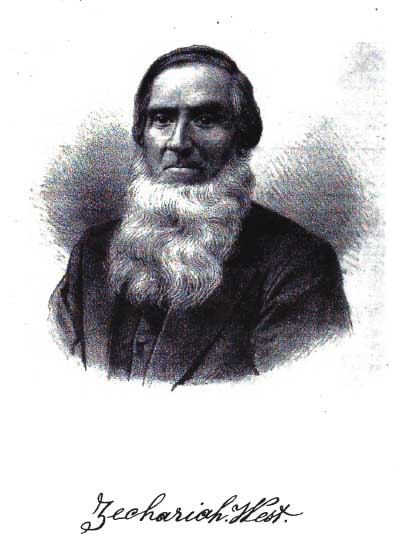
ZACHARIAH WEST Page 448 - [BLANK
PAGE]
Page 449 -
UNDERGROUND RAILROAD.
Ripley has yet no
railroad, but we have fair prospects for an early connection by
rail with the outside world. It is confidently believed
that work will soon be commenced on a standard gauge road
connecting Huntington and Cincinnati through this county, along
the Ohio River bank. But the town of Ripley was and is
known far and wide as the place where the Underground Railroad
had its mouth or entrance. On the high hill some 300 feet
above the level over looking the quiet village stands as of yore
the old residence of Rev. John Rankin, who is still
living at the ripe age of eighty-nine years. This
building, if it could speak, could tell many adventures and
hair-breadth escapes. At a window from dark to daybreak
was ever the beacon light, easily seen from the Kentucky hills
and the river bank, to which star of hope the fugitive’s eye
rested with delight - once here all was safe. Hundreds of
escaped slaves have been fed, secreted and ticketed at and from
this depot for Canada. There were plenty of stations along
the route through Brown County, where aid and comfort was never
denied. Mrs. Stowe, in “Uncle Tom’s Cabin,”
draws upon facts transpiring at this place for that thrilling
passage in relation to Eliza’s flight, pursuit and
perilous escape across the Ohio River. As an evidence of
the truth of the statement, a member of Rev. John Rankin’s
family, his son, Capt. Richard C. Rankin, informs the
writer that the river had been frozen over for some time, and
people crossing on it. She, coming to the Kentucky bank
through the snow at what is known as “ Stony Point” (near the
Asa Anderson farm, just opposite the Red Oak Creek
mouth), and knowing the river to be frozen over, at once stepped
into the slush and snow covering the ice, and crossed over
safely to Crosby’s Point; here she dropped the child’s
petticoat, which was picked up by the Crosbys the next
day. Her pursurers tracked her to where she went into the
river, as they supposed, for the weather changed suddenly warm,
and the ice melted so that none was to be seen the next day on
the arrival of the fiends who were hunting her down.
THE WAR OF THE REBELLION.
Page 450 -
Page 451 -
RIPLEY FAIR.
Page 452 -
RIPLEY GAS LIGHT AND COKE COMPANY
RIPLEY BUILDING AND SAVINGS ASSOCIATION.
Page 453 -
TRADES AND PROFESSIONS.
Page 454 -
|