|
CHAPTER LXII.
NEW CASTLE TOWNSHIP
Location - Physical Features - Scenery -
Indian Mound - Indian Villages - Reminiscences - Block House - Early Nursery -
Thomas Butler- A Panther Hunt - Robert Giffin
- Other Early Settlers - Mills - Distilleries - Other Industries - Bridges -
Schools - Churches - New Castle - Walhonding - Mount Airy
Pg. 565
NEW CASTLE was one of the townships
organized before the county was organized. It is understood to have been
named after New Castle in Delaware. It lies in the extreme western part of
the county, touching Knox county. Tiverton township, which forms the
northwestern corner of the county lies just north of it. Jefferson
township bounds it on the east and Perry on the south.
The Walhonding or White Woman river is formed in the
northwestern part of the township by the junction of the Mohican river and Owl
creek, the former flowing south from Tiverton township, the latter in a
southeasterly direction from Knox county; thence the river flows eastwardly by a
winding course and enters Jefferson township. The valley of Owl creek is
wide and fertile; that of the Mohican, though this is a larger stream, is
considerably narrower, containing little bottom lands. The other streams
are unimportant. One called Laurel run enters the river from the south
close to the junction of its two branches. Another named Dutch run enters
it in the eastern part of the township from the north. The surface from
the river rises for a mile or two to the south and there forms a water shed, the
land further south being drained by steamboats flowing in an opposite direction.
Tomica creek in the southwestern part of the township is the most noticeable of
these. It flows in a southwesterly direction into Knox county. The
land in the southern half of the township is generally rolling, in some places
gently undulating, and furnishes an excellent location for farming purposes, the
soil being rich and productive. North of the river the surface is broken
and hilly and the soil of a fair quality.
Page 566 -
Page 567 -
Thomas Butler was probably the
pioneer settler in the township. He was a Virginian; moved with his family
to Muskingum county, settling in the vicinity of the present village of Dresden,
one spring when there were but two cabins in Zanesville. He set about
preparing himself a house in the wilderness; but the climate did not agree with
him. He was seized with ague, and returned to Virginia, in the autumn of
the same year. The next spring his restless, adventurous spirit led him to
again tempt the wilds of the then far west, and he crossed the mountains again,
this time taking up his abode within the present limits of Coshocton county,
about two miles north of the forks of the Muskingum, half a mile west of Canal
Lewisville. He had cleared a cornfield, of eight or ten acres - the first
improvement in the vicinity - and remained three years; then removed to the
house he occupied during the remaining yeas of his life, in the upper Walhonding
valley. The farm is situated in the extreme eastern part of New Castle
township, just south of the river. The exact date of his arrival here is
uncertain, but it was at least four or five years prior to the emigration of
Robert Giffin.
The military section upon which he located - the
northeaster quarter of the township - be- belonged to George Suckley, an
eastern man, who sold it to settlers, in tracts to suit the purchaser, through
his agent, James Dunlap, living near Utica.
A few reminiscences of this, the earliest settler in
this township, would not be inappropriate. His grandfather had been shot
and killed by Indians close to his cabin, in Virginia, while he was making a
garden fence, and his grandmother, with her youngest child, James, then
seven years old, captured. Another son, Joseph, Thomas Butler's
father, who had been recently married, was out i the fields at work, at the time
of his father's untimely death, and his newly made wife, who was at the house at
the time,
Page 568 -
avoided captivity, or perhaps death, by fleeing to her husband, narrowly
escaping from a pursuing Indian. Mrs. Butler effected her escape
the second night after she was taken prisoner. The little boy, James,
remained in captivity with the Indians eighteen months, and was exchanged at
Carlisle, Pennsylvania, his brother Joseph, Thomas' father, going for him
there.
While Mr. Butler was living at the forks of the
Muskingum, one winter morning he took down his rifle, whistled his dog, and went
out to look for a deer. A thin bed of snow covered the ground, and the
trail of several deer was soon discovered, leading down the river.
Following it up as rapidly as possible, he came to a dense thicket of
considerable extent, through which the deer tracks led. Letting the dog
follow the track, he passed around, and on reaching the other side beheld
evidences of larger game, the tracks of a panther following he path of the deer.
Sending the dog on ahead, he himself followed as fast as he could, and upon
going some distance came upon the dog, lying upon its back with feet pointing
skyward, and apparently lifeless. Mr. Butler continued cautiously
in pursuit along the upper bank of the river, and after walking about one-fourth
of a mile he saw the panther in the lower bottoms lands, about fifty yards away.
Raising his rifle, he fired and wounded the animal, but not mortally. It
ran off and concealed itself among the top branches of a tree that had blown
down the summer before the dead leaves completely hiding it from sight on every
side. The hunter dared not approach within reach of its deadly spring, and
after waiting in vain for the animal to appear, seeing that he could do nothing,
Mr. Butler concluded to abandon the game and return home. Taking a
shorter route than that by which he came, he was surprised to met his dog
staggering feebly in the same direction. Upon his arrival he found his
brother Benjamin at the house, and they decided to return and terminate
the career of the panther if possible. Mounting their horses, they called
the dogs, two belonging to his brother and another one to Thomas, and
soon reached the fallen tree. The panther was no longer here, but had
taken refuge in a thicket not far away. The dogs soon drove it from this,
and it ran up a large tree, from which
START IN NEXT COLUMN.
Page 569 -
Martin and David Cox came several
years later. Martin lived on the Hammel place, about a mile
southeast from New Castle. He kept a postoffice for a number of years at
Cox Cross Roads, a little farther north. He afterward moved to Sandusky,
where he died. David moved to Knox county several years after he
came here. Another brother, Michael, resided in Perry township.
Matthew Duncan, from Westmoreland
county, Pennsylvania, emigrated about 1808, to the southwestern part of the
Giffen section, on the place now owned by Mr. L. Lawrence. He
distinguished himself in early times by building a large store house, the first
of the kind erected in the township.
John Ely purchased from Mr. Giffen the
land which the village of New Castle now occupies. He raised a numerous
family, and afterward removed to Richland county.
David Melick, who hailed from a region called,
Turkey Foot, in Somerset county, Pennsylvania, was another early settler of this
section. Having a great aversion to the river he settled in the extreme
southwestern corner of the township. John Wolfe, also from
Pennsylvania, settled in the same neighborhood, on the farm now occupied by
George Knight.
The congress land, which constitutes the
southeastern quarter of the township, was surveyed into half sections of 320
acres each by Silas Bent, Jr., in 1803. Unlike congress land
in many other townships this was settled in an early day. In 1810,
Joseph Severns, emigrating from Bucks county, Pennsylvania, entered land in
sections 11 and 20. His first cabin was built on the ridge in the
northwest quarter of section 20. He died in 1857, being above eighty years
of age. His oldest son, Samuel is still living in the southern part
of the township. He served in the war of 1812 and is probably the oldest
person in the township, having reached his eighty-sixth birthday on the 17th day
of October, 1880.
The Merediths also lived in this part of the
township. They were Virginians and came here as early as the Severns,
perhaps several years earlier. Those of the family who lived in New Castle
township were Isaac, Job and Obed. Isaac and Obed
served in the war of 1812, Isaac as captain of a company which he raised
in this part of the county. He entered the northwest quarter of section
22, and served the township many years as justice of the peace. Obed
occupied the southeast quarter of section 21, the extreme southeastern corner of
the township. Job lived on the Staats place on Giffen's
section. He afterward moved to Indian and died there. The
Merediths were one of the best known and esteemed families in the township.
William Hull settled on the northeast quarter of
section 18; also entered the southeast quarter of section 13. He died
about 1814. Thomas Horton, a son-in-law to Thomas Butler,
settled in the northwest quarter of section 12.
The northwester quarter of the township forms a
military section, which was granted Apr. 3, 1800, to James Taylor, George
Gillespy, "practitioner of physic," and Joseph Strong, also a
physician, all of Philadelphia. Some two years
Page 570 -
later Taylor purchased the interests of his two partners
for $1,200, Pennsylvania currency. In 1805 he sold the greater part of the
section, 3,272 acres, to Eli Nichols.
Squire Humphrey, who came into possession of the
remaining 728 acres of the section, the party lying east of the Mohican, was one
of the earliest and best known of the township pioneers. He was a Rhode
Islander and emigrated prior to the war of 1812. A man of considerable
learning and intelligence, he wielded a large influence for good; was a
representative to the State legislature in 1814 and for many years a justice of
the peace. Other early settlers on this section were John Woods, an
individual who had a great desire to preach the gospel, and sometimes attempted
it, though from all accounts, with ill success; a German called Conkle,
whose petulant temper made him the object of sundry pranks of the mischievous
backwoods urchins; Joe Beckwith and John Titus, Conkle's
sons-in-law; Jacob Cokenour, Moses Byrum and George Spurgeon.
Byrum's father (also several other persons) was buried on the big mound
near the forks of the Walhonding. Most of these settlers were Virginians,
and all were either leasors or squatters.
Eli Nichols, who owned the greater part of this
section, was for many years, ending with his death, the largest land owner in
the county. He settled upon his section about 1836, coming from St.
Clairsville, Ohio, and was for forty years, up to the event of his death,
well-known throughout the county. "His death occurred at his home, after
an illness of only two days. His age was seventy-two years. His wife
preceded him to the grave but a few months. His interest in education, and
especially his attachment to the public school system, was often avowed.
He was born and reared in the Quaker church, but in after years disavowed the
religious principles of that body, and repudiated the Bible as an infallible
book. In early manhood, he took an active part in the operations of the
colonization society, but soon abandoned it, and henceforward gloried in being
an 'abolitionist.' His gentleness of nature made him patient amid whatever
reproach he encountered in this, as in other liens of thought and action; and it
is claimed for him that, whatever his antipathy to the system of slavery, and
his sympathy with the oppressed, he was always wonderfully lenient toward the
slave holder. In his later years he became much interested in
spiritualism' and much of his time in his declining yeas was given to the study
of this, and he became a full believer in it, continuing in his faith unto the
last of earth.
His son Lloyd now has possession of this large
tract of land, and continues to be, as his father was before him, the most
extensive land holder in the county.
The streams of New Castle township,
except the Walhonding and its two branches, Owl creek and Mohican river, are
small and afford but a limited supply of water power. No mill is known to
have been built across the river on either of its two tributaries, consequently
the early milling operations in the township, prior to the building of the
canal, must have been limited in point of power if not in number.
About 1815, Samuel Fqrquhar built a saw-mill on
Tomica run, close to the Knox county line. After it had been running six
or seven years, the dam was swept away during a freshet. In 1834,
Joshua Clark built another saw-mill in the same place. Some twenty
years later, he moved it farther up the creek, close to his residence, and run
it here some six or seven years. During all this time the mill was run
steadily and a good business done, as much as sixteen hundred feet of lumber
being sawed a day. Then as the volume of water was insufficient to keep it
going, he removed it.
Three-quarters of a mile farther up the creek,
Joseph Mills erected a saw-mill about 1830. After several years it
came into the hands of his son, Samuel who has been operating it ever
since.
A little grist and saw-mill stands on C. H. Meridith's
place in the southeastern corner of the township. It has been running
about twenty-five years.
One attempt was made to construct a dam across the
river close to the village of Walhonding, by Walter Farmer, but it was
unsuccessful. The dam was partly built, heavy timbers being sunk to the
rock-bed, which were to be firmly bolted together with immense rods of iron,
when financial embarrassments and the projection of
Page 571 -
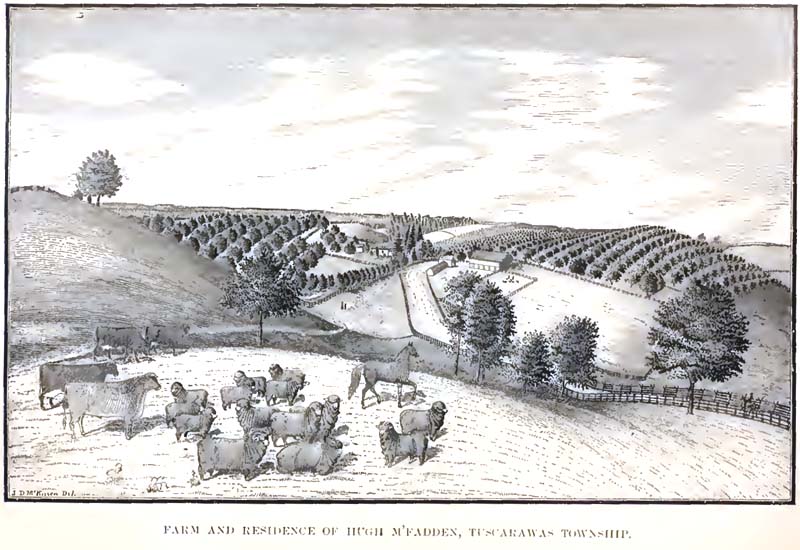
Farm and Residence of Hugh M'Fadden, Tuscarawas Township.
Page 572 - [Blank]
Page 573 -
the Wolhonding canal, discouraged the enterprise and led to its
relinquishment.
This same individual acquired quite a notoriety by
attempting to utilize the same water repeatedly in running a mill. He
erected a sawmill at the mouth of Dutch run, about two miles below Walhonding,
and to the machinery, set in motion by the water power, he attached a pump, the
purpose of which was to pump the water back into the race. Notwithstanding
this "freak," Mr. Turner was an intelligent Englishman. He
possessed considerable means, and figured quite prominently in the affairs of
the township forty years ago. He was an extensive land owner, dealt
largely in stock, expended his money lavishly, made extensive improvements which
the condition of his property at that time did not warrant, and, as a natural
consequence, lost heavily.
The township has not been without its distilleries,
though their tenure upon life has been somewhat precarious. One has
located on the C. Staat's place. It was a little copper affair, set
up by Joe Meredith, and operated a few years only. The grain for
this still was mashed at a mill over the line in Knox county. The
"California" distillery was an institution located about a mile and a half east
of New Castle, operated by Daniel Berry and John Lewis. It
was started about 1840 and kept up five or six years. During this time it
did an extensive business in the manufacture of whisky. A steam saw-mill
was also located here.
John R. Gamble owned a still house in the
northwestern part of the township which, during a brief career, produced large
quantities of the popular beverage.
About twenty years ago a great many oil leases were
taken on ground in New Castle township in the vicinity of Walhonding, the
"signs" indicating
MORE TO COME
Page 574 -
Page 575 -
Mount Airy was the title very
appropriately bestowed upon a little village that stood on an elevated ridge of
ground in the extreme southwestern corner of the township. It was laid out
in 1816, by Elijah Dillon. David Melick resided on the site of the
village before this date. He subsequently sold out to a Mr. Tilton.
A school-house was built here as early as 1820. Mrs. Kezia Alsach,
the wife of a Methodist local preacher, was probably the first school teacher.
She was succeeded by Arthur Scott, from Washington county, Pennsylvania,
a better educated man than most people at that time. The village may have
contained as many as twenty houses, including one blacksmith and one shoe shop.
It is uncertain whether a store was kept there. It has long since come to
naught, having been vacated, except several lots, twenty years ago.
- END OF CHAPTER LXII -
|