|
Hamilton township
is within the, so-called, Congress lands,
and is bounded on the north by Marion
township, on the south by Pickaway county,
and on the west by the Scioto river.
In the original division of Franklin county
into townships, Hamilton was embraced in
Liberty and Harrison townships. The
township was organized under its present
name in 1807. It then contained within
its limits the territory now constituting
Madison township. In the formation of
the township of Marion in 1873, the two
northern tiers of sections in Hamilton were
detached and included in the new township.
SURFACE, SOIL AND STREAMS.
The township, for the most part, is quite
level, the most rolling land lying in the
western part, along the Chillicothe pike.
In the quality of its soil, the township is
probably not equaled by any other in the
county, the soil being largely of a
limestone nature, except in the vicinity of
the Scioto river, where there is bottom
land.
The principal and only stream, worthy of description,
within the township, is the Gahanna river,
commonly called Big Walnut creek, a large
eastern branch of the Scioto. It rises
in the northeastern part of Delaware county,
and after running a southern course for
about forty miles, into the southeast part
of Franklin county, receives a stream from
the east called Black lick, and just below
Alum creek from the west. It enters
Hamilton and Madison townships, in section
twenty-four, flows a very tortuous course
through the township, leaving it in the
southwest corner.
ANCIENT REMAINS.
The township contains a number of mounds, or
earthworks the only records of the existence
of a former race. On the west bank of
Gahanna river, in section thirty-four, on an
elevated piece of land, are the remains of
an ancient fort, or ditch, which has been
almost completely obliterated by the
cultivation of the soil. Nearly a mile
east of this, on the farm of Thomas M.
Clark, are two mounds, situated about a
quarter of a mile apart, the larger of which
is round in shape, and the smaller oblong.
These mounds have been dug into to some
extent, and implements and human bones were
found. There are several other mounds,
in different portions of the township, but
they do not essentially differ from those
already mentioned.
A BEAR HUNT.
All kinds of wild animals were very
plentiful in the early settlement of the
township, although bears may be said to have
been scarce; sufficiently so to make their
hunt exciting. About the year 1818, an
old bear was seen, by Jacob Hamler,
preparing to make a meal of one of George
Rohr's hogs a short distance from his
house. Hamler ran over to
Mr. Rohr's, where there were several men
at the time, and informed him of the
circumstance. Armed with guns and
axes, and accompanied by a couple of dogs,
the men started in pursuit of the animal,
which the dogs soon overtook, and a running
fight ensued, for about a mile, when old
bruin ran up a large black oak tree.
By the time the men arrived it had become
too dark to shoot accurately, and, at
length, a bonfire was built up, by the light
of which the hunters poured a volley of
bullets into the animal. The tree was
cut down, after firing a number of times,
when the bear was found to be dead, having
lodged in the fork of the tree, with sixteen
bullet holes in his body. He was taken
home, and a barbeque made of him the next
day.
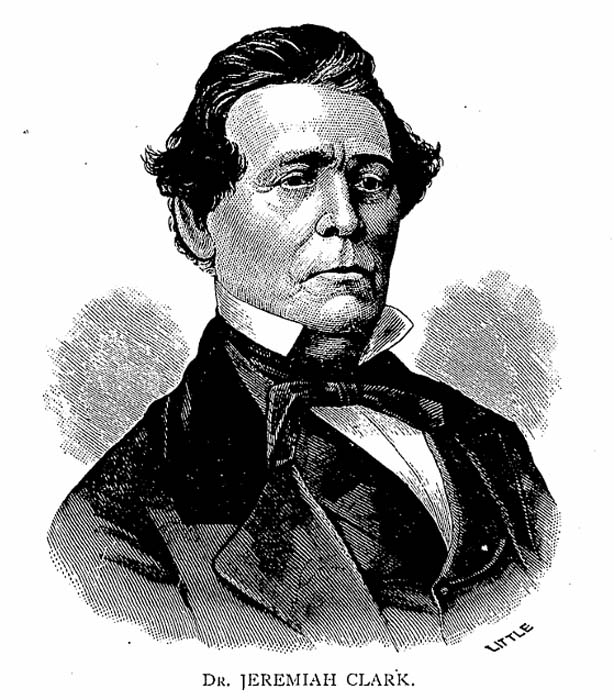
JEREMIAH CLARK
|
Hamilton received a valuable
accession to its settlement, in
1826, in the arrival of its pioneer
physician, Dr. Jeremiah Clark.
Dr. Clark was the son of John
and Mary Clark, and was born in
Waterbury, Connecticut, on the
fourth day of June, 1804. when
he was fourteen years of age his
parents removed to Ohio, and settled
in Medina county, where some of the
family had located before them, and
in a local history of that county we
find the following reference to
their arrival:
"In April, 1818, Dr. Bela B. Clark, a brother of
Ransom and John L. Clark,
arrived and informed them that their
father, John Clark, was
coming, and they left their chopping
and cut the logs for a shanty for
the family, and had got it up and
three-fourths of the roof on when
their father's team appeared in
sight. They soon finished the
roof, and the family crossed the
river on floodd-wood (the stream
being so high they could not then
cross with their teams), and carried
their bedticks - filled with straw
and leaves - and such other articles
as they could, lodged in their cabin
in real pioneer style, and like
others of their neighbors before
them, fared as best they could.
They were forty days on their
journey from Bridgewater,
Connecticut."
While yet a young man, Dr. Clark was offered, by
his father, a farm in Wakeman, Huron
County, Ohio, where he had two
brothers then living, if he would
locate on the land and clear it up.
the offer was promptly accepted, but
the young man soon became convinced
that the occupation of a farmer was
one for which he was not adapted,
and in which he would never achieve
success. He gave up the farm
and decided to study medicine, and
it is a somewhat singular fact that
no less than five sons of this
family were members of the medical
profession. His brother
Harmon M. Clark, was an early
and well-known physician in Huron
county, Ohio. In 1824, the
subject of our notice commenced the
study of medicine with his brother,
Dr. Bela B. Clark, of Medina
county, and subsequently attended
lectures at the Medical Society of
the Nineteenth Medical District of
the State of Ohio, located at
Cleveland, where he graduated Oct.
25, 1825. He first settled in
Green Castle, Fairfield county, but
only remained a short time, when he
came to Franklin county and
established himself in practice in
Hamilton township.
Oct. 4, 1826, he was married to Jane C.,
daughter of Thomas Morris,
who was one of the earliest, as he
was one of the most prominent, of
the pioneers of Hamilton township.
After his marriage
Dr. |
Clark located
on the farm of his father-in-law,
and with his practice combined
agricultural pursuits. His
wife died Feb. 8, 1831, at the age
of twenty-eight years, six months
and nine days. Sept. 3, 1833,
he was again married, to Julia
Ann Fox, of Madison township,
Pickaway county Ohio, originally
from Hampshire county, Virginia,
where she was born, July 29, 1805.
Dr. Clark continued in the active discharge of
his professional duties until 1846,
at which time his health had become
somewhat impaired, and he thereafter
led a more retired life. In
the fall of 1845, he was elected to
the legislature, as a Whig, from
Franklin county, and served for one
year - the period for which members
of that body were chosen under the
old State constitution.
Dr.
Clark
was a man of many admirable traits
of character, of unassailable
integrity, liberal and kind hearted.
He was for years one of the leading
members of the Walnut Hill Methodist
Episcopal church, and contributed
most liberally to its support.
He was a man of strong convictions
and when his judgment was once
formed it could not be easily
shaken. But he was not hasty
in his conclusions and, as a
consequence, was generally in the
right. In his manner he was
dignified, yet courteous and affable
to all.
After a life of great activity and usefulness he died,
at his residence, in Hamilton, on
the fifth day of March, 1865,
leaving to his family the priceless
inheritance of a good name.
Dr. Clark was the father of nine children, born
of his second wife, as follows:
Ann Eliza, born June 20,
1834, and died in September of the
same year; Mary Munson, born
Aug. 10, 1835, and married John
C. Platter, Aug. 28, 1860;
Thomas M., born Mar. 9, 1837,
and married Dec. 11, 1860, Sarah
Jane Frank, who died Sept. 16,
1867; married, second, Ellen
Hickman, Oct. 24, 1877;
John D., born Dec. 27, 1838, and
died July 6, 1842; William F.,
born Aug. 26, 1840, and married,
Mar. 15, 1866, Malinda N. German;
Henry G., born Oct. 8, 1842, and
married Anna H. Millar, Sept.
26, 1867; Herman J., born
Sept. 27, 1844, died Feb. 26, 1865;
John F., born Dec. 16, 1846,
and married Eliza Elliott, in
February, 1868; Sarah Ann,
born Feb. 16, 1849, and became the
wife of Frank B. Herr, Dec.
12, 1867.
Mrs. Clark, who is still living, and is now in
her seventy-fifth year, resides on
the homestead with her daughter,
Mrs. Herr. |
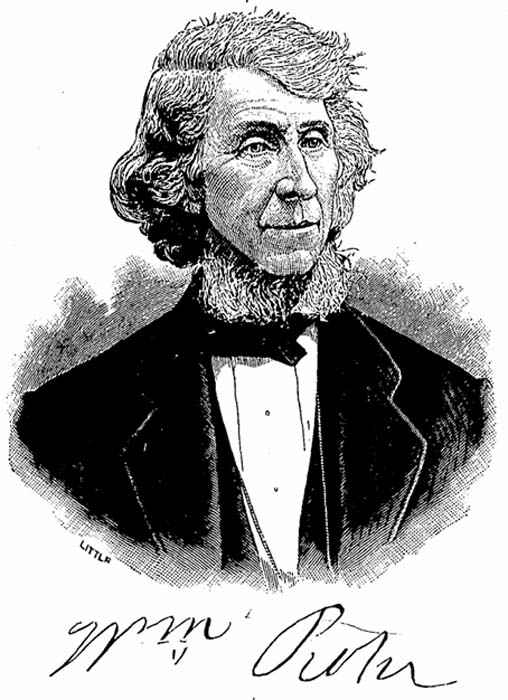
Wm. Rohr
|
Among the few pioneers of Franklin
county who still remain to enjoy the
fruits of their early toil,
privations and hardships is the
subject of this sketch, WILLIAM
ROHR. Born in Haycock
township, Bucks county,
Pennsylvania, Sept. 20, 1810, he
emigrated, when six years of age (in
1816), with his parents to Ohio.
On the 5th day of July, of that
year, a little company consisting of
seventeen persons, and facetiously
called Rohr's emigration
company, started on their journey to
the west. The emigrants were
Michael Rohr and wife;
George Rohr, his wife and two
sons, John and William;
John Rohr, wife and sons,
Jacob and Charles;
John Smuith, wife and daughter,
and a man by the name of Peter
Wisel. After a journey of
six weeks made with three wagons,
one four-horse wagon and two
two-horse wagons, and the most of
the way over mountains and hills,
the travelers arrived in Madison
township, Franklin county, Ohio, on
the sixteenth day of August.
Michael Rohr purchased
section number six, in Madison
township, on which a small clearing
had been made by Henry Bunn,
and resided upon it until his death.
He was born in 1756, and died in
1818. His son, George Rohr,
the father of the subject of this
sketch, was a native of Bucks
county, Pennsylvania, and was born
in 1785. He married
Elizabeth Catharine Funk,
who was born in Northumberland
county, Pennsylvania, in 1784.
He died on the homestead, in Madison
township, ___, 1862, and she, Jan.
14, 1854. They were the
parents of four children, two of
whom died when young. John
is still living in Madison
township, aged about seventy-one.
William Rohr was married, in 1831, to
Elizabeth Wolf, daughter of
Matthias Wolf, an early settler
in Madison township, afterward in
the east part of Hamilton.
She was born in Pendleton county,
Virginia, June 21, 1811, and was
about a year old when her father
emigrated to Ohio. After his
marriage Mr. Rohr remained
for over a year in the house of his
father-in-law, and they together put
up a saw-mill on Big Walnut creek,
not far from where the residence of
W. T. Rees now is. In
1833 he |
located on the
opposite side of the road from his
present residence, and subsequently
purchased and settled on the farm on
which he now lives. For about
twelve years Mr. Rohr
followed the trade of wagon-making,
which he had learned from his
father, and carried on the business
in the little shop which is still
standing near his residence.
His principal occupation, during his
life, however, has been that of
farming, in which he has been more
successful than falls to the lot of
the majority of agriculturists.
In former years Mr. Rohr was
extremely fond of the sport of
fishing. The streams abounded
in salmon, pike, white perch and
other varieties, now nearly extinct,
and no one in the settlement was a
more enthusiastic and successful
angler than he. His wife died
Feb. 8, 1868, and some three or four
years afterward he made a division
of his property, consisting of eight
hundred acres of land, among his
children, retaining a life lease
upon the whole.
Mr. Rohr has been a member of the Lutheran
church in Hamilton, for upwards of
fifty years, and has filled the
various offices in its gift.
In politics he is a Republican.
Mr. Rohr is the father of eleven children, as
follows: George, born Mar. 7,
1832, and died Aug. 7, 1833;
Matthias, born Nov. 4, 1833, and
died Jan. 30, 1835; Mary Ann
born Nov. 6, 1835, now wife of
Joseph Shoaf, and resides in
Hamilton; Eliza Jane, born
Dec. 7, 1837, now widow of John
B. Young, and lives in Hamilton;
Absalom, born Jan. 19, 1838,
now a resident of Madison township;
Lewis, born Aug. 28, 1841,
and died Jul. 27, 1842; William
Henry, born Apr. 24, 1844, and
resides on the home place with his
father; Sarah Elizabeth, born
Aug. 21, 18346, was the wife of
Dimmick Harris, and died Nov.
30, 1876; Rachel Catharine,
born Feb. 2, 1849, is now the wife
of William Strickler, and
occupies the old Matthias Wolf
farm; Louisa Ellen born
July 29, 1851, wife of Peter N.
Hudson, and lives south of the
home farm in Hamilton; and an
unnamed child, born Dec. 1, 1853,
who died the twelfth of the same
month. |
Pg. 391 -
A man by the name of Gordon killed,
just over the river, in Jackson township,
three bears in one day. - an old she bear
and two cubs.
SETTLEMENT.
The
first settler was, probably,
JOHN DILL, who came from York county,
Pennsylvania, about the year 1800, and
entered twelve hundred acres of land in the
north and entered twelve hundred acres of
land in the northwest part of the township,
residing first in Franklinton, where he was
one of the first settlers. He soon
afterwards sold the half of the tract to
Michael Fisher. He lived on the
bank of the river, and his old log house is
yet standing, and is now occupied by
Edward Fisher. Dill was an early
justice of the township. His life was
cut short by accident. While riding,
in company with Judge Flannagan, he
was thrown from his horse by a mis-step of
the animal, and sustained an injury to his
head, which caused his death a few hours
after. His wife survived him.
They were both buried in the old Franklinton
graveyard, but there is nothing to mark
their resting place. They had no
children.
MICHAEL FISHER settled
in the same vicinity soon after John Dill.
He was a native of Hardy
county, Virginia, and was born Sept. 15,
1767. After his marriage to Sarah
Petty, he resided in Kentucky one year,
when he moved to Ohio, some time prior to
1800. He purchased a military claim of
about eight hundred acres, Just west of the
river, in Franklin and Jackson townships,
and located in the bend of the river.
He lived there a year or two, and then sold
a part of his land, and bought six hundred
acres of John Dill, and moved into
this township. He built on the bank of
the river, on the Chillicothe road, as it
then run. He had a saw-mill there at
an early day, which was demolished when the
canal was built. Mr. Fisher was
also an early justice of the peace of
Hamilton. He died in this township,
Jan. 15, 1824, and his wife Jan. 2, 1843.
THOMAS MORRIS
settled
in Hamilton, in 1803 or 1804. He had
been in this section with a surveying party,
in 1799. He was a native of New York
city, and was born Sept. 1, 1767. At
the age of nineteen he went to Kentucky, and
in the fall of 1802 came to Ohio, and with
others located on the Scioto river, at what
was called "high banks," south of
Chillicothe. A year or two afterwards
he removed to this township, and entered
section twenty-seven, than which there is no
better section of land in Franklin county.
The old patent, therefor, issued Oct. 23,
1805, and signed by Thomas Jefferson,
president, and James Madison,
secretary of State, is now in possession of
Thomas M. Clark. Mr. Morris
located where widow Clark now lives,
and resided there until his death, July 16,
1853. He was a man of energy, of
character, and of strict integrity, and
every object looking to the moral well-being
of society, found in him a warm supporter.
He was largely instrumental in the
establishment of the Walnut Hill church,
formerly called the Morris church, to which
he made a donation of land, and at his death
bequeathed the income of one thousand
dollars for its support, and that of the
burying-ground located there. He, too,
served as a justice of the peace in an early
day, in this township. He was married
twice, and had two daughters, one of whom (Jane)
was the first wife of
Dr. Jeremiah Clark.
STEWART.
A family by the name Stewart were
early settlers in Hamilton, just south of
where the starch factory now stands. A
son, William, married Betsey
Fisher, and occupied the place after his
father's death.
JOHN STAMBAUGH and
family,
consisting of his wife and four
children, moved in from Lancaster county,
Pennsylvania, in 1804. He lived where
the widow of his son, Frederick, now
resides (now Marion township), taking up the
west half of section three. He had two
sons and four daughters, all now dead but
one daughter - Mrs. David Mooberry,
who lives in Illinois. Frederick,
who occupied the homestead up to the day of
his death, in 1861, was born there, in 1811;
he married Elizabeth Baylor, who is
still living on the same property.
PERCIVAL ADAMS,
about this time, settled on a part of the
southwest quarter of section twenty-seven.
DAVID SPANGLER,
one of the earliest settlers of the
township, emigrated with his family, from
Rockingham county, Virginia, and settled
where his grandson, W. T. Spangler,
now lives. He built the old brick
house there, about sixty-five years ago.
He had a large family, but only two sons are
living - one in the northern part of the
State, and the other in Illinois.
David, his son (now deceased), married
Julia Holmes, who is still living,
near South Bloomfield, Pickaway county.
David Spangler, sr., died July 26,
1841, aged nearly seventy-six.
THE RAMSEYS -
Samuel, James and Robert - were
among the early pioneers of the county.
Samuel and James settling in the west
part of Madison township, and Robert,
in this, on the east line of the township,
on Big Walnut, where the bridge now is.
His sons run a ferry across the creek as
early as 1814 or 1815, Their boat was
flat-bottomed and was capable of carrying a
loaded wagon and team of six horses at a
single time, and frequently ferried across
wagons loaded with merchandise from the
east.
FERGUSON MOREHEAD, originally from
Pennsylvania, came to Ohio from Kentucky
with his mother and a brother. In 1806
he married Jane Williams, and settled
on the Scioto river south of David
Spangler's. He died there about
the year 1846, and his wife in 1825.
Mrs. Maria Holmes, now living in this
township with her son, Isaac Holmes,
was their oldest child. She was born
Oct. 1, 1807, in the cabin on the bank of
the river, and was rocked in a sap-trough
for a cradle. She married Isaac
Holmes Sept. 6, 1827, and spent her
married life in Harrison township, Pickaway
county.
GEORGE W. WILLIAMS
came from Maryland in the spring of 1805,
and located in Franklinton. A year
afterward he moved into Hamilton, and
settled where his son, David, now
lives, section eleven, now Marion township.
He opened a tavern on the Groveport road, in
1812, which at the time was the principal
stopping place between Middletown, now
Oregon, in Madison township, and
Franklinton. Mr. Williams kept
a tavern there until his death, in 1829.
His wife survived him many years, and died
at the age of over eighty. They were
the parents of twelve children, four of whom
survive, viz.:
Pg. 392 -
George W. Williams,
living in this township; Eli, in
Mifflin; Mrs. Mary Earhart, in
Columbus; and David in Marion
township. The first named was born in
Hamilton, in 1809, and is, without doubt,
the oldest inhabitant of Hamilton, who was
born in the township. He married
Laura Ann Moore, whose father, Simeon
Moore, Jr. was an early pioneer of
Blendon township.
JOHN WEATHERINGTON
came into the township in 1805, with his
son-in-law, George W. Williams.
He entered a part of section seventeen, and
resided there until his death. His
sons, Isaac, John, and William,
all settled in the township. His
daughter, Rebecca, was the wife of
Mr. Williams, and two other daughters
- Margaret and Comfort, married,
respectively, John and Josiah
Williams, brothers of
George W., sr.
JAMES
and ANDREW CULBERTSON joined the settlement
about this time; also, ROBERT
SHANNON, and his sons, Samuel,
Hugh, James, John, Joseph, and
William.
JOHN HUFF came
with EMMER COX ( who
settled in Madison township), in the year
1807. He settled where AMOS CULP
now lives, in section twelve, and died on
that place at an advanced age. He was
a Revolutionary soldier.
HENRY
HORNBAKER was an early settler, in the southeast
quarter of section thirty-six, and Thomas
Swan, in the northeast quarter of the
same section. Swan sold out, in
1818, to Mathias Wolf, and went west.
The
SULLIVANTS -
Thomas, William, and James -
settled at an early day, on a portion of
section thirty-six. They bought no
land, but took a lease, at the expiration of
which, they moved out of the county.
ZEBULON GRAY came from
Maryland, at an early day, and a family, by
the name of German, came at the same
time. Gray and GEORGE GERMAN
moved to Indiana. Jesse German
was a resident of Hamilton until his death,
and some of his children now reside here.
WILLIAM
THOMAS was an
early occupant of section thirty-six, not
far from where WILLIAM ROHR, now
lives. He removed to Indiana, and died
there.
The
LAMBERTS settled,
quite early, on the farm now owned and
occupied by THOMAS M. CLARK, the
northwest quarter of section thirty-five.
The father and mother both died there.
Two of the sons moved west.
JACOB WOLF was an
early settler on the farm now occupied by
his son-in-law, Timothy Sherman and
died, only a few years since, at the age of
nearly ninety.
GEORGE HAYS located,
at an early date, in section twenty-four,
and occupied, as a renter, the farm now
owned by HARVEY LISLE.
LEVIN
SHINN was an
early pioneer of Hamilton, and settled in
section thirty-four.
In
1809,
SAMUEL PURSEL
came to Ohio, from near Brownsville,
Pennsylvania, a town on the Monongahela
river. Shortly after coming, he was
married to Nancy O'Harra, whose
parents were pioneers of the old town of
Franklinton, and located in Hamilton, a
short distance south of where Rees' station
now is. Subsequently, he settled in
the west part of the township, on the
Chillicothe road, where he lived until his
death, which occurred in the year 1844.
Mr. Pursel was a volunteer in the war
of 1812, and assisted in building the
blockhouses at Upper Sandusky. He was
an expert hunter, and, during the early
years of his settlement, killed a great many
deer, wild turkeys, and smaller game, whic,
as was the custom among the pioneers, he
divided with hid neighbors. Ten
children were born to him. Mrs.
Harriet Stimmel, now residing in this
township, was the eldest, and was born in
this township, in March, 1811. She became the wife of Yost Stimmel (now
deceased), son of Michael Stimmel.
Mrs. Stimmel has three children: Mrs.
John R. Cook, in Columbus; John,
in this township, and Smith Stimmel,
an attorney at law in Cincinnati. She
has buried four.
ASA
DUNN,
from New Jersey, was an early settler near
where Shadville now stands, on the bank of
the river. He had a distillery and a
small corn-mill on the river.
MICHAEL
STIMMEL, with
his wife and two children, came from
Hampshire county, Virginia, in 1810.
They made the journey on horseback, the
father carrying one of the children and the
mother the other, who was then about a year
old. Mr. Stimmel located first
on the farm of William Renick, in
Pickaway county, where he remained for a
year or two, when he came to Franklin
county, and settled in this township, on the
farm now owned by the family of Thomas
Johnson, jr. He was a blacksmith
by trade, and kept a shop there. This
farm he occupied about seven years, and then
purchased and settled on the farm now owned
and occupied by John Stimmel, his
son, where he spent the remainder of his
life, dying there in the spring of 1859.
Peter, Daniel, and Jacob,
brothers of Michael Stimmel, came out
afterward, and married and settled in this
county - Peter and Daniel in
Hamilton, and Jacob in Franklin
township. They are all now deceased.
JOHN
SHOAF, and
family, consisting of his wife and ten
children: John Plum, wife, and
daughter, and Samuel Riley, moved in
together from Hardy county, Virginia, on the
south branch of the Potomac river, in the
fall of 1812. HENRY and
JACOB PLUMB had arrived some time before
this. Shoaf and family spent
the following winter in a cabin of ANDREW
CULBERTSON, and in the spring located
near the present site of Lockbourne.
Some eighteen months afterward, he made a
trip to Virginia, during which he contracted
a cold, and died soon after returning to
Ohio, in the spring of 1814. Of this
large family, John, living in
Hamilton, is the only survivor.
JOHN PLUM
settled where WILLIAM RILEY now
resides, in section fifteen. He
purchased there two hundred acres of land,
and also a farm in the vicinity of
Lockbourne. He lived but a few years
after his settlement, but his wife lived
until the age of ninety-five.
SAMUEL RILEY was
single when he came to Ohio, but afterwards
he married Susan, daughter of John
Plum, and occupied the place on
which her parents settled.
DAVID WILLIAMS came from near Morefield,
Hardy county, Virginia, and in connection
with his brother, Abraham, who lived
in Chillicothe, located some seven hundred
acres of land in the southwest part of the
township. Apr. 23, 1811, he married
Margaret Kerns, and settled on the land
he had purchased, first occupying a
Pg. 393 -
cabin a
short distance south of Mrs. Catharine
Williams' present residence. He
afterwards built a brick house on the same
location. The frame house now occupied
by Mrs. Williams, he erected
fifty-four years ago, and occupied it until
his death, in 1834 His wife died in
May, 1840. They had nine children -
Abraham, Mary, Abner K., David, Rebecca H.,
William, Benjamin, Isaac, and Sarah
E., all now deceased, except Mary,
wife of Felix Renick, of Pickaway
county, and Rebecca, who married
P. L. Howlett, and is now living near
Springfield, Illinois. Abner K.
lived in this township, where his son,
David, now lives; and David, near
Lockbourne, on the place occupied now by his
family; William married Mrs. Nancy
McKinley, and after her death, Mary
Williams, widow of his brother, Abner
K.; she now lives in Shadeville;
Benjamin was married to Catharine
Wright, of Missouri - she still occupies
the old homestead of David Williams, sr.;
Sarah E. was the wife of Seymour
Renick.

JACOB STOUTZENBARGER,
one of Hamilton's
substantial farmers, is the eldest of two
children of John and Hannah (Rowe)
Stoutzenbarger, and was born in
Lancaster, Pennsylvania, Dec. 26, 1810.
His father died when he was three years of
age, and when he was ten years old his
mother also died. After her death he
worked out for a living, and when he was
fifteen years of age, hired to a farmer for
four dollars per month. He was
economical with his small earnings, and at
the end of the year had saved twelve
dollars. In this saving he laid
the foundation of his successful business
life. When his year on the farm
expired, he learned the carpenter's trade,
serving an apprenticeship of three years and
a half, and subsequently worked at the
trade, on his own account, for about three
years. Having by this time accumulated
a capital of about a thousand dollars, he
opened a store in a small country town of
Pennsylvania, called New Providence.
He conducted the little store for six years,
when he sold out for six thousand dollars.
Having a capital to invest, he was induced
by his friend, Amor Rees, to come to
Hamilton, and with him purchase a saw-mill.
They afterwards built a distillery on Big
Walnut creek, a short distance above the
present residence of W. T. Rees.
This they operated about four years, when
Mr. Stoutzenbarger, sold his interest to
his partner, the business not proving as
profit able as he desired. He then
went to Marion county, and erected a
distillery at Caledonia, which he carried on
some seven years, with success. He
then disposed of the still, and concluding
to engage at farming, he returned to
Franklin county, and purchased the one
hundred and sixty acres on which he now
lives. He has since, at different
times, added to his original purchase, until
he now owns nearly one thousand acres in
this county, besides a considerable landed
interest in the west. Mr.
Stoutzenbarger's extraordinary success
in the accumulation of property, having
never received any assistance whatever, has
been due to his prudence and industry,
combined with a large degree of sagacity.
Unlike many whose success in this direction
is the result of questionable methods,
Mr. Stoutzenbarger's honesty and
integrity were never doubted, and he enjoys
the confidence and respect of all who know
him.
Mr. Stoutzenbarger was married March, 1843, to
Elizabeth, daughter of Jacob and
Julia Ann Frank (afterwards wife of
Amor Rees), who was born in Lancaster
county, Pennsylvania, in the year 1823.
She became the mother of four children, and
died in 1848. Three of the children
died in infancy; the other, Susan,
born June 28, 1844, married C. S. Herr,
Dec. 21, 1864, and resides with her husband
on a farm of her father's, near Shadeville.

Residence of JACOB STOUTZENBARGER, Hamilton
Tp., Franklin Co., Ohio
MATHIAS
WOLF and
family moved into the township in 1812.
He settled in section twenty-six, and lived
there until his death, in March, 1849, aged
fifty years. His wife survived him ten
years. They had but one child - a
daughter, who became the wife of
William
Rohr.

FREDERICK STOMBAUGH,
with his wife and six children, came from
Pennsylvania during the war of 1812.
He settled on the place now occupied by
Dr. Blish, on the Lancaster pike, and
died there about 1849 or 1850. His
wife died previous to that date. They
raised a family of six children, of whom
there are living: Samuel, who lives
in Iowa; Frederick, who lives north
of Columbus; and Elizabeth, widow of
George W. McCloud, who lives in
Marion township. Mrs. McCloud
is now seventy years of age.
JACOB SHOOK came
from Westmoreland county, Pennsylvania, with
his father, Philip Shook, in 1812.
His father, with his family, settled in
Madison township, Pickaway county, where
Abraham Shook now lives, and resided
there until his death. Jacob Shook,
in 1817, married Judeth Glick, who
came to Fairfield county with her parents in
1808. Mr. Shook settled about a
mile north of his father, on forty acres of
land, on the south part of the tract now
owned by Z. H. Perrill. In 1822
he came into this township, but remained
only two years, when he returned to his
former place of residence, in Pickaway
county. In 1828, he erected a saw-mill
on Slate run, in Madison Township, Pickaway
county, the race for which he was five years
in completing. In the spring of 1849,
he removed to his township, and located on
the southeast quarter of section twelve,
which had previously been purchased by his
sons, Elias and Jeremiah. He
died there in 1860, at the age of seventy
years. His wife died in March, 1879,
at the residence of her son, Elias Shook,
at the age of nearly eighty-one. They
had six children, of whom Elias is
the only survivor. In 1859, the latter
married Rebecca, daughter of Henry
Allspaugh, and occupied the place on
which his father had resided until about
eighteen yeas ago, when he moved to the farm
on which he now resides, at Lockbourne.
GEORGE KLICKENGER
came from New Jersey about 1820. He
stopped in Franklinton for about six months,
when her purchased eighty acres in the
northeast quarter of section eleven.
He died there some twenty years ago.
He had nine children, all of whom were born
in New Jersey, but the youngest, John B.,
living on the old homestead, and Mrs.
Jasper Berger, in Iowa, are the only
surviving members of the family.
ALDRIDGE WATKINS,
a native of Massachusetts, came to Ohio from
Ontario county, New York, arriving in this
township July 4, 1822. He first
located in section two, but subsequently
moved to section twelve, where he lived for
some time; finally settling where his son
Q. A. now resides. He died in
March, 1849. Much of his life was
spent in work at jobs on the roads, on the
canal, and the streets of Columbus. He
was the father of seven children, four of
whom are now living, viz: Philo B.
and Quincey A. who are among the
substantial farmers of Marion township;
Madaline, widow of Capt. Morrison,
in Columbus, and Emeline, wife of
Philomel M. Gray, in Scioto township,
Pickaway county. The mother, now in
the seventy-eighth year of her age, lives
with her son, Quincey A.
ALEXANDER HARRISON,
then a boy twelve years of age, came with
his parents to Ohio from near Winchester,
Virginia, in 1802. They settled at
Lancaster, Fairfield county, where, Jan. 6,
1813, he married Nancy Strode who
came to the same vicinity from Berkeley
county, Virginia, in 1806. Mr.
Harrison came to Hamilton in 1829, and
settled in the southwest quarter of section
one. He was a carpenter by trade, and
worked on the canal, in the construction of
locks, for about three years. He died
in this township Dec. 6, 1853, aged
eighty-three. His wife died Nov. 24,
1857. There were three children:
William H., the only one now living,
married in 1846, Mary Kiger, who died
about two years after marriage. Mr.
Harrison has resided in the section
where he now lives continuously since 1829.
Mar. 4, 1852, he married Susannah Gushart,
with whom he now lives.
ALEXANDER HARRISON, SR.,
was a Revolutionary soldier, serving through
almost the entire war, and was in several
important engagements. He was a guard
at Independence Hall, Philadelphia, when the
Declaration of Independence was read.
SAMUEL RANCK has
been a resident of this township about forty
years. He was born in Lancaster
county, Pennsylvania, in 1811, and emigrated
to Ross county, Ohio, in 1834. The
next year he came to Franklin county, and
resided in Madison township nearly five
years, when he moved to Hamilton.
JOSHUA BETTS
settled, where Shadeville now stands, in
February, 1834. He married, in the
spring of 1835, Catharine Lilley and
kept, for several years, a boarding house in
a cabin that stood on the site of the
present residence of Mrs. Seeds.
He located, where he now lives, in 1844.
EARLY EVENTS
The first birth in the township was that of
Maximilla Fisher, daughter of
Michael and Sarah Fisher, who was
born Sept. 20, 1800. when this event
occurred, the parents were residing on the
banks of the Scioto. Miss
Pg.
394 -
Fisher became the wife of Arthur
O'Harra. There were some very
early burials in the Walnut Hill
burying-ground, but the graves have now no
mark to designate their location. The
oldest inscription in the graveyard is that
on the tombstone of John Hornbaker,
who was buried there in February, 1811.
In July, of the same year, his son, Henry,
was also buried there. The same year,
also, the wife of William Thomas was
deposited there. The first road laid
out in the township was the old Franklin and
Chillicothe road, which then run a different
course from that which the pike now does.
On the old road, on the farm now ocupied by
Timothy Sherman, the first tavern in
the township was kept by James Culbertson.
The next tavern was that of George W.
Williams, previously mentioned.
EARLY SCHOOLS
The earliest schools were kept in private
cabins, and were supported by subscription.
The first school was kept in an unoccupied
log cabin, on the farm of Thomas Johnson.
John Lusk and Samuel Clark were
among the earliest teachers. The first
school-house in the township was erected in
teh Stombaugh neighborhood, on the
back part of the Stewart farm.
One of the first teachers here was a
man by the name of Goodenough.
Andrew Armstrong and Ellen Toppin
were also early teachers. A
school-house was built, at an early date, on
the John Thompson farm. The
first school-house at Lockbourne was a log
building and stood at the upper end of the
town, nearly opposite the residence of
William Manypenny. The first
school in the vicinity of Shadeville was
taught in a log school-house, near the
present bridge at the intersection of the
pike and canal.
RELIGIOUS SOCIETIES
THE LUTHERAN CHURCH
In the year 1812, Rev. M. Foster, a
minister of the Evangelical Lutheran
denomination, was invited by members of the
Reformed and Lutheran denomination, residing
in Hamilton, to come and preach to them,
which request was complied with, and Mr.
Foster continued to preach for them for
two yes, holding meetings generally
indwelling houses. An organization was
formed with the following membership:
Philip Helsel, G. Kissinger, John Sharp,
Jacob Plum, Michael Stimmel, Nicholas Young,
Frederick Stombaugh, and others.
Philip Helsel and G. Kissinger
were chosen elders, and Michael Stimmel
and Nicholas Young, wardens.
The second minister was Charles Henkel,
who began his labors in 1819, and remained
six or seven years. In 1821 a log
meeting-house was built and the society
incorporated under the name of "The German
LUtheran and Reformed congregation of the
township of Hamilton." Prof.
William Smith, of the Columbus Lutheran
seminary, succeeded Mr. Henkel,
commencing in 1831, and continuing four
years. Rev. Mr. Pence was the
next pastor, and remained until the spring
of 1842. He was followed by Philip
Gast, under whom, in 1844, a new brick
church was built. The successive
pastors since Mr. Gast, are as
follows: Rev. Mr. Speilman, Rev.
Daniel Worley, Rev. Mr. Shultze, and
Rev. E. Schmid, who is still in charge,
having been pastor since 1863. The new
church building was erected in 1873, costing
about nine thousand dollars, and was
dedicated June 7th, of the following year.
The church consists of two divisions,
constituting one congregation. The
society is large and prosperous, the actual
membership being three hundred in the
English division, and seventy in the German.
The pastor preaches one Sunday in English,
and the other in German.
WALNUT HILL METHODIST
CHURCH
In 1894 the pioneer circuit rider, Rev.
James Quinn, was appointed to the
Hockhocking circuit. Soon after he
made his way from Toby Town, near where
Royalton now is, which was one of his
regular appointments, to the cabin of
William Harper, near where Lockbourne
now stands, with Ezekiel Groom as his
pilot through the wilderness. at
Mr. Haper's was organized the first
society on the waters of Walnut creek.
The members of the class were:
Williaml and Anna Harper, Noah and Thankful
Biship, Ezekiel and Rhoda Groom.
The Class was afterward removed to widow
Lambert's, and later to Walnut Hill.
A frame meeting-house was built there in
1833, the Presbyterian assisting in its
erection. Thomas Morris donated
two acres of land for the church and
graveyard, and at his death left the society
one thousand dollars, the interest on which
he directed in his will to be used in
keeping up the church and burying-ground.
The brick church was erected in 1869, at a
cost of six thousand four hundred dollars.
The membership is now about eighty.
The class in Lockbourne held their earliest
meetings in a log school-house, in the upper
end of town. After the erection of teh
United Brethren church they held their
services in that until 1850, when their
present brick church was built. Among
the membership composing the class at the
time of its organization were:
Josiah Hulva and wife, Thomas
Bennett, and J. M. Bennett.
The first preacher for the society was a
Rev. Mr. Martin. The membership of
this church is now about forty-seven.
The Sunday-school of this church was organized in 1848,
by Josiah Hulva and
wife, assisted by Willialm T. Smith,
Abraham Smith, Samuel Rank, and others.
The school was, at first, held in the United
Brethren church, but, in 1851, was removed
to the Methodist Episcopal church.
Josiah Hulva was the first
superintendent, and held the position until
1857, when he was succeed by Wm. T.
Smith. After Mr. Smith, the
superintendents were, successively: Dr.
J. N. Robinson, Joseph Brantner, John
Stimmel and John Rathmell.
THE METHODIST CHURCH
at
shadeville was organized in 1856, by Rev.
Mr. Hooper. The members were
Joshua Betts and wife, and Alban
Kaylor and wife. A frame
meeting-house was erected the same eyar, and
occupied about ten yeas, when it fell down.
The present brick church was built some six
or seven years ago.
ST.
MATTHEW'S CHURCH (EVANGELICAL LUTHERAN),
at Lockbourne, was erected in 1875, and the
society was formed about the same time.
The church cost some-

MRS. JOHN LISLE
JOHN LISLE

RESIDENCE OF JNO. LISLE,
HAMILTON TP., FRANKLIN CO., O
 
ARTHUR O'HARRA
The subject of this notice was of
Scotch ancestry; his parents,
Hugh and Mary O'Harra, were
natives of Virginia, whence they
emigrated to Ross county (now
Pickaway), in 1800. There
Arthur was born, Feb. 6, 1801.
He grew up to boyhood on the farm of
his father, and, about 1819, came
from Marion county (where his
parents had previously removed), to
Frankiin Franklin
county, and for a time worked at
brick-making in Columbus.
Subsequently, he engaged in
agricultural pursuits, in which he
continued during his life; he was a
intelligent tiller of the soil, with
advanced views of agriculture.
In 1826, he was united in marriage,
by the Rev. Dr. Hoge, to
Miss Maxamillia Fisher, daughter
of Michael and Sarah Fisher,
who were among the earliest settlers
in the county. Mrs. O'Harra
was born Sept. 20, 1800, and the
event is believed to have been the
first of the kind in Hamilton
township. Colonel O'Harra,
as he was familiarly called, was a
man of large stature, being six
|
feet in height and possessing
corresponding physical strength; he
also possessed a naturally vigorous
mind, and exerted a potent influence
over those with whom he mingled.
It was his custom to enforce upon
his children a strict compliance
with his serious religious views,
and all his conduct was regulated
from a christian standpoint.
He was a prominent member of the
Presbyterian church, and was an
elder in the church for thirty-five
years. Colonel O'Harra
possessed, in an eminent degree,
those sterling characteristics of
the race of which he was a worthy
descendant. He was frugal,
industrious, persevering, thoroughly
honorable and honest, and enjoyed
the respect of all who knew him.
He died in Hamilton township,
Franklin county, Mar. 6, 1875.
Mrs. O'Harra died in 1864.
They raised a family of eight
children, seven of whom are now
living. At the time of his
death, Colonel O'Harra had,
besides his children, ten
grand-children and one
great-grandchild. |
Pg. 395 -
thing over three thousand dollars, and is
not yet fully completed. It is a neat
and commodious structure, and well
furnished. The present pastor is
William H. Brown, resident at St. Paul,
Pickaway county.
HAMILTON PRESBYTERIAN
CHURCH
This society was organized, at an early date , by
Rev. Dr. Hoge, of Columbus. They aided the
Methodists in the erection of the church building at
Walnut Hill, and held their meetings therein until the
erection of the brick church south of Mr.
Shoaf's. This church was built about 1841 or 1842.
The organization has run down, and no meetings have been
held for several years. The church is now used by the
grange.
The United Brethren had a church organization at
Lockbourne for many years until within the last few
years. The class was formed at the former dwelling of
Samuel Ranck, about the year 1842, by
William K. McCabe, the first circuit preacher. There
has been prior to this time, local preaching in the
neighborhood by Rev. Louis Kramer and others of
the denomination, for several years. Preaching was held
at Mr. Ranck's on the Dresbach
place, in Madison township, this county, as early as
1837. The earliest members of the class were Samuel
Ranck and wife, Daniel Dresbach and
wife, Henry Hammond and wife, and H. P.
Jeffers and wife. Meetings were held
regularly at Mr. Ranck's every two weeks,
until the building of the frame meeting house in
Lockbourne, which was commenced in 1843, and completed
and occupied in 1844. Local preaching had been held
before this in the school house in Lockbourne. The
society in its infancy met with opposition, and even
persecution, from a class of individuals who had no
regard for religious teaching, and the school house was
finally locked against them. The church of the society
was open to all orthodox denominations, and the
Methodists and the Lutherans also occupied it for a
time. The church numbered at one time about fifty
members, but it was substantially broken up a number of
years ago, and on meetings have been held at the church
for three years; and a year ago it was sold to the
village of Lockbourne for a town hall.
Mr. Ranck was the
leader of the class, and the leading member of the
church many years.
MILLS.
The date of the construction of several
mills in the township, that have long since
gone down, we are unable to give. The
first mill was probably the saw-mill of
Michael Fisher, before mentioned.
It was erected on the Scioto river, in the
northwest part of the township, and was in
operation until the canal was built, when it
was torn down. Joseph Murray
and Isaac Weatherinton erected a
saw-mill at an early date on Gahanna river,
on the land now owned by W. T. Rees.
John Herr and Francis Johnston
had a saw-mill and grist-mill, and also a
distillery, on the same stream, about a ile
east of Shadeville. Oliver Hartwell
erected a mill at the four-mile locks, soon
after the completion of the canal.
After running a number of years; it was
burned down. A saw-mill was built at
Shadeville, by John and Cornelius
McCarthy, in 1834. They run it
until 1837, when they sold out to James
and John Dalzell, who subsequently took
A. G. Hibbs in as partner.
THE COTTAGE MILLS,
located at Shadville, were
erected by James and John Dalzell and
A. G. Hibbs, in the year 1841.
They operated them some ten years, when the
Dalzells sold their interest to
Hibbs, who made some additions to the
building. The mill is now owned by
C. & J. W. Seeds.
PHYSICIANS.
The first physician who settled in the
township was Dr. Jeremiah Clark.
Graduating at Cleveland in 1825, he soon
after came to Hamilton, where he practiced
medicine up to 1846. He resided on the
farm still occupied by his widow, and died
in 1865. Dr. Holbrook is said
to have been the earliest physician at
Lockbourne. About 1833, he came there
from New York; remained a few years, and
then moved to Allen county, Ohio.
Dr. A. N. Boales settled there soon
after Dr. Holbrook, removing from
Circleville, where he had been a former
student of the well-known Dr. Luckey.
He continued in practice in Lockbourne until
his death. Dr. Carl located in
Lockbourne about the year 1846, but remained
only two or three years. Dr.
Marshall, now of Blendon township, was a
physician of Lockbourne a number of years,
and was afterwards a representative in the
legislature. Dr. H. L. Cheney,
now of Groveport, practiced medicine in
Lockbourne eleven months, leaving in 1848.
Dr. Carney was there at the same
time. The latter afterwards went to
New Mexico. Dr. R. G. McLane
located at Lockbourne soon after Dr.
Carney left, and practiced a number of
years, when he sold out to Dr. I. N.
Robinson and removed to Michigan.
He returned a year of two afterward and
buying Robinson out continued in
practice for three or four years, when he
discontinued it, to accept an appointment as
supervisor at the distillery. He died
at Lockbourne. The present physicians
there are Dr. H. C. Blake and Dr.
M. A. Boner. The former obtained
his medical education at the Columbus
medical college, Columbus, Ohio, where he
graduated in March, 1876. In April, of
the same year, he commenced practice at
Lockbourne, where he has since continued
with success, Dr. Boner is a
physician of the eclectic school, and began
practice in Lockbourne in February, 1879.
Dr. Davis was the first physician in Shadeville,
where he settled about 1850 or 1851.
He was a student of Dr. Guard, of
Harrison township, Pickaway county.
After remaining about two years, he sold to
William Williams the property now
occupied by his widow, and removed to Indian
Territory. Before Dr. Davis
left, Dr. W. J. Scott came in, and
located where Dr. Blake now lives.
Dr. Scott remained a number of years,
and was a successful practitioner. He
removed to Cleveland, and is now professor
of theory and practice in the medical
department of Wooster university, in that
city. Dr. O. P. Brinker derived
his medical education at Ohio medical
college, Cincinnati, where he graduated, in
1864. He began practice in South
Bloomfield, Pickaway county, in the spring
of that year, and the next fall came to
Shade-
Pg. 396 -
ville, where he has since practiced, with
the exception of one year, in Circleville.
Dr. M. M. Stimmel resided in
Shadeville for a year or two engaged in the
practice of his profession, a part of the
time in partnership with Dr. Brinker.
He removed from there to Kenton, Ohio.
Dr. W. H. Blake, of Shadeville,
settled there in 1870, and has since built
up a fine practice. He is a graduate
of Starling medical college, Columbus,
receiving his diploma in the spring of 1870.
GRANGE SOCIETIES.
Hamilton Grange, No. 436, was chartered in
1874, the applicants for the charter being
Eli SHOOK, Christian Kortzholtz,
T. M. Huddle, J. C. Platter, Job Rohr, J. J.
Rohr, Rebecca SHOOK, G. L. Thompson,
Elizabeth Thompson, R. M. Williams, A. C.
Finks and others. The first
officers were Eli SHOOK, M.;
Christian Kortzholtz, O.; T. M.
Huddle, chaplain; A. P. Sawyer,
L.; J. C. Platter, secretary.
The grange was organized in the school-house
at Lockbourne, where a few of the first
meetings were held. It then met for a
short time at the house of Eli SHOOK,
after which the lower hall in the masonic
building was rented, and since May, 1874,
has been used as a grange hall. The
officers for 1879 are Eli SHOOK, M.;
R. M. Williams, O.; W. H. Roberts,
L.; Joseph Bradner, chaplain;
Absalom Rohr, secretary. The
persent membership is about thirty.
HAMILTON CHURCH GRANGE,
NO. 557.
was
organized Feb. 16, 1874, with the following
officers; H. C. Jones, master;
John Stimmel, overseer; Jacob
Reab, secretary; John
Helsel, lecturer;
Jacob H. Evans, chaplain; John R.
Shoaf, steward; H. G. Clark,
assistant steward; William Williams,
treasurer; F. M. Stimmel,
gate-keeper; Mrs. L. W. Simpson,
ceres; Mrs. Lizzie Stimmel, lady
assistant steward.
The present officers are as follows: John Stimmel,
master; H. G. Clark, overseer;
Mary Reab, secretary; Mrs. M. J.
Stimmel, lecturer; Lemon Meeker,
chaplain; John Lisle, treasurer;
John Strickler, gate-keeper; Emma
Shoaf, ceres; Ida Lisle, flora;
Mattie Boals, promono; Anna Clark,
lady assistant stewart.
MASONIC SOCIETY
The Lockbourne Lodge, No. 232, F. and A. M.,
was organized Nov. 18, 1852, with the
following officers: Dr. A. N.
Boalse, W. M.; R. G. McLean, S.
W.; Josiah Hulva, J. W.; Harvey
Gould, S. D.; Jacob Louis, J. D.;
P. Adams, secretary; A. G. Hibbs,
treasurer; John M. Yates, tyler.
Upon the death of W. M. Boalse in 1853, the G.
M. appointed as officer the following named:
R. G. McLean,
W. M.; Josiah Hulva, S. W.; Jasper
Berger, J. W.
The society was granted a charter Oct. 20, 1853.
At the first election under the charter of
following officers were chosen: R. G.
McLean, W. M.; O. B. Keene, S.
W.; Joseph Lochr, J. W.; J. N.
Kocher, secretary; J. A. Sarber,
treasurer; Joseph Brantner, S. D.,
J. B. Walford, J. D., and O.
Caldwell, tyler. At the present
writing the following are the officers;
M. D. Brantner, W. M.; William Wright,
S. W.; H. C. Blake, J. W. Joseph
Brantner, treasurer; Lewis R. Young,
secretary; Absalom Rohr, S. D.;
Charles S. Walford, J. D.; T. M.
Clark and W. H. Blake, stewards;
J. H. Haire, tyler.
There are two small villages in Hamilton, namely:
Lockbourne, and Shadeville. The
former, situated in the south part of the
township, on Gahanna river was laid out in
the fall of 1831, by Colonel Kilbourne,
as agent for Joel Buttles, Demas Adams,
and others. The first syllable of the
name of the village is derived from the
circumstance of a number of locks in the
canal at that point, to which the proprietor
added the last syllable of his own name.
The first store in the village was kept by George
Reed, in a frame building which stood
near the present site of William
Manypenny's residence. about three
yeas before the town was laid out, however,
the Granville company, who constructed the
canal through Lockbourne, established a
store there, principally for their own
convenience in the construction of the
canal, and that of the men in their employ.
They erected the building in which Reed
afterwards opened, and continued in trade
until the completion of the canal. Two
brothers, by the name of Coats, had,
at the same time, a store at the lower end
of town. John H. Stage started
a store after that of Reed, in a part
of the old warehouse, on the canal. He
afterward built and occupied the building
now occupied by Peter Palmer.
Stage finally removed to Columbus,
where he continued in trade. Other
stores have been established at Lockbourne,
too numerous to specify.
A post-office was established at Lockbourne, in 1837,
with Nathan G. Smith as postmaster.
His successors have been: Zebulon Marcy,
appointed in 1838; John H. Stage, in
1839; C. M. Porter, in 1849, Dr.
A. N. Boalse, in 1851; Dr. J. R.
Marshall, in 1853; John A. Sarber,
in 1854; John H. Haire, in 1856;
Peter Palmer, the present incumbent, in
April, 1875.
The distillery of William Manypenny was
established by Daniel Kellogg, in
1839. The original building was a
frame, and stood a short distance below the
present one. The brick building was
destroyed by fire in 1853, and was rebuilt
by A. H. Elliott.
Lockbourne now contains about three hundred
inhabitants, two stores, two churches, a
post-office, a school-house, two or three
mechanic shops, one distillery, two saloons,
and two physicians.
Shadeville, situated on the Chillicothe pike, two miles
north of the south line of the township, was
laid out, by A. G. Hibbs, in the
spring of 1853, and named for his wife,
whose maiden name of Shade.
Joshua Betts sold the first goods in
Shadesville, about the year 1838. He
kept his store in a part of Hibbs'
saw-mill, just below the present grist-mill.
A few months afterward, he erected a
building just south of the grist-mill, in
which he kept store for some four years,
when, deciding to discontinue business, he
removed the goods to his dwelling and closed
them out. The next store was started
by Huffman & Dresbach, in the
building which they also erected, now
occupied by D. S. Evans. They
continued several years, and then sold to
James Corey who, two years after-
Pg. 397 -
ward, sold to Simpson & Stimmel.
They continued in business about two years,
when they were succeeded by D. S. & C. W.
Evans. The latter withdrew from
the firm in 1876, and since then the
business has been carried on by D. S.
Evans. The Shadeville house was
erected by A. G. Hibbs, in 1850 or
1851, and was first kept by Jonathan
Hibbs. It has since been kept,
successively, by A. G. Hibbs, Joshua
Hertzell, and Jacob Reab, the
present proprietor, who purchased the
property in 1868. A post-office was
established at Shadeville, in 1853.
A. G. Hibbs was the first postmaster,
and served until 1858, when Joshua
Hertzell was appointed. He kept
the office some ten years, until his death,
when his widow was appointed, and served one
year. She was succeeded, in 1869, by
Jacob Reab, the present incumbent.
Shadeville now contains some twenty-five or thirty
families, a post-office, store, a hotel and
saloon, a grist-mill, a shop or two, a
church, a school-house, and two physicians.
These villages are not thriving.

W. H. BLAKE, M. D.
REV. ELIAS GOODRICH
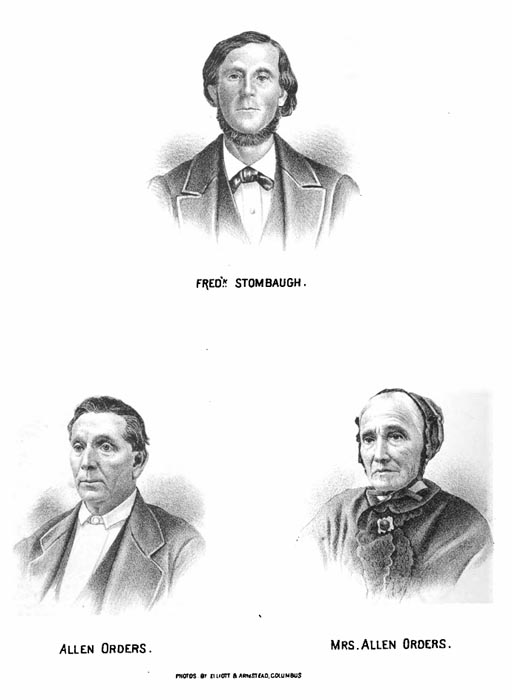
FRED'K
STOMBAUGH,
ALLEN ORDERS
MRS. ALLEN ORDERS.
BIOGRAPHICAL SKETCHES:
THE LISLE FAMILY
THE STOMBAUGH FAMILY
(w/ portrait)
<
CLICK HERE to
RETURN to TABLE of CONTENTS > |