|
Clinton - township number one, range number
eighteen, United States military lands -
consists of just one of the original surveyed
townships, of five miles square. It was
subdivided into four quarters, or sections, the
original owners of which were the following
named gentlemen: Jonathan Dayton,
the first and third sections; John Rathbone,
the second section; and George Stephenson,
the fourth section. The date of their
entries, was Mar. 12, 1800.
The township is level, east of the river almost
perfectly so. Its principal stream is the
Olentangy river - formerly called Whetstone
creek - which flows south through the western
portion of the township, uniting its waters with
those of the Scioto river, at Columbus.
INDIANS,
of the
Wyandot, and other tribes, remained in the
township, and region, for a number of
years after the white settlers took possession
of the soil. Intercourse between them and
the whites was of a friendly nature, and only
during the year of 1812, after the surrender of
General Hull, by which the whole
northwest was exposed to the ravages of the
enemy, were there any anticipations of
difficulty by the inhabitants. One
evening, shortly after that unfortunate event,
the settlers on the river were greatly alarmed
by a report that the Indians were over-running
the northern part of the State, and massacreing
the inhabitants, and settlers in Clinton fled in
terror to Franklinton, and a few went to
Zanesville, for protection. Andrew
Wilson says the report reached his father's
house after nightfall, and that he, though but
six years of age, distinctly remembers the
excitement that ensued. After a night of
dismal forebodings, in Franklinton, the refugees
returned to their homes, and soon afterwards
learned of the falsity of the alarm.
On the west bank of the Olentangy, on the farm of
James H. Hess, was a burying-ground of a
former race - probably Indians - which was
opened in the summer of 1879, and from twelve to
fifteen skeletons exhumed. They were in
two parallel trenches, which were about twelve
feet apart, and some three and a half feet deep.
A large number of arrows, tomahawks and other
rude implements of war, had previously been
found, indicating that a battle had once been
fought there.
WILD GAME.
The country, in its native state, and for many
eyars after its first settlement, abounded in
game of all kinds - deer, wild turkeys, and some
smaller game being particularly numerous.
There were not a great many bears in the
township, or vicinity, but they would frequently
pass through it, and a number have been killed
within its bounds. Deer were more plenty
than cattle are now, and venison was a common
article of food. It was not an unusual
circumstance for a settler to bring down a fine
buck with his rifle, from his cabin door.
One of the most successful hunters among the
pioneers was David Beers, jr., who had a
cabin on what is now "Squire Peggs' farm,
which he made his headquarters while he pursued
his favorite sport. He began to hunt when
a boy of fourteen, and did nothing else for
seven years. He used to say that he had
hunted in every county in the State,
Pg. 402 -
and that the first eighty acres of land that he
bought he paid for with the products of his gun.
In one day, in this township, he killed one bear
and five deer. The last deer killed in
this township were, probably, those shot by
W. S. Shrum and John Fleniken, about
the year 1840. They shot them (four in
number) on the Morse farm, in the east
part of the township. Wolves were plenty,
and were, perhaps, more dreaded than any other
of the beasts of the forest. They would
come up to the cabin doors of the settlers,
often protected only by a blanket, or quilt, and
rendered night anything but pleasant with their
piercing howls. Sheep were not safe from
them, unless shut up in pens, and the pioneers
suffered considerable loss from their ravages.
Wild turkeys were caught by means of a rail pen,
which was built over the end of a ditch dug in
the ground, and covered over. The birds
were decoyed into the inclosure with corn,
scattered in the ditch. When once within
the pen, they were safely imprisoned, for they
would never go down into the ditch to get out,
invariably seeking a means of egress above.
And squirrels were exceedingly plentiful.
They were so numerous, and destructive to the
cross of the settlers, as to be regarded only as
pests, and various means were resorted to to rid
the country of them. Large hunting parties
were organized, and thousands were destroyed in
that way. Mr. Shrum states that in
a few moments one morning, before breakfast, he,
and a brother, killed thirty-two of them,
without the use of a gun.
SETTLEMENT.
The first settlement of the territory now
constituting the township of Clinton, was
commenced as early as 1800, along the Olentangy,
on the west side. Among the first families
that arrived, were those of BALSER HESS,
John Lisle, and a family by the name of
Henderson. Balser Hess came
from Bedford county, Pennsylvania, with a
family, consisting of his wife and eight
children. He stopped in Ross county (as
now constituted) a couople of years, and then
came to this township, and located where his
grandson, James H. Hess, now lives,
subsequently taking up three hundred and twenty
acres of land there. It is thought that
this family made the first improvement in the
township, for they cut their way into the woods
of Clinton, the son, Daniel, going ahead
of the team, and with his axe preparing the way
for the slowly moving train. The first
house erected by the pioneer, Hess, was a
double log structure, which, although not a
tavern, was a common stopping place with
travelers. Mr. Hess' occupation in
Pennsylvania, was that of a shoemaker and tanner
of leather, and he followed the same trade after
his settlement here, tanning the first leather
and making the first shoes in the township.
People came from Chillicothe to get their boots
and shoes made by Mr. Hess, and his pay
very seldom consisted of legal tender. One
of the first pioneers in the township, Mr.
Hess was also one of the first of their
number who died, his death occurring in
December, 1806. He was the first adult
person buried in Union cemetery. His
wife's experience of pioneer life was in strange
contrast to his, surviving him nearly half a
century. She died in 1855, at an advanced
age, having raised nine children, all now dead
but one. The youngest, at the time of his
death, was fifty-seven years of age. The
names of the chilren, were: Daniel, Mary,
Eve, Polly, Balser, Catharine, Betsey, Susan,
Sarah, and Moses; Susan - now Mrs.
Israel Carpenter, and living in Illinois -
is the only survivor. Daniel and
Moses lived and died in this township, the
former a short distance west of his father, and
the latter on the homestead. Daniel
Hess was one of the first justices of the
peace in the township, being elected soon after
its organization, in 1812.
JOHN LISLE, a native of
Ireland, emigrated to Ohio, from Kentucky, in
1798, and first located in Franklinton, his
family being among the first inhabitants of that
old town. In 1799, or 1800, he moved into
Clinton, and settled where J. O. Lisle
now lives, and subsequently died there, his
wife, Rachel, surviving him. Their
children, all of whom are now deceasedd, were:
Robert, Margaret, Elizabeth, James, Rebecca,
Jane, John and Rachel. Robert
married Abigail McIntyre, of Fairfield
county, and resided in Clinton until 1817, when
he removed to Hamilton township, and settled
where his son, Harvey, now resides;
Margaret became the wife of James
McElvain, an early resident of this county,
but later of Indiana. Elizabeth
married Luther Powers and moved to the
same State; James, who lived in Hamilton
township, married Mary Golliford;
Rebecca was the wife of Joseph Young,
of Fairfield county, and Jane, of
Samuel Maynard, who lived in Clinton, for
several years, when he moved to Sandusky county;
John married Thankful Maynard, and
removed, soon afterwards, to Indiana; Rachel
was the wife of William Sackett, and
first settled in Fairfield, and afterward Putnam
county.
The HENDERSON
FAMILY located on land now owned by
Thomas Hess. There were three sons in
the family - Alexander, Samuel, and
Adam - all now supposed to be dead.
HUGH and
ELIJAH FULTON, brothers, were among the
first settlers of the township. Hugh
lived where the family of Henry Slyh now
does, west of the river. He had four sons,
who finally sold to Jacob Slyh, and moved
to Michigan. Elijah Fulton settled
just north of the Hesses, and died there
at an early date.
SAMUEL McELVAIN
and family located, soon after 1800, on the farm
just north of where W. S. Shrum now
lives. They subsequently moved to
Columbus.
JOHN HUNTER, the
first settler on the east side of the river, in
this township, occupied the south part of the
land now constituting the college grounds.
Above him, in successive order, were two
families by the name of Vance, and Herdoff,
Droddy, Smart, Simmons, and others hereafter
mentioned.
THE
CENTENARIAN.
DAVID BEERS,
SR., one of the oldest, and most active,
pioneerws of Clinton, was a resident of the
township from 1804 until 1850, when he died at
the great age, it is said (his exact age not
being known), of one hunderd and four years.
He was a natie of New Jersey, and when seven
Pg. 403 -
years of age, with a little two-year-old sister,
was stolen by the Indians. The two
children, and their widowed mother, were going
on a journey on horse-back when all three were
captured by the savages. The
children were separated from the mother (whom
they never saw again, and was undoubtedly
killed), and taken over into Canada.
David was kept in captivity for seven years,
when, by some exchange of prisoners between the
whites and Indians, he was released. His
sister, however, was taken to the region of
upper Sandusksy, and remained there among the
Indians during her life. she became the
wife, successively, of three Indian chiefs, her
last husband being the well-known Wyandot,
Between-the-Logs. Some years after his
settlement in Clinton, Mr. Beers heard of
a white woman living with the Indians at Upper
Sandusky, and he made a visit to the tribe,
where he found his long lost sister, contented
and happy in her savage life. David
Beers removed, with his family, from
Pennsylvania to Ohio in 1802. He remained
in Fairfield county two years, when he moved to
this township and located just north of the
college grounds. In 1809 he settled where
North Columbus now is. The old hewed log
house, in which he lived, is still standing.
He died there, May 16th, of the same eyar above
stated. He was the father of nine
children, they are: Conrad, David,
Elizabeth (who became the wife of Ransom
Coe), Moses, Peter, Catharine, Solomon, Rachel,
and George W. Five are yet living;
they are: Moses and Catharine, (wife
of D. P. Wilcox), who live in Missouri;
Peter, who lives in Iowa; Rachel (Mrs.
Wheaton), and George W., who live in
Clinton. Conrad died in North
Columbus. His son, Moses, and a
daughter, Mrs. Spencer, reside in this
township. Three other sons live in the
west, and a daughter in Lorain county.
David Beers, jr., some of whose hunting
exploits are briefly mentioned elsewhere,
settled in Clinton, where he remained until
1831, when he moved to Mifflin, and settled on
Alum creek, and resided there until his death.
He was justice of the peace of that township for
thirty years, when he was succeeded by his son,
David, who still retains the office,
having served twenty-one years. He was
twice married, and was the father of ten
children, three of whom are deceased; of the
remainder, Washington, David, Daniel, and
Gertrude reside in Mifflin township,
Ellen in Clinton, Mrs. Elizabeth Holden
in Champaign county, and Mrs. Eliza Spangler
in Columbus.
JOHN WILSON, in 1797, married Rachel
Cresswell, in Mifflin county, Pennsylvania,
and immediately after started, with his bride,
for the far west. They traveled on
pack-horses, as far as Pittsburgh or Wheeling,
carrying with them a few articles of household
necessity, and then put their horses on a
flat-boat, on which they, also, came down the
ohio river to the mouth of the Scioto, thence up
to Chillicothe, on their horses. They
lived on the Kinnickinnick, in Rose county, till
1804, when they came to what is now Clinton
township, and settled upon fifty acres, now
occupied by their son, Andrew Wilson.
The father died here, Oct. 2, 1879, at the age
of over eighty-one years; his wife survived him
about three years, and was about the same age at
the time of her death. They had a family
of three sons and two daughters. One of
the daughters is now living in Fremont, Ohio,
and the other in Iowa. Andrew Wilson,
the only surviving son, was born in Clinton,
Feb. 16, 1806, and is the oldest man in the
township, who was born in it; his wife was
Chloe, daughter of Jason Bull.
DENMAN COE, of Connecticut,
emigrated to Wayne county, Pennsylvania, where
he remained a year or two, and then, in 1807,
came to Ohio. After remaining a short time
in Worthington, he located in Clinton, on the
Harbor road, on the Henry Innis farm.
He lived there some five or six years, and then
returned to Pennsylvania, where he subsequently
died. Dudley and Ransom, his sons,
received the homestead, on which Dudley
resided until his death. He was married,
at the age of fifty, to Sarah Hoskins, of
Holmes county, by whom he had four sons and two
daughters, all now living. Ransom Coe,
in 1815, purchased, of Caleb Rice, a
hundred acres of land, now owned by his son,
A. F. Coe, which he cleared up, and on which
he lived until his death, in October, 1855.
At the time of his death, he owned over five
hundred acres of land. His wife was
Elizabeth, daughter of David Beers, sr.
She survived her husband some thirteen years.
They had a family of six children, two of whom
are deceased - Henry, who died,
unmarried, in Clinton, and Mrs. Salinda
Stewart, the eldest daughter, who died in
Burlington, Iowa. Three of the surviving
children reside in this township - Mrs.
Lovilla Ackerman, Alvin, and A. F. Coe;
Mrs. Rachel Stone lives in Delaware
county.
HARVEY COE, a
younger brother of Ransom, settled in
Mifflin township, where his widow and son,
James H. Coe, now live.
In 1809, or 1810,
JOSEPH SHRUM
bought, and settled upon, eighty-eight acres in
this township, where W. S. Shrum, his
son, now lives. He was a native of
Germany, and in 1800, when eighteen or nineteen
eyars of age, he emigrated to this
country. For a year or two, he lived in
Little York, Pennsylvania, and then came to
Franklin county, and located in Hamilton
township, where he had a distillery, for a
couple of years, on the Shoaf farm, on
the Chillicothe road. Afterwards, he
bought one hundred and sixty acres in the same
township, now the Klickinger farm, which
he lost on account of imperfect title, when he
came into this township and settled, as already
stated. Soon after his settlement, he
built a distillery on the west bank of the
Olentangy, just south of his residence.
The still was burned down in 1824, or 1825, but
he rebuilt it the same year, but on the east
side of the river, and carried on distilling
until 1837, when he retired from active
business. Jan. 1, 1809, he was married to
Elizabeth McGranahan, by whom he had
seven children. She died in 1823, and he
was married twice afterwards, but had no
children by these subsequent marriages.
Mr. Shrum was killed, in September, 1859, by
a train of cars on the Piqua road, while driving
over the long crossing, west of Jones
mill, living forty-eight hours after the
accident. At the time of his death, he was
over eighty-eight years of age. Although
owning and operating a distillery, he was a
strictly temperate
Pg. 404 -
man in his habits. For thirty years he was
a member of the Franklinton dragoons. A
son and two daughters are now living:
W. S. Shrum, born in this township, in 1814,
and now residing on the homestead; Mrs.
Elizabeth Reams, in Michigan, and Mrs.
Lucy Gillen, in the State of Illinois.
At an early date,
quite a number of New England people came into
the township, and settled mostly along the
Columbus and Worthington road, which originally
run a somewhat different course from what it now
does. One of the first was ABRAHAM
INGHAM, who came from Barkhampstead,
Connecticut with his family, then [1808]
consisting of his wife and three children.
The year before, he had made a trip to this
western wilderness, to take a look at the
country, walking the whole distance both ways,
and averaging over fifty miles a day the round
trip, and some days traveled sixty-five miles.
The family settled on the David Bristol
property, a mile and a half south of
Worthington, where they lived until 1812, at
which time Mr. Ingham purchased of
Daniel Case the farm now occupied by his
son, George W. Ingham. At the time
he erected his cabin here, on this now thickly
settled road, the nearest direction.
Mr. Ingham, after a useful life, died in
this township, in 1840, his wife surviving him
thirty years. They raised a family of six
children, four of whom are yet living, viz.:
Mrs. Arnold, in Delaware county, aged over
eighty; A. C. Ingham, in the town of
Delaware, aged seventy-nine; George W.
who lives in this township, on the old
homestead, and a daughter - Mrs. Wilcox -
in Iowa City, Iowa. George W. was
born in this township in 1816.
At the same time, Jordan Ingham, an older
brother of Abraham moved out with his
family, and settled on the farm adjoining his
brother on the south. He died about the
year 1843, and his wife previously. The
only member of the family now living resides in
Iowa.
DANIEL CASE came
from Hartford county, Connecticut, in 1811, and
settled on the farm, a part of which is now
owned by his son, William Case. His
dwelling stood on the bank of the river, near
where the mill now does. Mr. Case
died in 1817. Of his five children, two
only are now living - William, was above
mentioned, and Rodney, in Kentucky.
Prominent among the pioneers of this township
were THOMAS BULL and family, who arrived
in Worthington, in the fall of 1812, removing
from the State of New York. They remained
the first winter in Worthington, and in the
spring came to this township, Mr. Bull
having purchased in the Rathbone section, lots
eight, nine and ten, comprising something over
six hundred acres. He settled upon lot
eight. Thomas Bull was a native of
Vermont, born November, 1762, and died in
Clinton, October, 1823. His wife Sylvia
(Benedict), was a native of Connecticut,
born in 1766, and died here at the age of about
eighty years. They raised a family of four
sons and two daughters - Chloe, Jason,
Nathan T., Alonson, Hiram and Edith.
They all came to Ohio with their parents, except
Chloe, who came subsequently with her
husband, Isaac Brevoort, who was drowned
a short time afterward which crossing the
Olentangy river. Jason Bull lived
on the farm just north of his son-in-law,
Andrew Wilson, and died there, February,
1861. He was a local Methodist preacher.
Alonson died in Columbus; Hiram,
on the Mississippi, below New Orleans, where he
had settled; Edith became the wife of a
Dr. Beach, and resided in Marion county,
Ohio.
DR. NATHAN T. BULL,
the only survivor of the family, and now
residing in this township, was born in Clinton
county, New York, Sept. 29, 1795; married,
January, 1820, Fidelia, daughter of
Eber and Rebecca Wilson, who removed from
Washington county, New York, to this township,
with his family, in 1818. Mr. Wilson
resided on the farm now occupied by Mr.
Fuller, for two years, when he removed to
Lower Sandusky (now Fremont), and shortly
afterward to the Maumee river, where he settled
near Perrysburg. Mrs. Bull was born
Aug. 23, 1798. With the exception of her
hearing, which has become of late years
considerably impaired, Mrs. Bull still
retains her faculties in an excellent state of
preservation. Dr. and Mrs. Bull
have lived together as man and wife, for the
unusual period of three score years, and have,
now living, seven children, twenty-two
grandchildren, and sixteen great-grandchildren.
JOHN SMITH came
from Francestown, New Hampshire, in 1812.
He worked for Squire Samuel Wilson above
Worthington, about a year when he married his
employer's eldest daughter, Olive.
In 1814 he purchased of Thomas Bull, lot
number nine, in Clinton township, now owned and
occupied by Mrs. Catharine Smith.
Mr. Smith was a zealous christian man,
and was actively engaged, during most of his
life, in religious and reformatory work.
He was in Minnesota, as sort of missionary among
the Ojibway Indians, for several years. He
was the first president of the first temperance
society, and of the first anti-slavery society
in Franklin county. He organized the first
Sunday-school in this township, and was its
superintendent for about thirty years. He
died April, 1865, his wife surviving him a few
months. They raised a family of six
children: Rev. Samuel D. Smith, now
pastor of the Presbyterian church in
Reynoldsburg, this county; Elizabeth C.,
now widow of Willialm F. Breck, and
residing in Parker City, Pennsylvania; John
A., Jeremiah B. and Joseph, all
deceased, and Mary M., who married
William L. Starr, and lives in Nebraska.
Joseph Smith, above mentioned, was the
husband of Catharine Piatt who is still
living in Clinton, on the old homestead.
Mrs. smith is a sister of John J.
Piatt, the poet.
ROSWELL WILCOX
and family came to this county from Simsbury,
Connecticut, in 1805. The journey which
was made by wagon, consumed three weeks, and
from Granville to Worthington they traveled by
blazed trees - the country was then almost a
complete wilderness. They located, for a
short time, in Franklinton, when they moved
about two miles above Worthington, in the Wilson
neighborhood, where they lived some eight years.
In 1814 Wilcox moved with his family to
this township, and settled where Joseph
Guitner now lives, having erected a
saw-mill, where the Hess mill now stands,
in
Pg. 405 -
1810. He resided there
until his death. His wife survived him,
and died in Delaware county. They had a
family of eight children, of whom D. P.
Wilcox now living in Missouri, is the only
survivor. A daughter, Emily, was
the wife of Apollos Maynard.
PHIOLOGUS
WEBSTER and family, and his sons, Peter,
John, and Harvey, and their families,
moved into the township during the war of 1812.
They came from Connecticut - John, and
family, from Hartford, and the rest from
Simsbury. they came by wagon, and were
three months making the journey. the
father settled where the aged widow of Elihu
now lives, and died there a few years afterward.
Peter also settled on a portion of the old
homestead. John located in
Columbus, where he lived some ten years, when he
settled in Clinton, on the farm now owned by
Mr. Little, but lived on the east side of
the road; his son, Amason Webster, born
in Columbus, in 1814, is sstill a resident of
this township. Harvey died in this
townships, though hem ade no actual settlement;
he was the father of Lewis H. Webster,
a member of the bar of Columbus. Elihu
married Mary Anderson, who still survives
him, at the age of over eighty years.
Rhoda, who became the wife of Farin
Olmstead, and lived in Blendon township,
subsequently removed to Madison county, and,
finally, to Iowa, where she died. Levi
died in Clinton, at the age of eighteen.
ROSWELL COOK
and family moved in from Connecticut in the
winter of 1815, and at the same time came his
sons, Rodney and Chauncey, with
their wives. The father bought and settled
upon the farm now occupied by Rodney's
son, Clement Cook. After his death,
which took place in Delaware county, the elder
son had the home place, and Chauncey
lived on a portion of the farm south of his
brother.
EDWARD STANLEY,
SR., from Connecticut, arrived about the
same time as the Cooks, and located where
Erskine A. Fuller now lives; he died
there, and his son, Edward afterward
occupied the place.
EZEKIEL TULLER,
also from Connecticut, came to Ohio in 1814, and
after living a few years in Sharon township,
settled in Clinton, where James Wetmore
now resides. None of the family are now
left.
JOHN BUCK came out
with the Cook family. He was then
single, but afterward married Diadamia Cowles,
and settled on the place now occupied by his
son, William. the father and mother
both resided here until their death.
SADOSA BACON,
from Connecticut, purchased in 1813, the farm
now occupied by his son, John. In
1817 he married Anna Case, and lived upon
his farm until his death in 1822. He was a
traveling Methodist preacher.
PHILIP ZINN
settled in Columbus in 1813; afterwards bought
and located on the north part of what is now the
college grounds. He was an early
mail-carrier from Columbus to Chillicothe, and
from Columbus to Delaware. He is also much
engaged in transporting goods by wagon from the
east to Columbus. He died in Pennsylvania
while on such a trip. His children,
Adam Zinn and Mrs. John Garner, live
in this township, and Peter, a lawyer,
below Cincinnati.
In 1819
ALEXANDER SHATTUCK, born in Groton,
Massachusetts, Sept. 9, 1797, came to this
county with his brother, Simon, and wife,
Sarah Simpson who settled in Perry township.
He was a carpenter, and worked at his trade for
some time after his arrival. His first
purchase of land was ninety acres, still
occupied by his widow. It was then
uncleared except a few acres, and contained a
log cabin. He was married in Worthington,
Feb. 17, 1830, to Flora Andrews, who came
with her parents to Ohio from Connecticut, when
six years of age. She was born July 24,
1808. To them have been born two sons and
ten daughters, all now living but one son.
William Shattuck who lives on the farm
next south of his mother's, is one of the
leading farmers in the township.
Alexander Shattuck died Oct. 23, 1870.
HENRY INNIS, of
Westmoreland county, Pennsylvania, married, in
Harrison county, Ohio, Isabella Clifford Pegg,
and in 1817, came to Franklin county. He
located in Franklinton, where he kept a tavern
some four yers, when he moved to Clinton, and
settled on the farm now occupied by Abraham
Carl. He erected the brick house now
occupied by the family of A. R. Innis,
his youngest son, in 1840. He resided
there until his death, Apr. 13, 1865, aged
seventy-three. His widow, born July 30,
1793, is still living. They raised a
family of nine children, four of whom survive -
Colonel Gustavus S. Innis, manager of the
State Reform farm, at Lancaster; William H.,
one of the substantial farmers of Clinton;
Mrs. James Durrett, in Scioto township,
Pickaway county; and Adam R., also in
Clinton. Elizabeth was the wife of
Frederick Roder, formerly of Clinton, now
of Delaware county; Mary married Mr.
Jimeson, of Blendon township; Minerva
was the wife of Joseph Mock, of Clinton,
and died June, 1879; Isabella C., was the
wife of Silas Wilcox; and Elias P.,
died at the age of twenty-one.
The MAYNARDS - two
families - the most of whom settled in Sharon
township, came, with some others, from
Massachusetts, to this county, in the year 1806.
In Connecticut, the emigrants were arrested for
traveling on the Sabbath, in violation of the
old blue laws of that State. Two men of
the party went back with the officer to the
magistrate, who had caused their arrest, and
succeeded in getting off in some way without
suffering the penalty to which they had made
themselves liable. Moses Maynard
settled in Worthington, and, Stephen, his
brother, west of the river, in the same
township. Apollos Maynard, son of
Moses, born Sept. 12, 1796, married, in
1820, Emily Wilcox, daughter of
Roswell Wilcox and Dorcas Pinney, and
subsequently, in 1832, purchased, for one
thousand dollars, seventy-seven acres in
Clinton, where North Columbus now stands.
On the place west of High street, was in cabin
built by Jacob Loy, and this Mr.
Maynard moved to the east side of the
street, and occupied. He subsequently
erected the brick house occupying the same site,
or nearly so. He died, Mar. 24, 1868.
Mrs. Maynard died Dec. 20, 1857.
Two children were born to them - George
Clinton, who died Aug. 2, 1860; and Laura
Maynard, now living in North Columbus.
Pg. 406 -
SAMUEL G.
FLENNIKEN emigrated from Pennsylvania in
1798, settling at first on the Lancaster road,
below Columbus. He was born in North
Carolina, and raised in Pennsylvania. He
married Elizabeth Morehead, in
Chillicothe, in 1798. About 1820 he moved,
with his family, to Clinton township, when he
bought the land on which the county infirmary
was to be located. his purchase was made
from the McIlvaine heirs. He was
elected associate judge in 1817, and served
until his death, in 1845, a period of
twenty-eight years. He raised nine
children, seven sons and two daughters.
His son, Samuel W. Flenniken, lives in
Brown township, on Little Darby creek.
Eliza S. married Joseph R. Anderson,
and lives near Columbus, on the Dublin pike.
Dorcas J. married Daniel Lakin, and
settled in the southwest corner of Clinton
township. Two of her sons live in Perry
township, George W., on the bank of the
Scioto river, and Samuel W., near the
Clinton township line. Sarah Flenniken
remained single and lives with her sister,
Mrs. Anderson, near Columbus. The
remainder of the children of Judge Flenniken
went to the west where they died.
CASPER KINER
came to this county from Pennsylvania in 1824.
He lived a couple of years south of Columbus,
and then located where the college grounds are,
in Clinton township, where he remained for a
year. He then moved to Coshocton county,
where he resided seven yers, when he moved back
to Clinton. He settled on the farm, a
portion of which is now occupied by his son,
Jacob, and lived there the balance of his
life. He raised a family of ten children,
of whom three sons and a daughter are now
living, viz: Jacob, Henry, and John,
in this township, and Mrs. Nathaniel Smith,
near Georgesville.
WALTER FIELDS
moved into this township in 1824, from Athens
county, Ohio, where he had lived six years.
He located on one hundred acres of land, now
owned by L. L. Pegg, just east of his
son, Albert Fields' farm. In 1867
he moved to the farm now occupied by his son,
where he died ten years afterwards. His
father, John Fields, and his family, came
from Athens county in 1828, and settled upon the
same lot. He died in 1864, at the age of
one month and a few days over one hundred years.
JACOB SLYH came
from Jefferson county, Virginia, in October,
1828, his wife and father coming out with him.
They remained in Columbus through the winter,
and then came to Clinton and settled a mile
south of where he now lives. At this
writing he is aged eighty-one, and his wife
seventy-eight. They have five surviving
children, all of whom are married. William
occupies the homestead.
FREDERICK WEBER
emigrated to the United States, from Germany, in
the spring of 1830, and lived one year in York
county, Pennsylvania, and three years in Stark
county, Ohio, when, in 1834, he moved to this
township, and settled where he now lives.
This place, which he purchased of Thomas
Johnson, consisted of sixty-eight acres, on
which there was a log cabin, and only five acres
cleared. This part of the township was
then very new, wet, and heavily timbered.
Mr. Weber has now three hundred and ten
acres. In Stark county he married his
first wife, who died in 1851, and who was the
mother of his ten children, seven of whom are
now living. In 1862 he married his present
wife, Mrs. Amelia Schwartz, of Columbus.
WINDSOR
ATCHESON, who resides in the southeast part
of the township, at the age of seventy-seven,
has been a resident of Franklin county since
1828. In 1813, he came from Center county,
Pennsylvania, to Ohio, with his parents, who
settled in Stark county. In 1828, he came
to Lockbourne, and worked on the canal two or
three years, when he went to Columbus. In
1842, he located in Montgomery (now Marion)
township, west of where the round house now is,
and in 1846, moved into Clinton. For many
years he has been engaged in the manufacture of
brick. July 29, 1852, he was married to
Maria Kiser, and has a family of five
children.
ROBERT INNIS, a
brother of Henry, before mentioned, moved
into the township, from Harrison county, Ohio,
in 1834, and settled on the farm now occupied by
his widow, Mary Innis now aged nearly
seventy-one. Mr. Innis died Aug.
19, 1879, aged nearly seventy-five. There
are eight children of Robert Innis, all
married and settled for life.
JOSEPH PEGG, who
settled in Clinton in 1833, came from
Philadelphia, with his father, Elias Pegg,
who was among the early settlers in the old town
of Franklinton. Elias Pegg, his
son, now lives there, and his daughter, Mrs.
Henry Innis now in her eighty-seventh year,
resides in this township, and Mrs. Samuel
Fisher, another daughter, at Hilliard.
Joseph Pegg was married in Franklinton,
to Matilda Crawford, and, the year above
stated, purchased of Henry Innis, a farm
of sixty-eight acres, on which he resided until
his death, in 1854. His wife died a few
years since. They had eleven chidren, all
of whom are living, with the exception of a
daughter, who was killed in childhood, by
a tree, cut down by the hired man, falling upon
her. Elias W. Pegg, son of
Joseph Pegg, is justice of the peace of
Clinton, a position he has filled with credit
many years.
J. P. LITTLE and
wife came to Ohio from Washington county,
Pennsylvania, in 1833. They lived in
Licking county about three years, when they
moved to this township, and purchased of John
Webster, sr., the farm they still occupy.
Mr. Little was born Feb. 13, 1802, in
Greene county, Pennsylvania. His wife
(Anna Beck) whom he married in 1830, was a
native of Washington county, same State, an is
now aged sixty-six. they have raised six
children, and all of them are now living.
PIONEER
SCHOOLS.
The first school in Clinton, according to
Andrew Wilson and others, was kept by
Miss Griswold, in an old log cabin on the
Lisle farm, in the summer of 1809 or 1810.
The house had only part of a puncheon floor, and
greased paper for windows. The children
who lived east of the river, of whom John
Wilson sent four, had to wade the stream to
get to the school.
In 1812 Michael M. Baker, an Irishman, opened a
school in a log house on the Maynard farm,
north of the
Pg. 407 -
college grounds, then owned by Joseph Smart.
Jonas B. Ward and Roswell Fisk were
early teachers in the same house.
A school was kept by Miss Becky Gordon in a
vacant log dwelling on the Hess farm, as
early as 1817.
The first school in the Cook neighborhood was taught
by Diadamia Cowles, afterwards wife of
John Buck, in the summer of 1816. The
school was kept in a log structure, previously
used as a stable by Roswell Cook.
The first school-house was built in 1815, on
Webster's run, on the top of the hill, northeast
of the late Edward Stanley's residence.
The first pedagogue was Timotny Sedgwick,
of Connecticut, who taught a winter school.
The first summer school was kept by Miss
Rachel Cook, whose tuition was partly paid
in grain.
In the fall of 1819, or following winter, a small log
school-house was erected nearly opposite where
the present Methodist Episcopal church now
stands, in which James Ferson kept the
first school. He was a man of excellent
character and qualifications, as a teacher, and
taught a large and successful school.
A hewed log house was built a few years afterward, just
north of the old school-house which has also
long since disappeared. The now venerable
Dr. Bull was one of the earliest teachers
in this house, teaching two winters.
The township is, at present, divided into eight school
districts outside of the city limits, and each
district contains a good brick school-house.
CHURCHES.
CLINTON
CHAPEL.
Meetings by the Methodist in Clinton were
commenced, in 1819, at the log house of Eber
Wilson, on the farm now owned by Mr.
Fuller. The first circuit preachers
were John Tivis and Leroy Swomstedt,
who preached, alternately, once in two weeks.
A class was formed, with the following members:
Thomas Bull and wife, Nathan T. Bull,
Alonson Bull, Edith Bull, Fidelia Wilson,
Abel Tinckum and wife, Louis Gay and
wife, Eber Wilson and wife,
Jason Bull and wife, and widow Delano.
Meetings were held at Eber Wilson's house
about two years, and, after that, at the
dwelling of Thomas Bull, until his death,
some eighteen months. Subsequent to
this, and until the erection of the church, they
were held at the old school-house, which stood
just west of where the church now stands.
The church was built about the year 1838, and
was the first meeting-house in the township.
The ground for the church and graveyard was set
apart, for the purpose, in the will of Thomas
Bull, one of the society's most zealous
members. The church has been fairly
prosperous, and meetings have continued, without
interruption, up to the present time.
Andrew Wilson and Amoson Webster are
the present class-leaders. A
Sabbath-school has been in existence, in
connection with this church, for over forty-five
years, and is now flourishing. It contains
a good library. Amoson Webster is
the superintendent.
THE
M'KENDREE METHODIST EPISCOPAL CHURCH,
in the eastern
part of the township, was organized at the
dwelling of John Baker, in 1852.
Rev. Urich Heath, who was then on the
circuit, officiated in its organization.
The constituent members were twelve in number,
as follows: Henry Innis and wife,
Robert Innis and wife, David Canfield
and wife, Mrs. John Baker, and Mrs.
Cornelius Sharp. The church, a
small frame house, was erected the same eyar the
society was organized.
THE BAPTIST
CHURCH.
west of the
river, called the Clinton Predestinarian Baptist
church, was organized at the Union church, by
Elder Samuel Carpenter, of Lancaster, and
Elder Hiram Hendren, of Canal Winchester, in
August, 1860. the members composing the
organization, were: Rev. Daniel Hess
and wife, Josiah Kinnear and wife,
Sarah Hess, Aaron Hard, Jemima Hard,
Melissa Hard, Ansel Hard, Myron Hard, and
Robert Walcott. Aaron Hard was elected
the first deacon. The first meetings of
the society were held irregularly at the Union
church, and subsequently, in the Walcott
school-house, in Perry township. The
church, a neat brick structure, was built in
1870. The first pastor was Rev. Hiram
Hendren, who preached one year, when he was
succeeded by Rev. Daniel Hess, who
continued as pastor until October, 1877, when he
resigned. Since then Rev. George
Tussing, of Columbus, has officiated as
pastor. William Winegardner is the
present church clerk.
THE UNION
CHURCH.
near the west
line of the township, was erected by the
Episcopalians of Clinton, and a German Reformed
society, in Perry township, in the fall of 1852.
The lot, of one-half acre, was donated by
Jacob Slyh.
The German Reformed
society was organized by Rev. Jacob Weaver,
at the Kenny log school-house, on the
twenty-second of June, 1851. The original
members of the society were: Jacob
Eagle and wife (Mary Ann), John
Kenny and wife (Nancy), Rodolfus Phinegar
and wife (Elizabeth), Mathias g. Slough
and wife (Lydia), Frederick Wiser,
and Mary Whip. The first officers
chosen by the church were: Jacob Fogle,
and Rodolfus Phinegar, elders; John
Kenny, and Mathias G. Slough,
deacons. The successive pastors of the
Reformed church have been as follows: Jacob
Weaver, George W. Willard, Henry Willard,
and Joseph Heffley. Subsequent to
Henry Willard, the Rev. John Voght
preached for some time as a supply. The
society, at the present time, numbers about
twenty-six members. The elders are
Jacob Fogle and James Kenny, and
R. Phinegar, deacon.
The Protestant Episcopal society, with which the German
Reformed united in the erection of the church
previously mentioned, was organized at the time
the church was built, in 1852. The
membership consisted of Jacob Slyh and
wife (Emeline), Daniel Lakin,
Washington Lakin and wife (Rebecca),
and Elizabeth Lisle.
Jacob Slyh was elected senior Warden,
and Daniel Lakin, junior warden.
There are now about twenty-one members.
Rev. Messrs. Roberts,
Richards, Ross, Ruth, Nash,
Jones, and Young (the present
minister), have been the successive pastors of
the church.
The Winebrenarians ("Church of God") hand an or-
Pg. 408 -
ganization in this township for a number of
years, and in 1852 erected a brick church in
Clintonville, which is now used for a dwelling.
FIRST
SUNDAY-SCHOOL.
The first Sabbath-school in the township was
organized by John Smith, at his house, in
1832. He had charge of the school for a
number of years, keeping it for three or four
years in his own house, and afterwards in a log
school-house west of the site of the Methodist
Episcopal church.
MILLS AND
OTHER INTERESTS.
In the first settlement of the county the
pioneers were compelled to make extended
journeys to get their grain ground into flour.
to go thirty or forty miles to mill - to
Chillicothe, as the first settlers did - and
through unbroken forests, was no small
undertaking. The grist was ground in the
order of its reception at the mill, and the few
mills then in existence were so overcrowded with
business that several days would be required
some times to get the grist through the mill.
A man who has had some experience says "one in
going to mill could eat his grist while waiting
for it." Frequently, the mortar and pestle
was brought into use. A cavity burnt into
the top of a stump, or block, a spring-pole, or
sapling, with a pestle attached by means of bark
- these were the sum total of the parts and
mechanism of the mortar and pestle-mill.
With this the people pounded their corn.
Frequently, they had "jointed" corn - corn cut
from the cob with a joiner's plane. The
first grist-mills of any considerable advantage
to the county were those of Colonel Kilbourne
and Samuel Dyer, the former near
Worthington and the latter on Darby creek, where
Georgesville now stands. These were
erected about the year 1805. The first
grist-mill in the township was erected by
David Beers, sr., in 1810. The
mill is now owned by the Messrs. Hess.
Mr. Beers sold the mill, in 1816, to his
son-in-law, D. P. Wilcox, who operated it
until 1839, or 1840, when he sold it to James
Mateer. Mr. Mateer subsequently sold
it to John B. Piatt, who was succeeded by
the Messrs. Hess.
The grist-mill,
farther up the river, now owned by Jacob
Weisenhammer, was originally built on the
Olentangy, in Sharon township, by Stephen
Maynard, about the year 1813, and was
afterwards moved to its present location.
It is the same mill, just as the boy's
jack-knife was the same, which had had three new
handles and two new blades. George Whip
owned this mill for some thirty years, and it is
known as Whip's mill. Roswell
Wilcox in 1810, erected the first saw-mill
in the township, just below the Beers
grist-mill. The two mills were run by the
same flume, which caused some trouble and
litigation between the owners. A saw-mill
was built about the year 1814, near Whip's
mill, by Dan Case and Belias H. Skeels
The saw-mill in the eastern part of the
township, was moved in and put up by Messrs.
Jennings and Jeffries, about two
years ago. A saw-mill had previously been
erected there by William Keyes, of
Westerville, who afterwards moved it to
Columbus.
There were, at one time, three distilleries in the
township, which did an extensive business in the
manufacture of liquor. The most important
manufacturing interest in the township, at the
present time, is that of brickmaking, a large
number of brickyards being in active operation.
TAVERNS.
The first house in the township, kept for the
entertainment of the public, was opened by
Peter Haroff, in his dwelling, on the old
Columbus road, near where the college grounds
now are. The house consisted of three or
four log cabins, joined together, and in it the
early township elections were held. About
the year 1814, the Wilcox tavern was
erected, by Roswell Wilcox. The
building was a frame, and stood where the
residence of Joseph Buitner now stands,
and of which the old tavern now forms a part.
Mr. Wilcox kept the tavern until his
death.
PHYSICIANS.
Dr. Charles H. Wetmore, the pioneer
physician of the township, removed to this
county from the city of New York, in the year
1819. He commenced the study of medicine
with Dr. Henry, of Lansingburgh, New
York, and afterwards road with Dr. Burrett
of Troy; he attended lectures at the college
of physicians and surgeons of the University of
New York, and was licensed to practice in 1808.
He first began the practice of his profession in
Troy, but was practicing in New York City at the
time of his removal to Ohio. Dr.
Wetmore died, Sept. 10, 1868, in the
eighty-sixth year of his age. Dr.
Nathan T. Bull, born in Clinton county, New
York, Sept. 29, 1795, came to this township,
with his parents, Thomas and Sylvia Bull,
in 1812. Adopting the medical profession,
he went, when about thirty-one years of age, to
Cincinnati, and attended lectures at the Ohio
medical college, of that city, having previously
read with Dr. Comstock. He began
the practice of his profession in Hamilton
county, where he continued some six or seven
years, when he came back to Clinton, with the
intention of engaging in other pursuits; but so
great was the need of physicians at that time,
that he reconsidered his resolution. From
that time, until within a few years, Dr. Bull
has been actively engaged in the practice of
medicine.
VILLAGES.
In 1846 or '47 Alonson Bull laid out a
few building lots on the Columbus and
Worthington road, which were bought and improved
by mechanics. He did not design it for a
village, and had no plat of his lots recorded.
His purpose was merely to afford homes for a few
mechanics, for the benefit of the neighborhood.
The few houses erected, however, formed the
nucleus around which grew up a little town, and
took the name of Clintonville. A
postoffice was established there in October,
1847, with James Ferguson as postmaster.
In 1842 Solomon and George W. Beers laid out
forty acres into logs on the road, about a mile,
south of Clintonville. They recorded their
plat, and named the place North Columbus.
the first lots were purchased by Alexander
Shattuck and he erected the second house,
William Carroll buildilng the first.
The first store was opened there by a man by the
name of Bender. In 1859
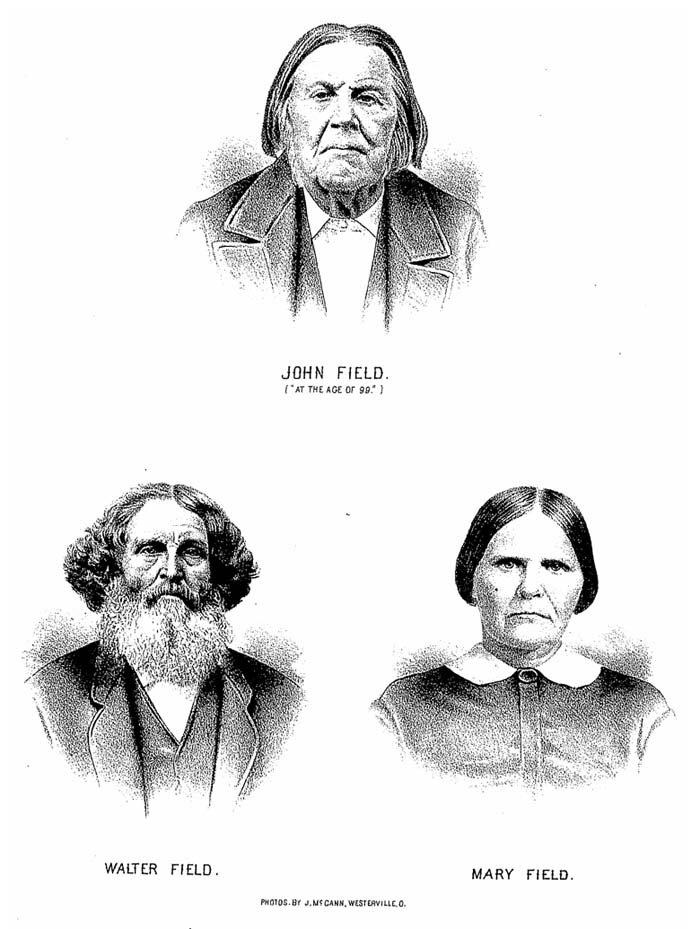
JOHN FIELD.
["at the age of 90"]
WALTER FIELD
MARY FIELD
Photos by .
McCann, Westerville, O.
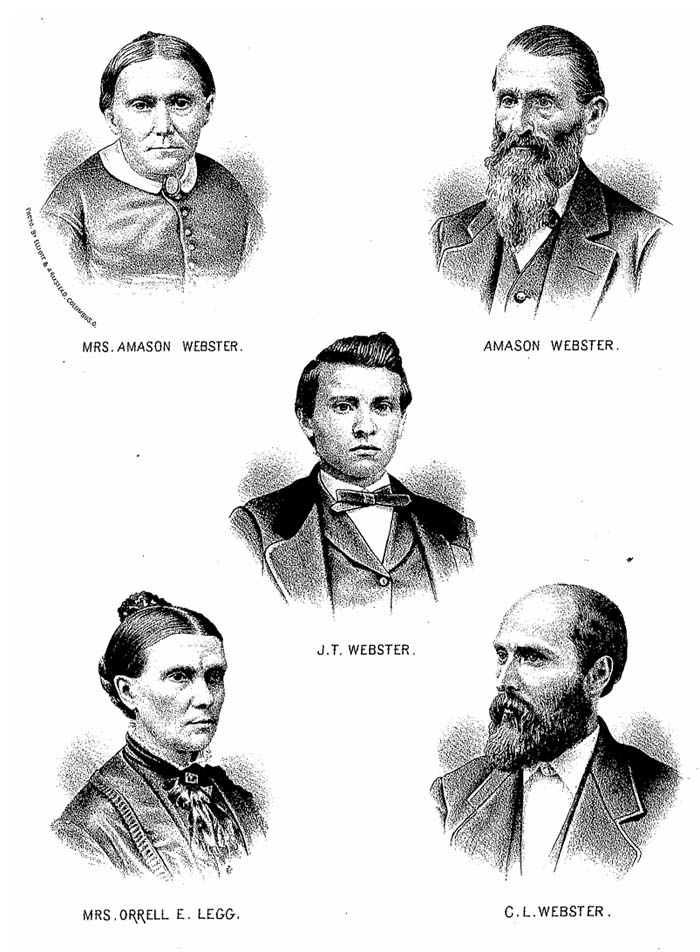
MRS. AMASON WEBSTER
AMASON WEBSTER
J. T. WEBSTER
MRS. ORRELL E. LEGG
C. L. WEBSTER
Pg. 409 -
Kinnear's addition, consisting of fifteen acres,
was laid out by Samuel Kinnear, and in
1870 an addition of one hundred and seven acres
on the east side of the street by George
Williams. The town is now embraced
within the corporation limits of Columbus.
_____
BIOGRAPHICAL SKETCHES.
_____
THE FIELDS
FAMILY - pg. 409
THE WEBSTER
FAMILY -pg. 409
DR. CHARLES
HENRY WETMORE. - pg. 409-410
<
CLICK HERE to
RETURN to TABLE of CONTENTS >
|