|
Plain township is the northeast corner township
of Franklin county, and is bounded upon the
north by Delaware county, upon the east by
Licking, south of Jefferson township, and west
by Blendon. It was first known as township
number two, in range seventeen, and was so
designated upon the maps. It is a part of
the United States military survey. The
fourth, or southeast, quarter was laid out in
one hundred acre lots, for the benefit of the
Revolutionary soldiers, who held one hundred
acre warrants, and the patents issued
accordingly. The north half of the
township was laid off in sections, a mile
square, and afterward divided into quarter
sections. Section three, the southwest
quarter, was patented to Dudley Woodbridge
in 1800, and two years later sold to John
Huffman, then of Washington county,
Pennsylvania, but afterward a well known citizen
of Franklin county, for a consideration of one
gallon of whiskey per acre, or four thousand
gallons of whiskey, to be delivered at Marietta.
Mr. Huffman, in 1822, divided the land
among his children.
THE EARLY
SETTLEMENT OF PLAIN.
The township was first settled in 1801, or 1802,
and though the soil was not regarded as the
best, the population increased quite fast and
regularly. This may be in part accounted
for by the fact that the water was good, and the
locality considered as a healthy one.
There has
Pg. 411 -
been a controversy as to who was the first
settler of Plain, most of those who are good
authority upon local history, affirming that it
was Joseph Scott, but some contending for
the priority of settlement of a man named
Morrison, who is said to have come in a very
short time before. Scott, who was
from Pennsylvania, settled either in the year
1801 or 1802, but in all probability the former,
upon what is now known as the Caleb FARVER
farm, near the south line of the township, and
in the southwest part of section four. A
tract of ground in this locality was generally
known among the early settlers, and even now
spoken of, as "Scott's plains." This
pioneer remained in the township for a number of
years, and then removed to Union county, Ohio,
where he died. Morrison settled
near the northern boundary of section three,
where Anthony Wayne Taylor's residence
now is, and built his cabin ten or fifteen rods
above Mr. Taylor's house. the broad
expanse of level land in this vicinity was named
after him, "Morrison's prairie."
ADAM BAUGHMAN
and his wife, Priscilla (Hoffman) of
Washington county, Pennsylvania, emigrated to
the township in 1805, and located upon Scott's
plains, or prairie, in the southwest part of the
township. They had two children when they
moved into the township, and a number were born
afterward. Their names, with those of the
persons whom they married, and other information
are given in the following: Eve
died in infancy; Elizabeth lives in the
township; Louisa, wife of Thomas
Havens, is deceased; Solomon, who
married Margaret Swickard, and
subsequently Martha Arnold, and
Catharine (Mrs. M. Swickard), are in the
township; Mary is in California;
Peter and Reuben, in the township;
Abram, deceased; Levi, in Blendon.
Adam Baughman, the pioneer, remained a
resident of the township until his death, which
occurred in 1853, and his wife until her death,
in 1865.
HENRY HOFFMAN,
son of John Hoffman, who owned one
quarter of the township - the southwest - came
in at the same time as the Baughmans.
GEORGE BAUGHMAN
and his wife, Barbara, came in 1807 and
located on Big lick but in 1812, removed to
Mifflin township, and settled on Big Walnut,
above the present village of Gahanna.
Samuel Baughman, the oldest son of George
and Barbara Baughman were: Elizabeth
(Mrs. David Ridenour), Susan (Mrs. John
Agler), Henry, David, Jesse,
and Sarah (Mrs. Jonathan
Swickard). All are deceased except the
last named. The Baughmans were an
important family in the early history of the
township.
SQUIRE THOMAS B.
PATTERSON, also of Pennsylvania, came in
1805, and located near where Jonathan
Swickard now lives. He has no
representative now in the township or vicinity.
One son, Hoffman, went to Illinois, and
died there.
JESSE BYINGTON,
another early settler, of whose family not one
is left, came in soon after Patterson,
and located on what is now the Frank Johnson
farm.
LORIN HIELS came
about the same time as Byington, and
lived in the township until 1875, when he died,.
Zimri, his brother, lived where Dennis
B. Strait at present resides.
GILBERT and PHILIP WATERS
were early and prominent settlers. They
were from Pennsylvania. Both were smart
men. The latter, according to the
testimony of several old settlers, taught the
first school in the township. Gilbert
Waters made his settlement where Nelson
Wilkins now lives, but after a few years
removed into the northern part of the township.
MATTHIAS DAGUE,
and his son, by the same name, Daniel and
George Dague, emigrated from
Pennsylvania, previous to 1810, for in that year
the last-named was married to Mary Baughman,
they being the first couple joined in wedlock in
the township. Matthias Dague, sr.,
settled in the southwestern part of the
township, and Matthias, Dague, jr., where
Job Wilson now lives. Daniel
settled upon Rocky fork.
MATTHEW and GEORGE CAMPBELL
came into the township when small boys, with
their widowed mother, their father having died
in Pennsylvania. This was in 1806.
George Campbell married Amanda Farver.
Both are now deceased. They reared a
family of six children, viz.: William,
now a substantial farmer of Plain township;
Rebecca Montgomery, in Columbus; Mary E.
Ranney, in New Albany; James in
Plain; Cicero, in Brooklyn, New York, and
Sarah Jane Laugh am in Philadelphia.
Previous to the war of 1812, there had arrived
in the township several settlers, not heretofore
mentioned, and soon after, the settlement had
become quite large. Among the arrivals
were: John Robinson, Jacanias
Rose, William Goodhart,
John Shesler, and Roger and
Benoni Hill.
DAVID COOK, and his
son, Emyl, came to Jefferson township
from New Jersey, in 1811, and moved into Plain
in 1819. Emyl Cook married
Elizabeth, daughter of Peter Cisco,
of the first mentioned township. He is now
ninety-four years of age. A son,
Nathaniel, is one of the leading farmers of
the township.
JOHN SMITH, came
from Berger (now Passaic) county, New Jersey, in
1813, and located on what is now the George
Daily farm, in the northeast part of the
township. John I. Smith, his son,
came to the township, in 1818, bringing with him
his wife, Catharine McCloud, and settled
on the farm next to his father's. His
children were: George and James
(deceased), Archibald, Abraham, and
Mary Ann (Cole), residents of the township.
Archibald, the eldest son, is aged
seventy-six, and lives upon a farm which he
bought in 1833. Just previous to the
arrival of John I. Smith, came his
brothers, Daniel, Henry, and David,
who settled in the same locality, which became
known as the Smith settlement.
About the same time (1818), John and James
Daniels came from Pennsylvania, and, soon
after, the settlement was increased by the
arrival of William Yantis and Joseph
Moore, both from Pennsylvania.
Yantis settled on the Nelson Wilkins farm
near New Albany, and Moore in the north
part of the township.
CHRISTIAN
HORLOCKER native of Montgomery county,
Pennsylvania, was born in 1769; came into Plain,
in 1816, and settled on the northwest quarter of
section
Pg. 412 -
fifteen, which he entered from the government.
He was a pioneer in Fairfield county, as
early as 1804, and lived for six years in
Prairie township, and four years near
Greencastle. Mr. Horlocker's
first was Barbara Wagner. This
union was blessed with four children. By
his second wife, Mary Crites, he
had seven children, and by his third, Mary
Myers, nine. But one by his first
marriage survives - Samuel Horlocker,
who resides near Galena, Ohio. Four of his
children by his second marriage are living:
John, Peter, and the Rev.
Daniel, in Franklin county, and William,
in Nebraska. Those children of the third
marriage who are still living, are: Christian,
in Franklin county; Sarah, in Columbus;
Anna, in Union county; David and
George, in Dacotah, and Mary
Jane, in Delaware county. Christian
Horlocker, the patriarch and pioneer,
died in Plain, in 1857. He was a soldier
in the war of 1812.
JACOB and CATHARINE
WAGNER, of Huntingdon county, Pennsylvania,
came to Plain in the year 1819, and made their
settlement upon Sugar run. Jacob Wagner
died in 1838, and his wife in 1833. they
had, when they emigrated from Pennsylvania, six
children: Mary A., Elizabeth (Horlocker),
James, Catharine (wife of G. H. Wagner),
and Abraham, all of whom are dead except
the last named. those born after the
arrival of the family in Plain were George,
David, John, and Harriet. David
and Harriet are deceased; John
lives in Blendon township, and George in
Plain. He was a soldier in the war of the
Rebellion, and earned a reputation for bravery
second to none. He is a man of affairs,
and much thought of in the neighborhood, as is
testified to by the fact that he has long held
the office of justice of the peace; has served
as executor and administrator of twenty-four
estates, and has been guardian of ten or more
children.
John CLYMER, Jacob BEVELHEIMER, and John
ALSPACH made their settlements about the
same time as the WAGNERS.
DANIEL TRIPLETT,
of Leesburgh, Virginia, arrived in the township
in February, 1816, when the snow was two
feet deep. He had traded for six hundred
acres of land, and it was upon this that he made
his settlement in the northern part of the
township. He married, in 1817, Sarah
Archer, from New Jersey, with whom he lived
until his death in 1859. His wife survived
him eight years. Their descendants were
G. W., Delilah, and Huldah.
G. W. is probably the oldest man living, who
was born in the township. He has lived in
one place sixty-three years. He married
Agnes, daughter of William H. and Cynthia
Jolley, of licking county. Delilah
Triplet married Orrin Landon, and
resides in Kokomo, Indiana; Huldah is the
wife of Nelson Wilkins, and lives in New
Albany.
PETER QUINN and his wife,
Elizabeth Cramer, came from Union county,
Pennsylvania, to Fairfield county, Ohio, and
after living there for two years, moved in 1820,
into Plain township. Their descendants
were Abram, now in Oregon; David,
for many years a resident of Blendon township,
but now a merchant in New Albany; Loh (Mrs.
H. Parks), in Iowa; Sarah, John and
Jackson, deceased; Mary (Mrs. J.
Campbell), in Missouri; Sophia (Mrs. U.
Campbell), in Blendon; Samuel,
deceased, and Cicero, in Mifflin
township.
ANTHONY WAYNE TAYLOR,
his wife, Melinda,
and one child, John P., emigrated from
Hardy county, Virginia, in 1822, and settled at
the place where Mr. Taylor now resides.
By his own thrift he has become the owner of
upwards of one thousand acres of land.
Mrs. Taylor died in 1875, and Mr. Taylor
is still living. Their children were
Huldah, Dora, William, Lorenzo, and Buren.
The three last named are residents of the
township.
JOEL and MARY B. RANNEY
came in to Plain in 1820, and in 1826, Joel
Ranney, Jr., and his wife, Mary E.
arrived, and located about a mile and a half
east of New Albany. Mr. Ranney
bought a good farm, and returning east worked in
the Portland stone quarries, to earn money to
pay for it. The Ranneys had ten
children six of whom are living, viz.:
Mary A. Hoffman, in Columbus; S. W.,
in New Albany; Harriet (Headley), in
Nebraska; Emily R. (Clark), in
Kansas, and John H., and Joel C.,
in the same State.
FREDERICK HENRY,
and his wife, Christina Kramer, came in
from Pennsylvania, in 1826, and settled where
their son, Jacob, now lives. Their
children, in order of age, were Jacob, Sarah
Alspach, Rachel Wagner, Samuel, George,
Elizabeth Alspach, Mary Newbold, and
Louis.
EZEKIEL PARK, who
now lives in Harlem township, Delaware county,
came into Plain in 1826, from Hampshire county,
Virginia. He married Elizabeth Crist.
SAMUEL RIGEL, a
native of Pennsylvania, came into the township
in 1828, from Fairfield county, Ohio, where he
had married Sarah, daughter of Daniel
Hoy. For his second wife, he
married Mrs. Miller (nee
Wilson). Mr. Mr. Rigel is still
living and is located in Westerville, where he
has been for the past thirteen years. His
children were: Daniel and Joseph,
both deceased; Diana (Ulery), in Delaware
county; Catherine (McClurg), in Columbus,
and Fanny (Crist), in Blendon township.
ABRAM WILLIAMS
came in from New Jersey, in 1830.
Betsey, his daughter, married the Rev.
Daniel Horlocker, now resident of
Columbus.
ISAAC WILLIAMS,
and his wife, Elizabeth,
came from Sussex county, New Jersey, in 1832,
and located where their son, Isaac B.,
now lives, in the northern part of the township.
Isaac Williams died, in 1862, and his
wife two years earlier. Their children
were: Catharine (deceased), Enos, John
(deceased), Abraham, Isaac B., Elizabeth
(Waters), Almeda (deceased),
Alanson, Richard, Ann (Glick), and Jane
(Fairchild). All but the last two were
born before their parents emigrated to the
township.
DAVID MORRISON and his wife, Nancy
(Mann), came from Sussex county, New Jersey,
in 1837, and located at their present place of
residence.
JOHN and REBECCA ROBINSON
came in the same year as the above, from
Pennsylvania. A son, George W., is
a leading mechanic of Westerville, and has been
located there for twenty-one years. He
married Ann, daughter of Gilbert
Waters, of Plain township, elsewhere spoken
of.
ABRAHAM A. and DULCINSA STRAIT, of Sussex
county,
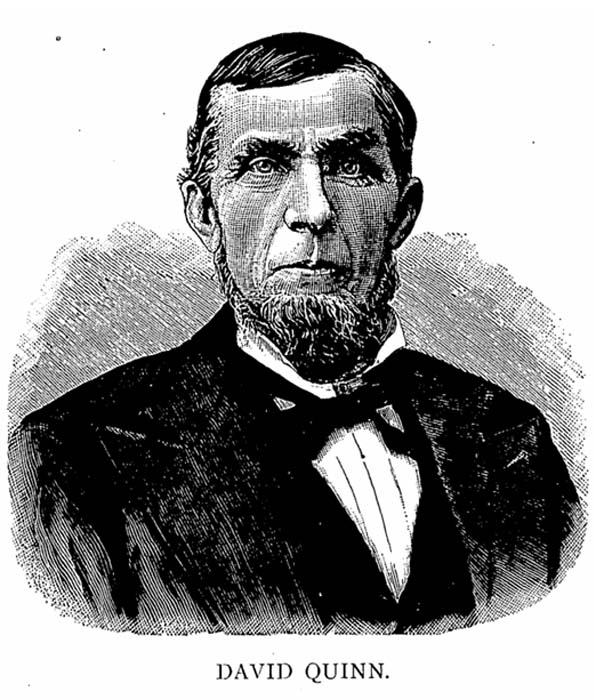
DAVID QUINN.
|
The subject of this sketch was born
in Union county, Pennsylvania, Dec.
12, 1814. His parents were
Peter and Elizabeth Quinn.
In 1818, when he was but four years
of age, his parents removed to
Fairfield county, Ohio, where they
remained two years, after which they
came to Franklin county, and located
in Plain township, where Mr.
Quinn purchased one hundred and
sixty acres of land, on which he
made a permanent home, and where
both himself and his wife spent the
remainder of their lives.
David Quinn obtained a limited education at the
schools then taught, after he became
thirteen years of age. On the
9th day of April, 1835, he was
united in marriage to Catharine
Eyer, immediately after which he
settled on an eighty acre lot, which
he had purchased from his father, in
the northwest part of the township.
No clearing had been made on his
place, and with his young wife he
settled in the green woods, where
they lived fourteen years, clearing
and improving the land. In
1849 he sold his farm, and bought
one hundred acres of wild land in
Blendon township, which he also im- |
proved, and where they lived
twenty-three years, when he also
sold this land, and returned to
Plain township. He had
previously bought a brick store
building in the village of New
Albany, where he engaged in the
mercantile business in 1871, and
where he has since remained.
To Mr. and Mrs. Quinn have been born three
children, as follows:
Elizabeth, who married Adam
Neiswander, and died, leaving
one child; Sarah Jane, who
married H. H. McCurdy, and
lives in New Albany, and Angeline,
who died when a little more than
three years of age.
Mrs. Quinn died Nov. 6, 1876. She had
lived a consistent christian life as
a member of the Methodist Episcopal
church, and was well prepared for
the last change in this life.
Mr. Quinn is also a member of
the same church. Since the
death of his wife he has made his
home with his only surviving
daughter Mrs. Sarah J. McCurdy,
and her husband, in New Albany.
A portrait of Mr. Quinn appears in connection
with this sketch of his life. |
Pg. 413 -
New Jersey, settled near New Albany, in 1839.
Their children were: George R., now in
Westerville; William D., Henry H., and
Dennis B., in Plain township.
Dennis B. has been county commissioner and
auditor.
FIRST
EVENTS.
The first marriage of whites in Plain
township was that of George Dague and Mary
Baughman, July 10, 1810. George
Dague died in 1871, and his wife in 1877.
The first death was that of Eve, daughter of
Adam Baughman.
The first barn
raised in the township belonged to George
Baughman. It was built in the season
of 1807-8, and his neighbors form Plain, Blendon,
Mifflin, Jefferson and Truro townships assisted
at the raising. Those who belonged in
Plain, were Adam and Samuel Baughman, Joseph
and James Scott, and Henry Hoffman.
From Blendon there came Simeon Moore, sr.,
Simeon Moore, jr., and some of the
Phelps family; from Jefferson, Matthias
Dague and sons; from Truro, the Edgar
and others; and from Mifflin,
Frederick and John Agler,
John Scott, Isaac Johnson
and A. Anderson.
The first frame house was built by Daniel
Triplett in 1819. It stood just north
of the present residence of his son, G. W.
Triplett.
The first brick house was erected by Henry Smith.
The first burial place was set apart in 1814, on
land given by John Smith. It so
happened that he was the first person buried in
the lot which his generosity had given to the
people of the settlement. Soon after the
time that this cemetery, which is on the
Reynoldsburg and Johnstown road, was
established, another one was opened upon what is
now known as the Caleb Farver farm, then
owned by Joseph Scott. About the
same time a regular place of burial was set off
from the farm of Daniel Triplett.
THE FIRST
SCHOOL.
It is known, absolutely, that the first school
in the township was taught by Philip Waters,
and there was but one term in seven years.
The school-house was on the northeast part of
the Alspach farm. There was
a school-house on the Triplett farm, as
early as 1821. Jacob Smith, of
Jefferson township, taught there, and was, in
all probability, the first teacher after
Waters.
ORGANIZATION.
The township was organized in 1810, and
originally included the territory now embraced
in Blendon and Jefferson. The early
records have been lost, and no man’s memory
retains the names of the first officers elected.
John Scott and Simeon
Moore, the latter an early settler in what
is now Blendon, were the first justices of the
peace. The next year Jacob Thorp,
who lived in what is now the township of
Jefferson, was elected in place of Scott.
Simeon Moore was re-elected in
1814, and in 1815 the choice fell upon Jacob
Smith and Thomas B. Patterson, the
first of Jefferson, and the latter of Plain
(according to present boundaries).
George Wells was elected in 1817;
Thomas B. Patterson was re-elected in 1818;
Asa Whitehead, in 1819, John
Davis, in 1820; Thomas B. Patterson,
re-elected in 1821; John Davis and
Abraham Williams, in 1823, and both
re-elected in 1826; Daniel Swickard
and Joseph Moore, in 1829.
These were all the justices of the peace elected
prior to 1830.
THE CHURCH OF
THE UNITED BRETHREN IN CHRIST
was organized
in Plain township, in 1826. Among the
early pioneer members of the church were
Daniel and Catharine Cramer, Jacob and
Catharine Wagner, Frederick and Christina
Henry, Rev. John and Mary Clymer, and
George and Eva Cramer. Of this number
there is but one living, namely: George
Cramer. The early ministers were
George _____, Bishop Samuel Heistand, Lewis
Cramer, Bishop John Russell, Benjamin Moore,
Elias Vandermark, Bishop William Hanby, William
Hastings, and John Montgomery.
Two are still living - Elias Vandermark
and ex-Bishop Wm. Hanby. The
church, in its early days, worshipped in the log
cabin of the settlers, and in school-houses,
and, besides, held annual camp meetings.
The church has three organized societies in
Plain township, each of which has a house of
worship of its own. Franklin chapel is a
large and well-built brick structure, and was
erected in 1836, at a cost of one thousand; one
hundred dollars. The trustees were
Jacob Wagner, Frederic Henry, Ezekiel Park,
George Cramer, and M. "F. Clymer.
The pastor, at the time the church was built,
was W. W. Davis, now dead. The
church was dedicated by Bishop William Hanby.
The present trustees of the church are:
George Wagner , J. P. Coil, Jacob Henry, Jacob
Alspach, and G. F. Commins. The
pastor is Rev. S. Manger; J. B. Resler,
presiding elder. The present membership is
eight-seven. Mount Pleasant chapel was
built in the year 1857, at a cost of about nine
hundred dollars. It is a good brick
structure, well furnished. The building
trustees were Martin Swickard, Jacob
Swickard, and George Dague. The
present trustees are John Martin, Frederic
and Noah Swickard; George Dague, pastor;
J. B. Resler, presiding elder. The
number of members is forty-six. Rocky Fork
chapel is a small framed structure, which has
been used as a house of worship for many years.
The trustees of this society are J. E. Park,
Levi Baughman, Abraham Crist, Peter Scarfass,
and W. F. Park. The church
numbers forty-two members. Among them are
Ezekiel Park, who has been connected with
the church about fifty years, and Abraham
Crist, who has been a member for forty-three
years. The pastor and presiding elder of
this society are the same as those of the other
two. The total membership of the three
societies is one hundred and seventy-five.
METHODISM.
The circuit now called New Albany circuit, and
embraced in its territory Johnstown, Alexandria,
Reynoldsburgh, Pickerington, Galena, and
Worthington. It was larger than the
present district, containing several circuits
and stations, now called Columbus district.
Plain chapel was built in 1836, at a cost of
twelve hundred dollars. The first
Methodist Episcopal church, of Plain, was
organized prior to that date. The early
min-
Pg. 414 -
isters were James Casper, Charles Waddell,
Russel Bigenoe, Samuel P. Shaw, Nathan Emery,
John Clark, David Whitcomb, James Ferree, Abner
Goff, Jacob Young, Olive O. Spencer, Joseph
Trunble, Uriah Heath, James Gilneth, Andrew
Perkins, Andrew Murphey; and those later
were David Lewis, William Porter, George W.
West, Sheldon Parker, Isaac Williams,
James Gurley, Alexander Mchamey, Samuel C.
Riker, William Pitzger, John Miller, James
Ellis, Joseph Adair, John White, J. Q. Lakin, J.
and Ralph Watson. Under the
administration of Andrew Murphey, at a
protracted meeting of nine weeks' duration, one
hundred and one persons professed religion, and
nearly all connected themselves with the
Methodist Episcopal church. The church has
now but fifteen members, having been reduced by
deaths and removals. The present board of
trustees are Jacob Williams, Isaiah Needles,
John S. Miller, Wellington Landon, Oliver
Waters, and C. W. Williams; Isaac B.
Williams, secretary.
NEW ALBANY
METHODIST EPISCOPAL CHURCH.
About 1805 or 1806, Joshua Williams, then
living where the village of Galena, Delaware
county, now is began to preach in Plain
township, at the Baughman
cabin, and continued until 1808,
when the Revs. Benjamin Lakin and John
Grave began to visit the settlement as
regular appointees. The station did not
enjoy great prosperity, and no society was
organized, or appointment maintained, in the
neighborhood. A class was organized at
Archibald Smith‘s in 1834, and another at
the school house a half mile north of New
Albany. The class in the Smith
neighborhood was composed of the following
persons: Archibald Smith and wife,
Mary Evans, Isaac Smith and
wife, Roland Evans, James Smith
and wife, and John Hughes. In 1846, the
Revs. G. G. West and Sheldon Parker
opened an appointment which combined the class
from the Smith settlement and one
from Jefferson township. They continued
preaching, at the school-house north of New
Albany, until 1848, when the present church
edifice in the village was completed, and a
great revival was held there, which inaugurated
the establishment of Methodism in New Albany.
The church has ever since been maintained, in a
fair degree of prosperity, and at present
numbers one hundred and three members. The
present pastor is Rev. R. Watson.
George Goodrich is local preacher.
Job Wilson and Joseph Goodrich are
stewards, and Job Wilson, Joseph
Goodrich, George Cisco, and
W. K. Evans, class leaders. N.
Browning is superintendent of the
Sunday-school. The church trustees are:
David Quinn, George Goodrich, Joseph
Goodrich, J. N. Smith, Homer Smith, Isaac
Browning, Joseph Cisco and Nelson
Wilkins.
THE
CONGREGATIONAL CHURCH.
was organized
July 12, 1848, the ministers present being
Revs. H. L. Hitchcock, of Columbus, J.
Harrison, of Reynoldsburg, S. H. Rose,
of Alexandria, and M. B. Starr, a
missionary in this field. The charter
members were James M. and Sarah Woodruff,
Naman and Roxanna Case, Charles Pettit and
wife, Louisa Landon, Louis Hard and wife;
Mathilda Stedman
and Susan J. Marvin.
The first officers were: Deacons, James
Woodruff and Naman Case; trustees,
Naman Case, Charles Pettit, Z. T. Guerin;
clerk, Louis Hard. The first
minister was the Rev. Milton B. Starr.
The first sacrament of the Lord's Supper was
administered Oct. 14, 1848. The council
was organized by the appointment of Rev. H.
L. Hitchcock as chairman, and Rev. Milton
Starr, scribe. The present officers are as
follows: Deacon, Thomas Simmond;
trustees, Thomas Simmond, John Ross, Rowland
Phelps; clerk, G. E. Simmond.
The church has no regular pastor.
THE
EVANGELICAL ASSOCIATION
of the village
are: Sylvester W. Ranney, I. N. Smith and
A. B. Beem, the later late of Licking
county. Dr. Ranney graduated from
the Sterling medical college, of Columbus, in
1836, and has been in practice in New Albany
ever since. Dr. Smith was born in
the township, and is a son of Archibald
Smith. He graduated in Cincinnati, and
has been in practice in the village for over two
years. The physicians who have practiced
in the township are: Z. F. Guerin, Henry
Goodrich (who was a soldier in the war of
1812, and is still a resident of the township),
Dr. McGill, David Camp, Stephen and Charles
Stimpson, father and son, Dr. Ward, Frank
Brooks, Dr. Gilchrist, Dr. Mitchell, Dr.
Anderson, now of Gahanna, and Dr. Holmes,
now of Florida.
THE
PHYSICIANS.
of the village
are: Sylvester W. Ranney, I. N. Smith,
and A. B. Beem, the later late of Licking
county. Dr. Ranney graduated from
the Sterling medical college, of Columbus, in
1836, and has been in practice in New Albany
ever since. Dr. Smith was born in
the township, and is a son of Archibald Smith.
He graduated in Cincinnati, and has been in
practice in the village for over
TEMPERANCE.
As early as 1820 there was a temperance
agitation in this township, a thing quite
unusual at that time in the Ohio settlements.
Abraham Williams was the leading spirit
in the reform. Meetings were held to test
the feeling of the community in regard to the
matter of dispensing with whiskey at raisings,
husking-bees, etc. It was found that many
were in favor of prohibiting the use of liquor
on such occasions, but as the inhabitants were
by no means unanimous in that decision, no
definite action was taken, and at most of the
social gatherings, and occasions of united
labor, whiskey was furnished as in the other
settlements, at an early day. Later, about
1835, there was another flurry of temperance
feeling which soon subsided, however, and left,
probably, a residue of good. Meetings were
held, at this time, at Jacob Wagner's .
MILLS.
There is, and has been, no grist-mill in the
township.
The first saw-mill was built on Rocky fork in 1827, by
Daniel Kramer. The next was erected
on Black lick near his present residence, by
Archibald Smith.
It was put into operation in 1834, and was
continued in use about fifteen years.
Christian Bevelheimer and Daniel Swickard
built mills at later dates.
The only permanent or stationary mill, at present, in
GEORGE W.
TRIPLETT
AGNES J. TRIPLETT
|
was born in Plain township, Franklin
county, Nov. 22, 1818. His
father, Daniel Triplett,
emigrated from Leesburg, Loudoun
county, Va., and settled in Ohio in
1816. Here he married Sarah
Archer, who came from New Jersey
several years previously.
Before his marriage he had purchased
the first section of six hundred and
forty acres in Plain township,
where he remained during his life.
To them were born three children,
one son and two daughters, of whom
George W. Triplett was the
eldest.
George W. Triplett, the subject of this sketch,
obtained an education at the
subscription and select schools of
the day, and Oct. 30, 1848, married
Agnes Jolly, daughter of
Rev. William H. Jolly, a
Universalist minister, who was among
the first of that denomination to
settle in the State. To Mr.
and Mrs. Triplett were born five
children, as follows:
Arthur, born June 29, 1849; married Mary
Montgomery, and lives in Harlem
township, Delaware county. |
Florence, born Dec. 25, 1850;
lives with her parents on the home
place.
Alice, born May 11, 1853; died Sept. 20, 1854.
George, born Apr. 9, 1862; lives at home with
his parents.
Pearl,
born May 13, 18Zz68; also at home.
Immediately after their marriage,
George W. Triplett and his wife
settled on his father's farm, which
became his by inheritance after the
death of his father in 1859.
He has spent his life on the farm on
which he was born, and has always
taken great interest in all matters
pertaining to agricultural pursuits,
in which he has achieved merited
success. His farm of two
hundred and twenty acres is well
appointed and well tilled, and the
home occupied by himself and family,
a neat brick residence, is kept in
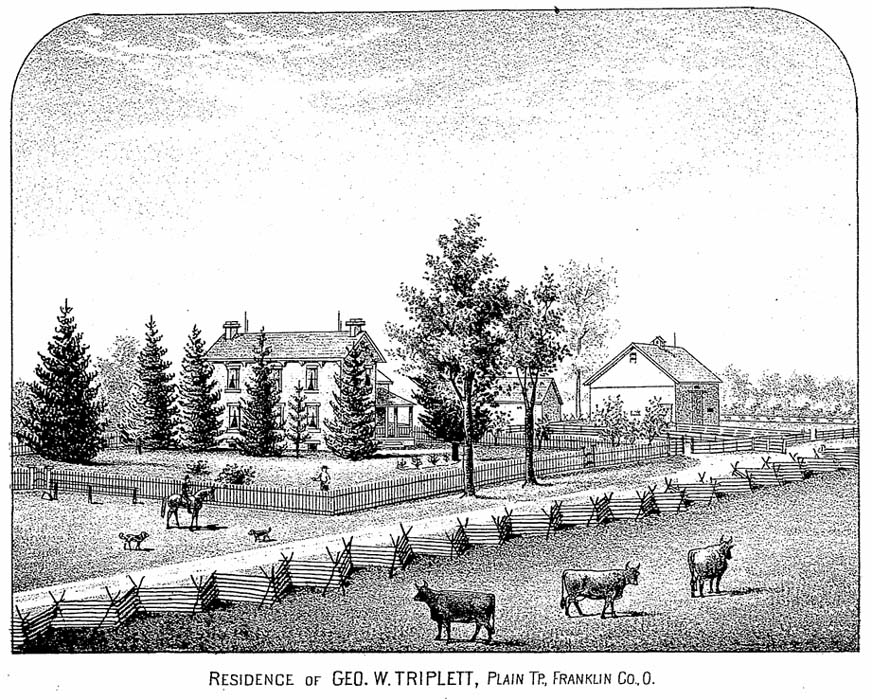
excellent order. It is
situated a mile and a half northeast
of New Albany, and is well portrayed
in the representation accompanying
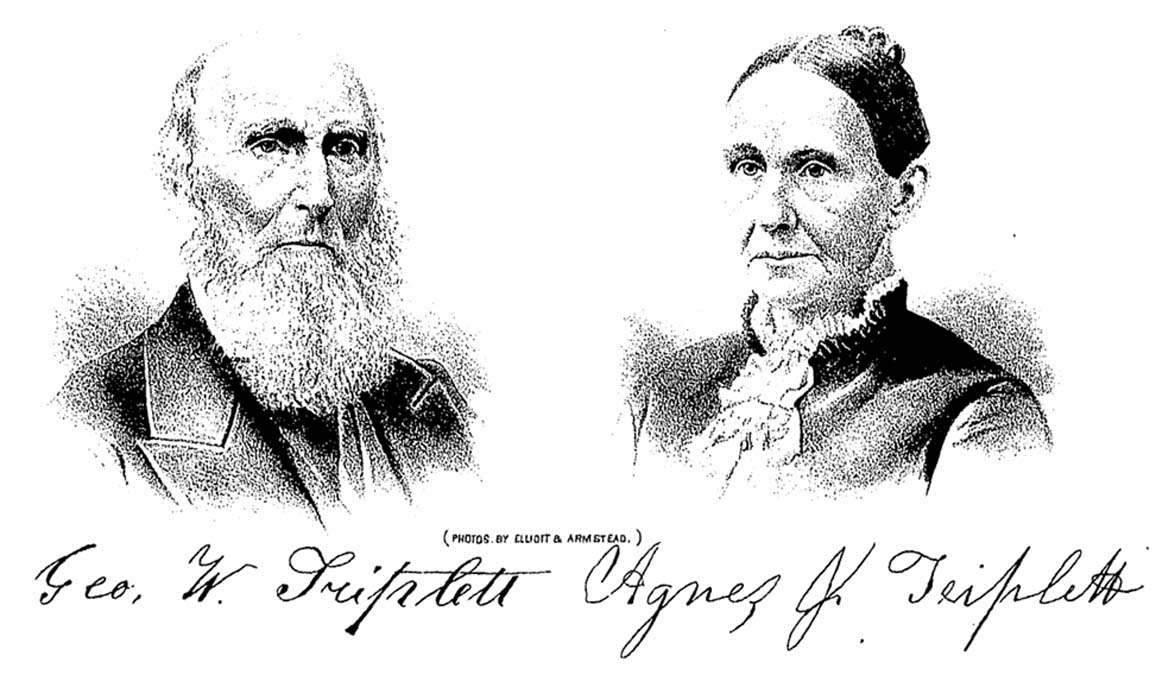
this sketch. Portraits of
George W. Triplett and Mrs. Agnes
Triplett, his wife, also appear
in this connection. |
Pg. 415 -
the township is the stream saw-mill in the
southeastern part of the township, owned by
Martin
Ealey. Beside the Brooks
tile factory, this is the only mechanical
industry in the township.
POST OFFICE.
There is but one post-office in the township,
and that is at new Albany. It is named
Hope, and was established in 1838. The
first postmaster was Daniel Landon,
commissioned May 15, 1838, and continued by
re--appointment until Apr. 15, 1853. The
present post-master is John W. Goodrich.
THE VILLAGE
OF NEW ALBANY.
located in
little south and east of the center of the
township, was laid out in May, 1837, by
Daniel Landon and William Yantis each
being the owner of one half of the land laid out
in lots. The village had unite a
prosperous growth for a few years, and was of
considerable advantage to the country round
about. The village was incorporated.
In April, 1856, was held the first charger
election, which resulted in the choice of the
following officers: S. Ogden,
mayor; C. S. Ogden, recorder; F.
Johnson, J. McCurdy, C. Baughman, A. B. Beem, S.
Stinson, councilmen; R. Phelps,
marshal. Following are the officers
elected in 1879; James Carpenter mayor,
Miles H. DeWitt, clerk; John Ulery
married, J. W. Goodrich, treasurer; E.
Rice, L. Hines, Alexander Carpenter, G. D. Ulery,
D. Quinn, Isaac Browning, councilmen;
Christopher Horlocker, commissioner.
The village is a special school district.
A good school building of brick, two stories in
height in height, was erected in 1872, at a cost
of three thousand dollars. The building
trustees were S. W. Ranney, George W. Holmes,
J. W. Goodrich, J. J. Boston, Louis Hine,
and H. H. McCurdy. The first
superintendent after the new school-house was
built, was R. P. Mills.
The schools have at present about fifty pupils,
and are in a very satisfactory condition, under
the superintendency of Mr. Homer Smith,
son of Archibald Smith. New Albany
has two hotels, kept by A. J. Fix and
G. D. Ulery; three stores, F. Johnston's,
D. Quinn's and John W. Goodrich's.
Mr. Johnston has been in business in the
village since 1854. Wagonmaking is carried
on by Alexander Carpenter, and
Zachariah McGuire; blacksmithing by Miles
H. DeWitt, and Louis Hine; and
shoemaking by William
Johnston.
OTHER
VILLAGES.
Loren Hills and Lester Humphrey,
in 1826, laid out a village plat on the
Granville road, near where New Albany now is,
and named it "Lafayetteville," but no
improvements were made there, and the round was,
a few years later, given back to agriculture.
Francis Clymer laid out a village in 1835, upon
his farm, and named it Mount Pleasant, but this,
too, was a failure, and was abandoned.
<
CLICK HERE to
RETURN to TABLE of CONTENTS >
|