|
This township is bounded on the north by Canaan
township, Madison county, and Washington; west
by Canaan and Jefferson townships, in the same
county; south by Prairie, and east by Norwich,
Washington, and Jefferson townships. The
surface presents the same level plain which
characterizes the townships comprising this
portion of Franklin county, except along the
extreme western boundary, where it is cut by
numerous small ravines. It has no stream
of water, except Big Darby creek. This
flows along the entire western line of the
township, and was considered, in the early
settlement, of much importance.
The soil is mainly gravel, though in some portions a
black loam predominates. In
productiveness, the township is fully up to the
average.
Michael Sullivant and Lyne Starling
formerly owned much of the land in this
township.
SETTLEMENT.
The first settlement of Brown township was
made along Big Darby creek, and began in
perhaps, 1808 or 1810. The eastern portion
remained a dense wilderness, until as late as
1840. the writer is unable to state to
whom belongs the honor of having been the first
settler in Brown township. ADAM BLOUNT
was one of the earliest settlers. He was
from Virginia. Joseph Belchey, a
son-in-law, came with him.
JOHN
PATTERSON, also
from Virginia, located here, about the same
time, but, after a few years, returned to his
former home.
JOHN
HAYDEN, a native
of Pennsylvania, came from Hamilton county, in
1818, locating upon the farm now occupied by
Jacob High, in Brown township, and here he
died, in March, 1827. He was twice
married. The children, by the first wife
were: Elizabeth, David, Isaac, and
Rachel, who are all deceased, except the
eldest, now the widow of Dr. Rathbun,
from whom the writer obtained the principal
items of early history for the township.
The children of John Hayden, by the
second marriage, were: Hannah, William B.,
Nancy, Joseph, Jeremiah, and Sarah,
only one of whom is living.
JAMES
BOYD, from
Tennessee, settled in the township
Pg. 416 -
in 1820. None of the family now live in
the township.
JAMES RINIER, a
native of Pennsylvania, settled in Brown
township, in 1822. After a few years, he
moved to Hamilton county.
KNOWLTON
BAILEY
settled in the township quite early.
OBIL
BEACH, whose wife
was Elizabeth Kilbourn, came from Vermont
to Ohio, in 1817, and located near Plain city,
Madison county, where he died, as did also his
wife. The children were: Susan,
Amos, Marova, Uri, Ambrose, Rhoda, Sarah,
Lorenzo, Roswell, and Obil O. and
Orin O. (twins). two of Uri's
children live in Brown township, Malona C.
(Mrs. John Kilgore), and Uri, who
married Elleanor Downing.
Chauncey Beach, a son of Ambrose, who
married Elizabeth Kilgore, also lives in
Brown township.
JACOB FRANCES and
wife, Winnie Adams, were natives of
Virginia. Early in the present century
they settled in Athens county, Ohio. After
living there a few years, the family located in
Madison county, and, in 1825, made purchase of
the land in Brown township, now occupied by a
son, Henry. This was covered with a
dense wood, but by determined and well directed
effort, this has disappeared, and in its stead,
we find broad acres, whose product yields in
rich return to the husbandman. Mr.
Francis died in August, 1840, and his wife
some two years later. The children were as
follows: Elizabeth, John, Sarah, Mary,
Joseph, Henry, Nancy, Winnie, Hester, Jacob,
and James. One only lives in the
township: Henry, who married Elizabeth
Hunter now occupies the old homestead.
From this gentleman the writer obtained the
following names of settlers who were living in
the township in 1825; George and
Ananias Harris, Benjamin Morris, John Ross,
and Samuel Ballinger. James
Huggett came about the same time.
ABRAM
REECE and Theresa
King, his wife, were from Virginia, and came
to Franklin county in 1812. Ten years
later they removed to Madison county, where they
lived until 1831, when they located permanently
in this township. The farm is still
occupied by the heirs. Mr. Reece
died May 5, 1875, and his wife Sept. 2, 1860.
There were ten children in the family, six only
of whom are now alive, and but three reside in
this county; Robert, who married Sarah
A. Slyh; David, not married, and
Wilson, who married Jane Walker.
All of these sons were soldiers in the Union
army during the rebellion.
HENRY C. ALDER,
whose wife was Elizabeth Patterson, is a
grandson of Jonathan Alder, of
whom we learn as follows: In March
1782, he and his brother, David, were in
the woods, near their home, in what is now West
Virginia, when they were surprised by a party of
Indians, and Jonathan, being but a mere
boy (nine years of age), was easily captured.
The brother ran, but was thrust through with a
spear, killed, and afterwards scalped.
Jonathan was finally adopted by the
Shawnee tribe, and lived with the wife of
Colonel Lewis, one of the chiefs. In
June, subsequent to his capture, occurred the
defeat of Crawford. After Wayne's
victory, Alder, having in the meantime
married an Indian woman, came to live on Big
Darby creek. He became dissatisfied with
his wife, and, after considerable trouble,
succeeded in effecting a separation, when he
returned to his family in Virginia, where he
married Mary Blount, with whom he
returned to his former home on Big Darby creek,
in Madison county, and here he died in about
1850. A son, Henry, purchased in
1835, the farm in Brown township where
Henry C. Alder now lives. Jonathan Alder
lived with the Indians twenty-four years, and
when he left them could talk but little English.
THOMAS KILGORE
was born in Pennsylvania, soon after which event
his parents removed to Kentucky. In 1798
they came to Ohio, and for a few years, lived at
Chillicothe. Thomas came to Madison
county. He married Jane Patterson,
and located in Canaan township, some two miles
southwest of Plain city. Here he
died on Jan. 9, 1873. His wife died June
5, 1863. Of the eight children composing
the family, three settled in Brown township;
John, who married Malone C. Beach;
Sarah, who became the wife of Jeremiah
Sherwood, now deceased, and Elizabeth,
who married Chauncey Beach.
JOHN
LLOYD and wife,
Margaret Evans, were natives of Wales.
They were married there on Saturday, and the
following Monday, took passage for America.
They arrived in Columbus on June 1, 1840, and
the latter part of the same month, located in
Brown township, erecting the log cabin a short
distance from where stands the substantial brick
dwelling now occupied by the family. He
now owns five hundred and sixty acres of land,
which he purchased in a wild state, paid for by
honest labor, and has the greater part of it
cleared, and under4 cultivation. His wife
died Aug. 9, 1878. the children were
Mary (who is deceased), John, Elizabeth,
Richard, Margaret, David and Anna.
N. E. FERRIS who married
Maria L. Samuels, located in Brown
township in 1840. He became prominent
among its best citizens. He died Mar. 23,
1879. None of his children live in the township.
JOHN
HELSER purchased the
farm he now occupies, in 1844. His wife
was Elizabeth Hendell. Two of his
sons live in the township; Levi W., who
married Mary Brant, and Frank,
whose wife was Mary Schofield.
WILLIAM
WINEGARDNER,
and DANIEL and NATHAN WALKER settled in
the township about the same period is the above,
and now occupy a prominent place in the
township.
JOHN
McCOY and wife,
Elizabeth Bell, came from Harrison county,
Ohio to Brown township in 1849. He
purchased a tract of wild land, consisting of
five hundred acres in the southern portion of
the township. This is now occupied by his
descendants. He died in 1864, and his
widow now resides in West Jefferson, Ohio.
The children were Jane (Mrs. Judge
Clark), John, Colmore, Jacob, James,
Alexander, William, Hannah (Mrs. B.
Carson).
CHARLES
A. HOLMES came
with his parents from New York to Kirtland, Lake
county, Ohio, early in its settlement. The
Mormons became unpleasantly numerous, and in
1856 he sold and located in the eastern portion
of Brown township, then all woods. He
married Mary J. Ferris, a native of
Columbus. Mr. Holmes died
October
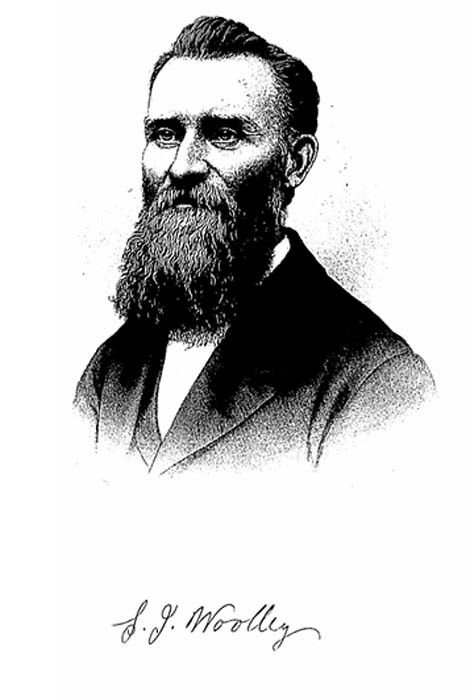 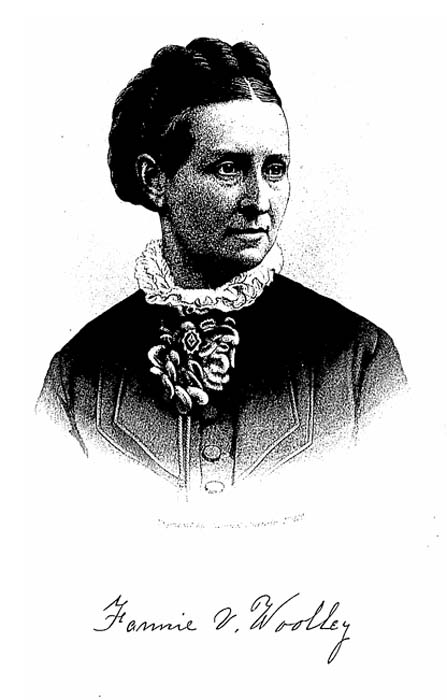
S. J. Woolley
Fannie V. Woolley
SOLOMON JACKSON WOOLLEY
This gentleman, in some respects, one of the
most remarkable characters in Franklin county,
is a native of the Buckeye State, born near
Zanesville, Muskingum county, on the twelfth day
of January, 1828, the first son of Isaac and
Elizabeth (Askins) Woolley, poor but very
worthy people, to whom our hero owes many of his
traits and much excellent early training.
Mr. Woolley describes his mother as "not
an educated woman, but a woman of remarkable
natural abilities." On her father's side,
she was of Holland descent, and her
ancestors, including her father and grandfather,
had been people of considerable substance of
Amsterdam, where they carried on a large
manufactory of silks, linens, etc.
Jacob Askins, her father, during a
commercial voyage to England, some time in the
last century, was overtaken by a terrible storm,
which so disabled the vessel upon which he was a
passenger that she drifted for several months at
the mercy of the winds and waves, and was
finally driven across the Atlantic, and cast a
wreck upon the shores of Virginia, nearly all
originally on board having perished.
Mr. Askins, then still a young man, was
among the survivors, but was deterred by his
dreadful experiences from again venturing upon
the sea, and decided to settle in the new world,
to which he had so strangely emigrated. He
settled in Loudoun county in the Old Dominion,
married a Miss Shafer, and after some
years, removed to Washington, Guernsey county,
Ohio, where he reared his family, including
Elizabeth, who was the mother of S. J.
Woolley. Mr. Woolley's ancestors on
the father's side were English, but emigrated
from the mother country long before the
Revolutionary war, and were among the first
settlers of New Jersey. Jacob Woolley,
his grandfather, removed to Athens county, Ohio,
when that part of the State was almost an
unbroken wilderness, and settled upon what is
now called Jonathan's creek. His son,
Isaac, father of the subject of this sketch,
was bred a stone cutter, and afterwards spent
most of his time away from the paternal home,
working at his trade. After his first
marriage, which was to a Miss Stokely,
of Muskingum county, he settled on a place of
his own near Zanesville, from which he removed,
when Solomon was but one year old, to
another, three miles from Amesville, in Ames
township, Athens county, on a branch of Federal
creek, where most of his family were reared.
But this marriage he had several sons,
half-brothers of Solomon, who, in after
years, generously remembered them, as will be
presently and more fully recorded. the
mother died while they were young, and Mr.
Woolley, in the year 1827, took Miss
Elizabeth Askins to wife. Several
years afterwards, he sold the Athens county
farm, and purchased another in Star township,
Hocking county, where he resided for many years.
Solomon was still very young at the time
of the removal, but rendered all the assistance
he could in the labors of the farm, and in due
time, as the half-brothers, one after another,
grew to manhood and went away, he took upon
himself its chief burdens, as his father was
absent a large part of the time, pursuing his
vocation of stone-cutter. He found little
time or opportunity for schooling nine months in
all, or three terms of about three months each,
in the primitive country schools of that day,
comprising the whole of his formal education.
Until he was fourteen years of age, he had never
had an hour's training in school. About
that time the people of the neighborhood
spontaneously agreed that they ought to have a
school-house, and forthwith set about the
erection of a rude affair, which was ready for
occupancy within a fortnight after the vote to
build it was taken. Mr. Woolley
thus pleasantly describes this antique
structure:
The
architecture of this school-house did not
correspond with that of the present days.
It was made of round logs, with a clap-board
roof, laid on loose, with weight-poles on top,
to hold the clap-boards down; the floor was laid
with what we called puncheons a free split in
wide pieces, from two to eight inches thick, and
hewn on one side; the chimney was made at one
end, of stone, and we gathered up enough news
papers to past over the windows, in place of
glass; the paper, being oiled, transmitted a
very mellow light. Slabs, or boards, were
fastened around the walls, for our writing
desks, and pins upon the walls to hang our hats
and dinners on. Our seats were made of
small trees, split in two with the split side
dressed, and four pins, or legs, underneath,
making each of the proper height for a seat."
The schools kept in such buildings in those days
were of the kind, long since passed away in this
State, known as "subscription schools."
Miss Rebecca Prindle was the first teacher
in this school, and so young Woolley's
the preceptor, except his mother, from whom he
had already received as he subsequently learned
valuable instruction at home. He
was even now remarked as different from other
young people of his age, preferring to associate
with men rather than boys, and poring over his
book at noon-time, during recesses, and in spare
hours at home, rather than engage in play as the
others did. He learned rapidly within the
limited round of studies to which his
opportunities confined him, and has since
considerably redeemed his early deficiencies by
persistent and careful reading, and is now
fairly accounted among well-disciplined and well
informed men.
When but sixteen years of age, young Woolley
achieved a notable business and industrial
triumph. Through bad management his
father's finances became involved, and he was
compelled to borrow four hundred dollars at ten
per cent interest, giving a mortgage upon his
farm by way of security. A year rolled
speedily around, and nothing was realized toward
the extinguishment of the debt. It was
considered in the neighborhood inevitable that
the mortgagee would get the place by
foreclosure. At this crisis Solomon
came to the rescue, and proposed that while his
father should continue at his trade for the
support of the family, he would undertake the
sole charge of the farm (one hundred and sixty
acres) in a vigorous effort to make enough to
lift the mortgage. It as agreed to.
Within eighteen months the full sum must be
raised, and Solomon saw that with the
best of management it was only possible to
effect it by sowing most of the land to wheat,
and that then with a good harvest and fair
price, success was certain. He had not
only the entire responsibility to shoulder, but
almost the entire labor to do, since his adult
half brothers and now all gone from home, and
his younger brothers were too small to be of
much service. He buckled fearlessly and
stoutly, however, to his task. Beginning
his day of labor at four o'clock, he worked
three hours until breakfast, and then with brief
intermissions for dinner and supper, he he
kept on until dark and on moonlight nights until
far into the evening. His faithful toil,
though it brought him many hours of weariness
and somewhat impaired his health, met with its
reward. It turned out to be "a good wheat
year," and Solomon's crop - "good, well
filled grains of a superior quality" - was the
finest in that region. Wheat, too, was
higher than usual, and he sold for a good price.
Consequently, when the mortgage fell due, he had
the proud satisfaction of releasing it in full,
and presenting it to his lately burdened and
anxious, but now overjoyed and grateful parents.
His first commercial venture, however - an enterprise
which was taken in hand as soon as the troubles
and labors induced by the mortgage were well out
of the way - was not so fortunate. In the
spring of 1845, he discovered an earthly
substance upon his father's place, which turned
red in course of burning or baking, and which,
after sundry experiments, he concluded would be
an acceptable substitute for Spanish brown or
Venetian red. As soon as his big wheat
crop was disposed of, he set about the erection
of a horse-mill for grinding the stuff, though
he had not the slightest experience as a
mill-wright, and in his effort incurred the risk
of unlimited ridicule from his neighbors.
It was finished in about six months, and did run
successfully, notwithstanding the unfavorable
prophecies of his friends. He prepared
about twelve hundred pounds of the new "Spanish
brown," and soon afterwards started with it on
his first visit to a large city. Taking a
steamer at Pomeroy, he went to Cincinnati, and
there made diligent and persistent attempts to
sell the novel product. The real article
of commerce however was bringing but a small
price, and all the dealers were fully stocked
with it, so that he did not succeed in effecting
a single sale, and finally left the whole for
sale on commission with the firm of Springman
& Son, form whom he does not appear ever to have
received a single remittance on its account.
Young Woolley made no complaint, but
returned quietly to is rural home, where he
remained, the last of his regular residence
beneath the old roof-tree, during the winter of
1845-6.
The next spring, at his own solicitation, he went to
Chauncey to learn the trade of cabinet-making,
but left it shortly for the purpose of enlisting
among the volunteers in the Mexican war.
Visiting home, however, before enlistment, he
there met with so much opposition that he
changed his plans, and went to work for two
months with Mr. H. Kanode at Logan,
Hocking county. He then served Mr.
Alvin Finney as a laborer for a month, when
he went to Chillicothe, and obtained employment
in a slaughter-house for a short time. He
had now got about twenty dollars ahead, and
determined to embark in book-agency.
Arranging with a Hartford (Connecticut0 firm,
the publishers of a "History of the United
States," for a supply of books, he went to
Cincinnati to procure the first lot shipped to
him, and returning to Pomeroy, at once began his
journey from house to house, in the effort to
sell his wares. It was disheartening work
at first, and several days elapsed before a
single sale was made. Meanwhile he had
visited home, and in the neighborhood, by giving
adequate security - for such was the general
want of confidence in his success as a
book-canvasser, notwithstanding his financial
victory on the farm the year before, that he
could get nothing "on time" without giving
security - he purchased, on credit, a cheap old
horse and the wood-works of a buggy, which he
rigged up for his business, and started out
again. He soon began to make sales, and
rapidly reaped a tolerable harvest, selling over
one hundred and fifty books in a comparatively
short time. He remained at this work until
the fall of 1848, traversing parts of Ohio and
Virginia, and then intended to launch out more
extensively into the business, but was
forestalled by a Columbus firm, which secured
the general agency for his book for all the
western country, and effectually shut him out of
the canvass.
Mr. Woolley now retired, temporarily, from the
book business, but in no way discouraged by his
various reverses and checks, he determined to
make a bold push for the great metropolis of the
country, the city of New York, to see what
opportunities it had to offer in the way of
business. At Kingston in Ross county, he
engaged to accompany a party going with a drove
of horses to that city, taking his own horse
with the lot. They started about the first
of March, 1849. It proved a singularly
interesting and eventful journey to the youthful
adventurer. He records, with enthusiastic
delight, his observations of scenery, especially
in the region traversed by the Alleghenies, of
the towns and farming country passed through on
their slow journey to the seaboard, which was
reached in about six weeks. After staying
at Chatham near New York, ten days, to put the
horses in suitable order for market, they were
sold, and among them the horse owned by young
Woolley, for which he realized seventy-five
dollars. He did not engage in any
employment in the city, but, after investing
most of his means in a lot of brass clocks and
some more books, the former of which he had
shipped to Fort Wayne, Indiana and the books to
Logan, Ohio, he embarked on the river Hudson for
Albany. On the way thither, late at night,
the "Empire," the steamboat on which he had
taken passage, came in collision with a schooner
heavily loaded with lumber, in Newburg bay, and
sank with considerable loss of life.
Mr. Woolley had not yet retired at the time
of the collision, and with some difficulty made
his escape to the schooner, losing all his
clothing, except what he had on, but thankful to
escape with life, especially when compelled to
view the heart-rending scene of terror, panic
and drowning that speedily succeeded upon and
near the "Empire." Albany was reached in
safety upon another steamer the next morning,
where cars were taken for Buffalo, and there he
took passage on the steamer "Baltic" for
Cleveland, en-route home. Upon this vessel
he was destined to meet with another thrilling
adventure. When about twelve miles out,
the "Baltic" collided with a propeller, which
did considerable damage, and led the captain of
the former to return to Buffalo. An
inspection of the injury, the next morning,
however, resulted in a decision that the vessel
might safely proceed on her voyage. She
again put to sea, and Cleveland was reached
without further incident. Mr. Woolley
proceeded thence homeward on stage, receiving
generous aid and hospitality, after his money
was exhausted, from Judge Robison and
other friends at Wooster.
After resting a few days at home, Mr. Woolley
started for Fort Wayne, to sell his clocks. It
was now the middle of August; the wheat crop of
the year had failed, and the cholera had broken
out in many places. It was, apparently, a
very unfavorable season for such operations as
his; and the clock peddlars, with which the
neighborhood of Fort Wayne was then overrun, had
already made an unlucky and discouraging canvass
of the whole region. But the young
speculator was not daunted, and, setting
vigorously and intelligently to work, his clocks
and books were soon all disposed of, in and
about the localities to which they had
respectively been consigned. Returning in
November, he was able to make an investment in
land to the amount of one hundred and eighty
acres, in the same township where his family
resided. He realized at least one thousand
dollars from this one operation. He
afterwards made a present of eighty acres from
it to Isaac Casey, his half brother.
He now, in the latter part of 1849, at the instance of
a friend, Dr. T. P. Jackson, turned his
attention to the then comparatively new business
of taking portraits by the daguerreotype
process. Early in this next year, with an
apparatus and stock, purchased in Cincinnati,
and only four days' instruction, received from
Mr. V. L. Richardson, a Zanesville
artist, at an expense of as many dollars, he
embarked in this business, to which much of his
future life was faithfully and successfully
devoted. His beginnings were very small,
however. At New Plymouth, his first point,
he took no pictures for a week, but had more
encouragement the second week, and then moved on
to McArthurstown, where he seems to have become
disheartened at his poor success, both in
getting orders and in managing his chemicals so
as to take good portraits, and sold his
apparatus to one G. W. Pitcher. A
siege with the chills and fever followed, which
lasted about three months. Procuring a
larger apparatus than before, Mr. Woolley
started out again, and operated, with varying
success, at Logan and Amesville, where he again
sold out. Purchasing another outfit in
Cincinnati, he took it to Virginia (that part of
it now West Virginia), where he visited
Parkersburgh, Harrisville, Point Pleasant,
Buffalo and Ripley, making some progress, but
not yet doing very well. It was now
January, 1857, and most of this year was spent
in another Ohio tour. The next year he
took his apparatus and stock down the Ohio
river, landed at Henderson, Kentucky, and
remained there and at other points in that State
for several months. At Madisonville, the
county seat of Hopkins county, he saw, for the
first time, a slave sold, a young negro girl
being struck off at auction by the sheriff.
Another place of interest visited was
Russellville, the birthplace of the notorious
forger, Monroe Edwards. From
Kentucky, Mr. Woolley pushed into
Tennessee, visiting Nashville, Franklin,
Lebanon, Gallatin, and Memphis. At the
latter place he took passage on the steamer
"Charleston," for New Orleans, where he embarked
upon a gulf steamer for Franklin, in the
Attakapas country. In this place he stayed
but nine days, returning to New Orleans by way
of the Bayou Plaquemine, and thence going o
Bayou Sara, where, and at St. Francisville,
Morganza, and other places in Northern
Louisiana, he operated successfully during the
early part of 1853. On the sixteenth of
April, at Springville, Louisiana, he was
initiated into the mysteries of the Sons of
Temperance. He returned to New Orleans the
latter part of the month, and there re-embarked
for Cincinnati, and the dear old home in Hocking
county. A few weeks were passed pleasantly
here, and, on Independence day, 1853, he started
for New York, to revisit that city and see the
World's fair, then being held in the
well-remembered Crystal Palace, in the upper
part of the city. During this visit he
purchased a new instrument for daguerreotyping,
and several hundred dollars' worth of stock, and
returned, as from his former eastern trip, by
way of Albany, Buffalo, and Cleveland, but
without the perils of the trip of four years
previous. He set up his new apparatus at
home, and took a large number of portraits, and
also operated with much success at Athens and
Pomeroy. At the latter place he dropped
daguerreotyping for a time, and entered upon a
new and bold undertaking. Purchasing
a flatboat and its load of sash for one thousand
and forty-one dollars, he embarked with it, in
person, down the river, having, also, two
families, a small party of emigrants, on board.
Dropping slowly down the Ohio and Mississippi,
at times leaving the frail and uncomfortable
vessel and going on to some important point in a
steamer, he arrived, with his animate and
inanimate cargo, after many adventures and
dangers, and a thoroughly disagreeable voyage in
general, at Memphis. He found that he
could sell none of his sash here at a profit,
but, nevertheless, disposed of a small amount at
this place, and, presently, of a much larger
quantity at Vicksburgh. At the latter
point he sold the flatboat to the heads of the
families on board.
His total loss by this venture was about eight hundred
dollars, but he considered it a decided
advantage to him in the long run. From
Vicksburgh, he went to Bayou Sara again, to
begin another tour of business as a daguerrean
artist. He operated in a number of towns
in this region, and on the twenty-fourth of June
reached his first point in Texas, at the
pleasant town of Marshall. He remained
here over a month, and thence proceeded to what
eventually became an extensive tour of the
State, which he found remarkably profitable, and
by which he far more than redeemed his recent
losses. At Jefferson he sold his apparatus
to a Mrs. Hargrave, and then traveled, by
stage, to Shreveport, where he awaited the
arrival of another instrument from New York.
Re-entering Texas, he made another tour of
travel and business in the State during 1855 and
a part of 1856, visiting a large number of
important towns, and everywhere observing men
and things with his characteristic shrewdness
and care. About the middle of the latter
year, he returned to his father's home, now
removed to a farm, fifteen miles northwest of
Columbus. In August, he health having been
impaired by his long and arduous labors in a
southern climate, he went to New York city, to
reside for a time at Dr. Taylor's
water-cure establishment, where he soon reaped
decided benefit. He had now accumulated
about seven thousand dollars as the gains of
honest industry; but aspiring to still higher
rank in the profession, he took the opportunity
of his short residence in New York city to learn
the art of taking portraits on paper and glass,
with the then celebrated firm of Meade
Brothers. Upon his return, he opened a
photograph gallery in Columbus, and continued in
business there for several months. In
October, 1857, he lost, by consumption, his own
and only brother, to whom he was very greatly
attached. The next month he bought a tract
of seven hundred acres of land in Brown
township, Franklin county, about three miles
from the present Hilliard's station, on the
Columbus, Cincinnati & Indiana Central railway,
the same which he has since developed into the
beautiful and very valuable "Appledale farm."
During this year he took another professional
tour through Ohio, and made a second visit to
Kentucky, during which, at the State fair, in
Henderson, his photographic work was honored
with the first premium offered by the society.
In December, he revisited Louisiana, and
operated there, and in Texas, until the last of
June, 1858, when he returned to Columbus, and
spent some time and money in improving his new
place near Hilliard's. In November,
he again went south, and at Pattersonville,
Louisiana, formed a partnership with a Dr.
Cissna, and with him built a floating
gallery, for business along the rivers and lakes
of that region. This arrangement was
dissolved the next June, and Mr. Woolley
spent the rest of the summer in Ohio a part of
it with the erection of a handsome marble
monument over the remains of his brother.
In the fall of this year (1839), he made more
ample preparations for business, by the
engagement of Mr. Asa Bushby, a landscape
and portrait painter of some note, to travel
with him, color pictures, and perform such other
duties as his special talents and training
fitted him for. With him another and final
southern trip was projected, and the pair
arrived at Alexandria, Louisiana, on the
twenty-sixth of December, where they remained
two months, and afterwards visited one or two
points in Texas, when Mr. Bushby,
disgusted with southern experiences, although
they paid well, withdrew and returned to his
home in Massachusetts. Mr. Woolley
continued the tour in the Lone Star State, with
greater success than ever, making in a single
month, at Bonham, for example, nearly six
hundred dollars net profit. This trip kept
him away from home for many months, being the
longest absence he had had; and he did not come
north until after the great drama of the
Rebellion had opened, when he took passage on
the "Grey Eagle," the last boat which was
allowed by the rebels to leave New Orleans for
the north, and reached Columbus in safety, about
the first of June. By this one trip,
extending over something less than two years, he
had netted about five thousand dollars.
His traveling business, now for a time over, Mr.
Woolley settled down to the improvement of
his large tract in Franklin county. It had
originally been exceedingly swampy and rough -
apparently about the most hopeless piece of
landed property in that part of the country; and
the neighbors scouted the idea of his being able
to make any thing of it. They expected to
see him "pour money down a rat hole,' and
prophesied that he would sink his entire fortune
amid its bogs. He set resolutely to work,
however, clearing, draining, planting an
orchard, etc., until, by successive improvements
from year to year, he has made this once
forbidding tract one of the most productive and
valuable farming properties in Ohio. Early
realizing that an immense amount of drainage
must be done, he purchased and set up a
tile-mill on his own premises, which has been
sufficient to equip fifteen or sixteen miles of
tile-drain on his farm, as well as to fill
numerous orders for his neighbors. His
success in the reclamation of this unpromising
purchase (made from Mr. M. L. Sullivant,
the great Illinois farmer, at fifteen dollars
per acre), is one of the most noteworthy
features of his career, and has, of itself,
sufficed to make his name known far and wide.
In 1862 Mr. Woolley determined to do something
of his old work inside the army lines.
Proceeding to Fayetteville, Virginia, he
opened a gallery in such rooms as were to be
had. the provost marshal here at this time
was Cool. R. B. Hayes, now president of
the United States, from whom Mr. Woolley
received sundry favors. Driven from house
to house, however by the necessities of military
occupation, he was finally forced to fit up a
cow shed for his artistic operations. He
remained here through the winter and most of the
spring, leaving on the fifteeth
fifteenth of May for home. He now had his
aged and infirm parents removed to his own farm,
near Hilliard's where they died in due course of
nature, and were remembered by their son, by way
of external honor, in the erection of a noble
monument, of Scotch grey stone, standing sixteen
feet high, and built at a cost of eight hundred
dollars. He afterwards operated inside the
army lines, at Corinth, Mississippi, having now
a photographic tent of his own, one hundred by
twenty-five feet in size, the largest of the
kind then used anywhere with the army. He
was here during the battle of Corinth, Oct. 3,
1862, in which he lost a nephew, killed in the
ranks, whose remains he had decently buried in
the cemetery at that place. His health was
very poor while here, and he was unable to work
more than half the time; yet, by careful
superintendence of four picture-rooms which he
had established in and about Corinth, he cleared
over three thousand dollars in this one venture.
In 1863 he operated at Memphis and other points;
but was compelled, by the state of his
health, to spend part of this and several after
years at the water-cure, in New York city,
before mentioned. While on his way to
Little Rock, Arkansas, in the fall of the year,
he had a narrow escape
from capture
by the rebels - a large steamer, in full sight
of that upon which he was, being taken and
destroyed by them. At this place he
remained until May, 1864, and cleared four
thousand dollars. During he following
summer, at the request of his fellow-townsmen
and on the commission of the governor, he
undertook a recruiting expedition among the
negroes at the south, to raise men to fill the
quota of Brown township. He visited many
points in Tennessee and Alabama for this
purpose; but the field had been too persistently
and diligently gleaned, and he returned without
success, but generously bearing all his own
expenses, and returning every penny of the three
thousand seven hundred dollars raised in the
township for the procurement of recruits.
His career in the portrait business was now ended, as
he supposed, and he was to give thenceforth his
entire time and attention to the development of
his home property. In the fall of 1867,
however, his health compelled him to go to Dr.
Trall’s water-cure, at St. Anthony,
Minnesota, to spend the winter. He took
his photographic apparatus along and opened a
room in that place, where it was destroyed by
fire shortly aftewards
afterwards. Much sympathy was expressed
for him at Dr. Trall’s, and offers of
pecuniary aid were made, which he, of course,
declined, and returned to his home the March
following. His life since has been
comparatively uneventful. Although an
ardent and unswerving Republican since the birth
of the party he has declined to go actively into
politics, and has invariably refused office,
although frequently tendered him, except once,
when he accepted a petty township office rather
than pay the penalty with which he was
threatened; and he has also filled some school
offices in his township. He has not spent
much time upon secret societies, but was made a
Free and Accepted mason in 1857, at Logan,
Hocking county; and is the original granger of
Franklin county, having been instumental
instrumental in securing the organization of the
first grange of the Patrons of Husbandry within
its borders. In religion he has long been
a member of the Methodist Episcopal church, and
is fairly orthodox in his views, yet an
independent thinker, with broad sympathies and
liberal tendencies. He is a vegetarian in
his dietetic belief; but is by no means rigid or
troublesome in the application of his
principles, at the home table or elsewhere.
His feelings are strongly with any society for
the prevention of cruelty to animals.
While still a boy, he notes the killing by his
shot of one of the deer that abounded in the
forest adjoining his early home; but declares
that “the poor thing made such a pitiful crying
that I could never be induced to shoot at
another.” He would not rob or tear up a
bird’s nest, or allow other boys to touch one.
Some humane views of his on this subject of
killing birds, communicated to the Ohio
Farmer a number of years ago, were very
kindly received and led to his engagement as
regular correspondent of that paper - an
arrangement which was maintained with mutual
satisfaction for six or seven years. He
has also written much, mainly agricultural
topics, for the National Agriculturist;
the American Patron; the Western Rural,
of Chicago; the Dirigo Rural, of Bangor,
Maine; the Western Patron, of Findlay,
Ohio; the Southern Agriculturist, of
Columbia, South Carolina; the Germantown
( Pennsylvania) Telegraph; the Ohio
State Journal, of Columbus; and the
Drainage and Farm Journal, of Indianapolis,
Indiana. to the topic largely treated by
the last named, as indicated by its title, he
has given especial attention; and his writings
thereon, growing as they do out of his large
practical experience, have especial value.
One communication of his, traversing an opinion
expressed by the Drainage and Farm Journal,
converted the editor of that magazine, and
brough_ it into harmony with Mr. Woolley's
views. In 1878, an essay upon drainage,
prepared by him, took the prise of twenty-five
dollars, offered by the State board of
agriculture, for the best paper upon this theme;
and it will be found printed in full in the
report of the Board for that year. His
writings, although devoid of rhetorical effect
and making no attempt at exhibition of
scholarship, have proved thoroughly acceptable
and useful to sensible, practical men.
Of late years, Mr. Woolley has given much
attention to the growth of Devon cattle and
Southdown sheep, from the sale of which
he has realized large sums. About the only
designation in the way of business which he
himself, as indicated by the return-card upon
his envelopes, is "Proprietor of the Appledale
Herd of Devon Cattle." With his vegetarian
proclivities, he would not be likely to neglect
fruit-raising; an the orchard which was among
his first improvements nearly twenty years ago,
with subsequent additions, is now in fine
bearing condition, and is a very valuable
feature of the property. It comprises
about forty acres, mainly set to apples and
pears, producing, of the former alone, about
four hundred bushels last year.
Mr. Woolley is a quite, self-contained man, not
familiar in his manners, nor easy in the
formation of acquaintances; yet he is thoroughly
faithful and tenacious in his friendships.
His retiring nature is not the result of
timidity or lack of nerve, as his long and
courageous battle with the fiickle Dame
Fortune would indicate, as also the following
incident: About two years ago, while engaged in
cider-making, the end of a forefinger was
unluckily smashed. It needing immediate
attention, as he thought, and disdaining to
await the services of a physician, he had his
pocket-knife taken out and opened by a friend,
and then coolly and deliberately amputated his
finger at the first joint. It healed up
without difficulty, "at the first intention,"
and presents a more sightly appearance than most
of the fingers which the doctors amputate.
His practical benevolence to his relatives is also well
worth a note. the gift of an eighty-acres
farm to a half brother has already been
recorded. To another he presented a farm
in Union county, of one hundred acres, worth
four thousand dollars; and to a brother-in-law
he gave another farm in the same county, of
sixty acres, held at three thousand dollars.
In the later years of his parents he also
voluntarily relinquished a mortgage which he had
taken on their farm, to save it from falling
into the hands of designing men, and handed the
place over to them unincumbered.
In response to the great desire of his many
friends in Ohio and elsewhere, Mr. Woolley
is now engaged in writing am autobiography.
It is almost finished, and promises to be a
volume of great interest, not only to those with
whom his own life has come in contact, but to
those who desire to see the record of a life
devoted to the honest pursuit of life's great
ends and works, and all beautiful with
generosity, kindness, and truth.
Mr. Woolley was united in the holy bonds of
matrimony Aug. 30, 1869, to Miss Fannie
Virginia Cromwell, also of Franklin county,
by the Rev. Daniel Horlocker, at the
residence of the latter, near Groveport.
In August and September, 1876, they took a
pleasant trip to the Centennial exposition at
Philadelphia, visiting on their way Harper's
Ferry, Valley Forge, Mount Vernon, and other
interesting historic points. In their
pleasant home at "Appledale," enjoying the
fruits of their labor, and with the promise of a
serene and sunny course and ending of life, we
now bid them farewell.
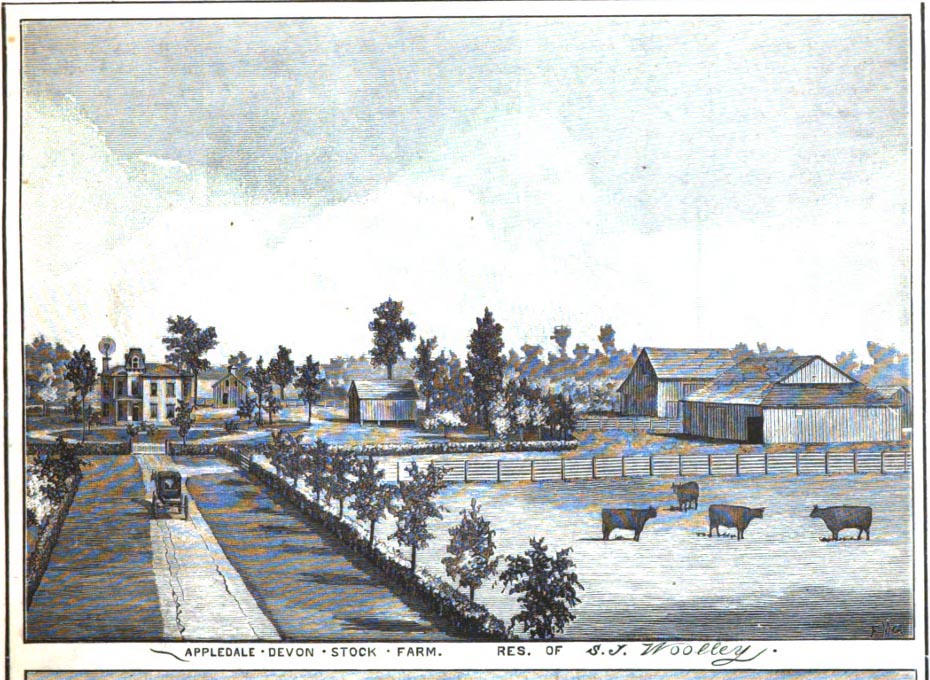
Appledale - Devon - Stock - Farm
Res. of S. L. Woolley
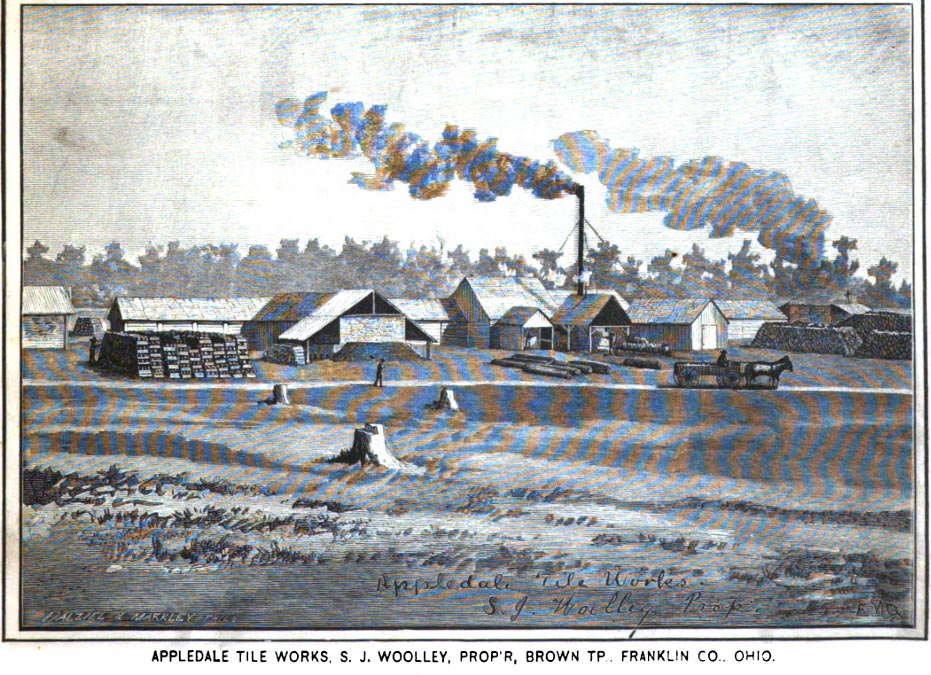
Appledale Tile Works, S. J. Woolley, Prop'r.
Brown Tp., Franklin Co., Ohio
Pg. 417 -
4, 1874. The children were Nancy M. (deceased),
Anna E. (Mrs. James Vanschoyck),
and Wilbur C.,
who lives on the home farm.
PHYSICIANS.
The first doctor, to permanently locate in Brown
township, was John Rathbun, in1839.
Dr. Rathbun was a skilful practitioner, and
a valued member of the community. His
practice was extensive and lucrative. At
this time but one physician resides in the
township, D. H. Welling, who is a
graduate of the Eclectic college at Cincinnati,
in the class of 1876 and 1877. Dr.
Welling is spoken of as devoted to the
profession of his choice, and a rising
practitioner.
INDUSTRIAL
PURSUITS
Under the head the writer finds little to
record, as Brown is exclusively an agricultural
township. In 1837 Isaac Hayden
erected a saw mill on Big Darby creek, the first
in the township, not a vestage of which now
remains. Numerous steam saw-mills have had
an existence in the township; they were of the
portable variety. The only manufacturing
establishment now in this township is the tile
and brick works, which were established by S.
J. Woolley, some fourteen years since.
The location is on the Hilliard pike, in the
northwest part of the township. Mr.
Woolley does a large business; employing
twelve men, and having invested, in real estate,
buildings, etc., ten thousand dollars. His
sales for 1878, aggregated for thousand dollars.
Mr. Woolley is among the prominent
farmers in the township; his farm comprising six
hundred acres of land, forty of which is in
orcharding. He also pays considerable
attention to the breeding of Devon cattle.
EARLY
EVENTS.
The first frame house in the township was built
by Henry Alder, in1834. It is now
occupied by a son, Henry C. The
second frame house was built by Dr. Ruthbun,
in 1841. This is still occupied by his
widow, who settled here in 1819. Henry
Francis erected the first brick house in the
township, and is still a resident therein.
A private post-office was established here in
July, 1848, and called "Darby." Joseph
O'Harra was the first postmaster, though not
commissioned. The office was, after a few
years, abandoned, and none now exists in the
township. The first store in the township
was opened by Sylvester Brown, many years
since.
ORGANIZATION.
The territory, as at present embraced within the
boundaries of Brown township, was formerly a
part of the townships of Norwich, Prairie, and
Washington. It was erected a separate
township in the spring of 1830, but o records
are now extant showing who were the township
offices elected on organization. The
present (1879) officers are: R. K. Reese,
Cornelius Beyer, and Levi W. Helser,
trustees; Samuel Patterson, clerk;
Samuel Francis, treasurer; Samuel
Patterson, clerk; Samuel Francis,
treasurer; Uri Beach, assessor; Lemuel
Rathbun and A. J. Carter, constables,
and twelve supervisors. Following is a
list of the justices of the peace for Brown
township, from its organization until the
present time: Jacob S. Rogers, James
Layton, John D. Acton, Paul Alder, Joseph
O'Harra, William Walker; Henry Francis, James
Huggett, Chauncey Beach, N. E. Ferris, John
Kilgore, George M. Clover, Richard Jones, Robert
Bynner, and the present incumbents, Henry
C. Alder and Robert K. Reece, who
were elected to the
position at the spring election of 1879.
CHURCHES.
METHODIST
CHURCH.
The first christian organization in Brown
township was that known as the McCoy Methodist
Episcopal church, in the south part of the
township. This grew to be a flourishing
church, and, in time, a comfortable frame
meetinghouse was erected. This church has
ceased to exist, and the building has been
converted into a barn.
WESLH WELSH CONGREGATIONAL CHURCH.
This is now the only christian organization in
the township. The eastern portion of the
township is largely settled by people of this
nationality. The writer is indebted to
John Lloyd, esq., for the data from which
the following sketch is prepared. As early
as the year 1845, services were held in a little
log school-house, standing near the present
church edifice, and during the same year an
organization was effected. It was composed
of the following members: John E. Rowland
and wife, Francis Jones and wife, John
Bibb and wife, and, possibly, two or three
others. Services were held in the
schoolhouse until about 1860, when the present
brick meetinghouse was erected. Its cost
was about eight hundred dollars. The
trustees were: John Lloyd, Francis Jones,
and Robert Bynner. A Sabbath-school
was formed here, many years since, and has
continued, with varying success, until the
present time. The average attendance is
small now, perhaps thirty. This is mainly
due to the formation of a school in Norwich
township, easier of access. Thomas W.
Jones, is the present superintendent.
The preachers of the Congregation faith who
have, from time to time, spoken to this people,
are: First, Rev. Dr. Hoge, of
Franklinton, and, later, of Columbus, the
pioneer of this denomination in Franklin county;
following him - Revs. Seth Howells, David M.
Evans, John H. Jones, Reese Powell, John Jones,
James Davis, and Evan Jones.
The church has no regular pastor at this time.
The present deacons are: Francis Jones
and Edward Evans.
SCHOOLS.
The first school remembered was held during the
winter of 1820, in a little log cabin standing
on the farm of Adam Blount. The
teacher was Marantha Adams, and the
children comprising the school were mainly of
the families of Blount, Patterson,
Hayden and Belchy. The pioneer
school-house was erected on the farm of James
O'Harra. Some years later, it was a
small affair. The Welsh church. The
man named Lynn taught a term of school in
this building the subsequent winter. The
school was made up from the families of
Jones, Huggett, Evans, Roberts, Samuels, Bynner,
Richards, Riggs, Rogers, Morris, Wilcox, Clover,
Marshall, and a few
Pg. 418 -
others, all first settlers in this portion of
the township. In, perhaps, the year 1847,
a number of colored people formed an association
for the advancement of the cause of education
for the children of their race. A tract of
land was purchased in Brown township, buildings
erected, and a school formed. It was
finally abandoned, but the writer is not
conversant with the causes which produced this
result. Nothing is now left to mark the
location of this institution. The present
township board of education are:
Willson Reece, president; Samuel
Patterson, clerk; Thomas Jones, John
Major, F. E. Linn, H. C. Alder, and
Benjamin Davis.
ANCIENT
REMAINS.
Along Big Darby creek, in the western part
of Brown township, there existed, in the early
settlement, many evidences of that mysterious
people of whom so much has been written, and so
little known - the Mound Builders. On the
farm of Henry Francis there is yet
remaining quite an extensive mound, and toward
the creek were numerous others, which have now
disappeared. These were evidently tumuli,
or burial places, as many human bones were found
during the excavation of these works. There was
also an enclosure, or fort, on the farm of H.
C. Alder, esq., with two circles, enclosing
perhaps, one-half acre of ground. Its
location was upon the high bank of the creek,
toward which was the usual opening, found in
works of this kind. It was composed of
gravel, which has been removed for building and
other purposes. Human bones were also
found here. It is highly probable that
this was a favorite camping ground for the
Indians, as stone hatchets, arrow points,
skinning knives, etc., were found in great
number by the settlers. Mr. Francis
has a number of fine specimens found here.
<
CLICK HERE to
RETURN to TABLE of CONTENTS > |