|
This is known as township two, in range
eighteen, and is one of the townships included
in the United States military district.
The original township was known as Liberty, and
at that time it extended for a considerable
distance into what is now Delaware county.
Franklin county, was first organized, comprised
but four townships, of which this was located in
the northeast, Franklin in the northwest, Darby
in the southwest, and Harrison in the southeast.
The names was changed from Liberty to Sharon,
Mar. 4, 1806, and it was finally established,
with its present boundaries, Mar. 4, 1816.
It is now five miles square, and is bounded on
the east by Blendon, on the south by Clinton, on
the west by Perry township in Franklin county,
and has for its northern boundary the Delaware
and Franklin county line.
The first election, held in the original township of
Liberty, took place at the house of Joseph
Beaty, June 21, 1803, at which time
Joseph Hunter and Ezra Brown were
elected justices of the peace. At the same
election Jeremiah Morrow was made the
first representative from the State of Ohio to
Congress.
NATURAL FEATURES
At the date of the advent of the early settlers,
Sharon township, Franklin county, like nearly
all portions of Ohio, was covered by a dense
forest, consisting here of oak, elm, beech,
maple, ash, walnut, and other varieties of
timber. When these were removed, by the
gradual process of clearing and burning, a rich
soil was revealed, especially in the valleys of
the Olentangy, and the numerous runs which help
to form that stream. The entire surface of
the township is naturally well drained, the land
being of a sufficiently rolling nature to effect
this without the use of any great artificial
drainage. The Olentangy river runs from
north to south through the township, a number of
small runs emptying into it on either side.
The eastern part of the township is drained by a
number of small runs that empty into it on
either side. The eastern part of the
township is drained by a number of small runs
that empty into Alum creek, in Blendon township.
ORIGINAL
OWNERS.
Sharon township, or at least the western part of
it, was originally owned by General Jonathan
Dayton of Elizabethtown, New Jersey, and
Doctor Jonas Stanberry, of New York city.
It is included in the military lands,
appropriated by congress in 1796, to satisfy the
claims against the government of the United
States, held by officers and soldiers who served
in the Revolutionary war. These lands were
surveyed about 1798, into tracts of five miles
square, which were divided into quarters,
containing each four thousand acres.
On the fourteenth day of December, 1802, a colony was
formed in the States of Massachusetts and
Connecticut, to purchase land and found homes in
Ohio. Articles of agreement were made and
signed by the owners of the land, comprising
four sections (or quarters) situated upon and
near the Whetstone (now Olentangy) river, in the
military tract, as follows: "In the
eighteenth range, first township and first
section, second township, second and third
sections, and third township, second section,
containing sixteen thousand acres." The
price agreed upon was one dollar and twenty-five
cents per acre.
The purchasers in the formation of the colony agreed
Page 419 -
between themselves that one lot of one hundred
acres should be perpetually used for the
purpose of providing a school, and a lot of one
hundred acres should be used for the benefit of
the Protestant Episcopal church. Also, two
roads should be laid out, one running north and
south, and one running east and west through the
tract. It was also agreed that at the
crossing of these roads a square plat,
consisting of one hundred and sixty acres,
should be laid out and divided into one hundred
and sixty lots, four of which, and those lying
on the four central corners, should be given as
a public square, to remain for a green or
parade. One of the town lots was also
reserved for a school lot, and one for a
Protestant Episcopal church lot.
In the year 1804, the entire tract was partitioned off,
and divided among the members of the company,
each of whom received a little less than one
hundred acres, with a certain number of village
lots. The following is a list of the
original colony, and the lots apportioned to
each person; James Kilbourn, lots 93, 94,
116, 117; Thomas T. Phelps, 5, 6, 156;
Abner Pinney, 54, 59, 70, 102, 127, 128,
129, 130; Russell Atwater, 30, 40, 46,
86, 90, 108, 119, 120, 121, 122, 135, 136;
Jedediah Norton, 15, 41, 42, 47, 48, 49, 50,
55, 56, 74, 83, 85, 87, 92, 106, 111, 113;
Job Case, 84, 88, 91, 95, 155; Levi Hays,
13, 14, 19; Levi Buttles, 3, 4, 29, 149,
24; Jeremiah Curtis, 68, 69; Zophar
Topping, 1, 20, 80; Ebenezar Street,
57, 81, Nathan Stewart, 67, 99, 100, 143;
Roswell Wilcox, 133; Lemuel Kilbourn,
45; Jonas Stansberry, 36; Abner P.
Pinney, 28; Josiah Topping, 23, 24,
53; Azariah Pinney 44; Moses
Andrews, 21, 22; Samuel Sloper,
51, 52; William Thompson, 63, 77, 82,
103, 115, 141, 142, 146, 159, 160; Alexander
Morrison, sr., 2, 26, 39, 58, 72; Samuel
Beach, 11, 12, 149, 148; John Gould,
18, 109; Alexander Morrison, jr. 31, 32,
33, 34, 43, 77, 114, 125, 126; Ezra Griswold
16, 17, 61, 62, 78; William Vining, 104,
105, 123, 124; John Topping, 131, 132;
Israel P. Case, 27; Israel Case, 37,
38, 137, 138; David Bristol, 7, 8, 60,
61; Glass Cochran 97, 107, 112, 139, 140,
150, 151, 152, 153, 154; Lemuel G. Humphrey,
Ambrose Case, and Jacob Mills, 9, 93,
98; James Allen, 65, 69, 96; Nathaniel
W. Little, 25, 71, 75, 118, 144, 157, 158;
Icabod Plumb, 101; James Kilbourn,
and others, committee, 10, 35, 64, 76, 134.
SETTLEMENT.
In the winter of 1801 and 1802, a company of
enterprising men in the States of Connecticut
and Massachusetts, organized a company under the
name of the Scioto company, the object being to
form a community of congenial tastes at some
point in the territory of Ohio, near its
principal stream, the Scioto river. Of
their number, Rev. James Kilbourn was
largely instrumental in promoting the
enterprise, and he was appointed as agent to
visit the west, and examine the country.
He made his trip of exploration in the spring of
1802, and after traveling one thousand miles on
foot through the wilderness, he selected sixteen
thousand acres of land in sections two and
three, of what is now township two, in range
eighteen (Sharon township), and section one, in
township one, and section two, in township
three. He returned to Connecticut in the
fall of the same year, and reported the purchase
and location of the lands to the company.
The following year he came on again, and
preparation was made for the removal of the
families who were to become the pioneers in this
part of the wilderness. During the summer
of 1803, Lemuel Kilbourn came to Ohio,
with his family, accompanied by the following
persons: Levi Pinney, Alexander Morrison, jr.,
Abner P. Pinney, William Morrison, Adna Bristol,
E. C. Brown, and Israel P. Case.
This party came in advance for the purpose of
erecting cabins for the use of the colony, and
also to erect a mill. On the fifteenth day
of September, 1803, James Kilbourn,
Ezra Griswold, with various others, and
their families, commenced their journey toward
the setting sun. Ezra Griswold,
with his family, first completed the journey,
arriving on the ground where is now situated the
village of Worthington (then a perfect
wilderness), on the twenty-sixth day of October.
The other emigrants arrived soon afterwards.
Ezra Griswold occupied a cabin on the
village lot number seventy-one; William
Thompson, on seventy; David Bristol,
on sixty; James Kilbourn, on sixty-one;
Samuel Beach, on ninety-two; Zophar
Topping, on eight-three; Alexander
Morrison, on eighty-two; Nathan Stewart,
on one hundred; and Glass Cochran, on one
hundred and one. All used the same well,
which was dug on the south church lot. A
school-house was immediately built on south
college lot, and the same winter the first
school was taught by Thomas T. Phelps.
The first female teacher was Clarissa
Thompson, who taught in the summer of 1804.
It is a fact that the first timber cut for any
kind of building purposes, in the woods, where
the village now stands, was for a school-house,
and the first house erected was a school-house.
And as with the first settlers matters of
education were foremost in their minds, and
first in their work in the new country, so has
it continued with the inhabitants of this town
to the present day. Worthington attained
notoriety for furnishing the best schools of all
kinds to be found in the State, and at the
present time has an excellent public school, as
well as a normal school.
COLONEL JAMES
KILBOURN came to Ohio to 1802, as agent of
the Scioto company. He made a purchase of
sixteen thousand acres of land, situated about
the present town of Worthington, and, in 1803,
brought out the colony of which he was agent.
He was an Episcopal minister and held the first
service of that church in this part of the
country. He was a prominent man in the
early and later affairs of the colony; was
instrumental in building the Worthington
factory; kept a public house forty years or
more; served in congress during 1812 and 1814;
was in the State legislature in 1823, and again
in 1838, besides filling various minor offices
with credit. He was thrice married, first
to Lucy Fitch, in Connecticut. She
died in 1807, and he married Cynthia Goodale.
By his first wife his children were:
Hector, Lucy, Harriet, Orrel, and Byron.
The latter became a distinguished civil
engineer, and founded the city of Milwaukee,
Wisconsin; he was also a member of the
legislature of that State. His other
children were: Eliza and Cynthia
(twins), Lin-
Pg. 420 -
coln, Charlotte and James.
His son, Lincoln, in engaged in the
hardware business in Columbus. Colonel
Kilbourn died in April, 1850.
ROSWELL TULLER
came from Simsbury, Connecticut, to Ohio in
1803, with his wife and six children. They
had three children after settling in Ohio.
He remained in Sharon township a few years, and
moved to Delaware county, where he was killed by
a stoke of lightning. His son, Jonathan
D., is the only one of the family now in the
township.
CAPTAIN ABIEL CASE
came soon after 1803. He owned a farm
north of Worthington, and commanded a company in
the war of 1812.
MOSES CARPENTER
came very early, and remained a few years, when
he went to Cincinnati. About 1829 he again
came to Sharon township, and bought a small farm
near the north line. He children were:
Rodney, and Olive. Rodney lives
near Worthington. Olive married a
man named Cummings, and went to California,
where she died.
JAMES RUSSELL
came to Worthington at a very early day.
He was a machinist, and a natural genius, and
while living here constructed an orrery, to
illustrate the revolutions of the heavenly
bodies. This he sold in the east.
His children were: Holman, James, Otis,
Salome, Jerusha, and Mary Ann.
The daughters married, and some of them are now
living in Columbus.
ARIAS KILBOURN
came soon after in 1803. He was a hard
worker, and after the factory was established
worked there. He accumulated quite a large
property, and owned a farm east of Worthington.
Two of his sons went to the South, were they
made homes. In his late years he took up
the practice of dentistry, and went south,
winters, to practice. His second wife was
Phebe, daughter of Judge Stansberry.
Both were buried in Worthington.
JUDGE
RECOMPENSE STANSBERRY came soon after the
Scioto company, and bought a tract of land in
the south part of Worthington, where he lived
and died. He was a prominent man in the
country, and was appointed associate judge in
1849. In 1821, and again in 1841, he was
postmaster at Worthington. Phebe,
his only child, married Riggs Chapman, a
merchant of Worthington. After the death
of her first husband, she married Arias
Kilbourn.
JACOB FAIRFIELD
was a well-known blacksmith, in an early day.
His father was Jacob Fairfield, who had
two sons, Jacob and John. Jacob
Fairfield, sr., married, for his second
wife, Mrs. Sabra Lewis, widow of
Jedediah Lewis who came to Worthington in
1807.
ISAAC CASE came from
Simsbury, Connecticut, to Worthington, in 1804,
with his family, consisting of wife and five
children. Two more were born after
settlement. He bought a farm of
ninety-five acres, west of the river, but lived
in the town, where he built a cabin, going from
thence to his farm while engaged in clearing the
land. He remained in the village a year or
two, and then erected a cabin on his land, with
no chimney, but simply a hole in the roof,
through which the smoke could escape. They
soon had a puncheon floor and chimney. His
children were: Orlando, who married and
died on the farm; Melona, who died with
consumption; Pyrene who was twice
married, and died in Kentucky - her first
husband was a tanner and currier, and had charge
of that department in the Worthington factory;
Philo, who died in Indiana, having a
small family of children; Isaac Newton,
who married Emily Vining, by whom he had
two children - she died, and he married Mrs.
Julia Case, by whom he has one child - and
Jane, who married and died in Union
county.
SAMUEL WILSON
came to Ohio, from Cooperstown, Otsego county,
New York, in 1802. His birthplace was in
New Hampshire, but he lived sometime in New
York, and was married before emigrating.
Chillicothe was the first place in which he
settled, remainding two years, after
which he came to Sharon township, in 1804.
One hundred acres of land were bought by him, on
the east side of the river, and north of
Worthington. A part of it was owned by
Roswell Wilcox. When he came to Ohio
he had four children, and three more were born
here. He died in 1813. The children
were: Laura, who married John Smith,
and lived and died in Clinton township;
Elizabeth, who married Alden Fuller,
and died at Central college; Samuel, who
was in the war of 1812 for a short time, and
afterwards captain of a company of light-horse
under the old State militia laws - he owned the
old homestead after his father's death, and died
there; Sarah, who married Jonathan
Finney, and died in Delaware county; Jane,
who married Ozem Gardner, and lived near
Flint post office, where she died in 1869;
Lucy, who married John Seller, and
died in Delaware county; John M., who
married Jane Payne, now owns the
old homestead, and lives on the west side of the
river. Samuel Wilson, sr., came
from New York by way to Pittsburgh, in a sleigh;
from Pittsburgh by boat, to Chillicothe.
The first house in that city, covered with a
shingle roof, was built by him. After he
came to Worthington he managed Colonel
Kilbourn's grist-mill some eight or ten
years. He died in 1813, and his wife died
in about 1847.
BELA M. TULLER
came from Simsbury, Hartford county,
Connecticut, to Ohio, in 1805, and settled in
Worthington. He came in November, and in
the spring of 1806, bought one hundred and
twenty-five acres of land in Perry township,
where he died in 1831. Early in the summer
of 1812 he took a load of provisions to
Sandusky, arriving just after news was received
that war had been declared. He remained in
Sandusky, with his team, until September, when
he came home. He was sick when he left
Sandusky, but managed to drive to Delaware, and
from there sent a message home for assistance.
His son, Flavel, went on, and brought him
home. His children were Flavel, Homer,
Flora, Elvira (who died in infancy),
Lydia, Holcomb, Achilles, Aurelius and
Elvira.
FLAVEL TULLER
came with his father in 1805, then ten years of
age. When seventeen years old, in 1812,
he went as teamster in the quartermaster's
department, where he remained some three months,
conveying provisions and supplies from Urbana to
the army, under General Tupper. His
early education was obtained in Washington,
Page 421 -
where he studied for a time in Bishop Chase's
school. In 1832 he married Lucinda
Holcomb, by whom he had eight children:
Franklin F. and Homer (twins);
Henry who died in 1834; Susan, Lucinda,
and Henrietta. Before his
marriage about 1816, he built two boats on the
Olentangy, which he loaded with produce, cheese,
potatoes, butter, pork, etc., and floated them
down to the Mississippi river, when he sold
them, bringing, up finally, at Natchez,
Mississippi. About three years after his
first venture he built another boat, which he
took directly to Natchez, and there disposed of
his entire stock. About 1822 he engaged of
his entire stock. About 1822 he engaged in
business in Worthington with his brother,
Homer, remaining with him until about 1860.
Together they built the first distillery in
Perry township. The first year they did
not do much business, but the second year they
commenced before the Christmas holidays,
and worked, almost continuously, one hundred
days and nights, sleeping in their clothing.
They cleared, at this time, about fifteen
hundred dollars. In 1826 Mr. Tuller
started a packing-house for pork, which he
operated for about ten years. When in
business in Worthington, they procured their
goods by way of Baltimore and Wheeling in
wagons; afterwards by wagon from Sandusky, until
the canal was completed, when they were sent to
Columbus. He has in his family a Bible
that was sunk in Lake Erie in November, 1838,
when the schooner "Toledo" went down. It
was recovered, with other goods during the same
season. Mr. Tuller held an office
in the old State militia. He now lives
with his son, Franklin, in Worthington,
aged eighty-four years.
HOMER TULLER,
brother of Flavel Tuller, was his partner
in business for many years. He married
Ann Eliza Kilbourn, Flora, a sister, married
Treadwell More, and moved to Wooster,
where she died. Lydia married
James E. Woodbridge, and moved to Mt. Union,
where she died. Holcomb married
Jane Woodruff, and settled in Dublin, where
she died. Achilles died at Mt.
Vernon, Indian. Aurelius died
young. Elvira married R. W.,
Shawhan, and lives in Tiffin.
MR. CHAPMAN came
very early, and settled on the west side of the
river, some three miles north of Worthington.
He had a large family, consisting of Ridge,
Polly, Sally, Albert, Lucinda, Lucius, Harriet,
and Sylvia. His son, Albert,
is a physician at Dublin.
JOSIAH FISHER
came about the same title as Chapman and owned a
tract of land adjoining him, which he cleared
and improved. His wife died there, and he
sold his land and moved to Illinois.
Dr. Timothy Fisher, his son, lives at
Marion.
MR. STARR came early,
and settled north of Vining, in the north part
of Sharon Township, on the west side of the
river, where he died. His widow married a
man who worked for them, and afterwards sold the
farm, and removed to near Carey, Ohio. One
of the family still lives there.
CHARLES THOMPSON
came from Massachusetts in about 1806, when
about twenty years of age. His father,
Judge William Thompson, came at the same
time, and settled a mile north of Worthington.
They remained on this land, clearing and
improving it, until 1817, when Charles
Thompson married Orill Morrison, and
moved to a tract of land owned by his father, in
Delaware county. He remained there but
about six months, when he returned to his
father's, and worked with him about two years.
He then moved to a farm a mile further north,
where he lived the remainder of his days.
Their children were Pamelia, William, Henry,
Catharine, Harriet, and Mary.
Pamelia married Louis Johnson, and
lives at the old homestead; Catharine
married Christopher Calkins, and died in
Delaware county; Harriet married
Horatio Wright, and died in Worthington;
Mary is engaged in the millinery business in
Worthington; William died when a child.
JONATHAN PARK
came to Ohio from Bernardston, Franklin county,
Massachusetts, in 1806. He first settled,
with his family, in the Rogers settlement,
on the west side of the river. He remained
there about one year, when he moved to
Middlebury, in what is now Liberty township,
Delaware county, where he remained several
years, finally returning to Sharon township.
He bought a farm of one hundred and fifty acres
east of Worthington, where he built a cabin, and
improved his land. In 1865 he moved into
Worthington, where he died the same year.
His wife died in 1878. Their children
were: Rodney J., who lives in
Missouri; Hulbert H., in Rock Island
county, Illinois; William S., in
Worthington, where he has a farm - he is also
part owner of the Miami Powder works, at Xenia,
Ohio; Sophia A., who lives in De Kalb
county, Illinois; Sylvia M., who lives in
Greene county; and Juliette, who was the
youngest child.
MOSES MAYNARD
emigrated to Ohio, from Massachusetts, in 1806,
with his family, consisting of eight children,
as follows: Eber, Asa, Joel, Achsa, Moses,
Electa, Apollos, and Lovisa. Mrs.
Maynard died before he came west. He
purchased two hundred acres of land from
Nathan Stewart, besides several town lots in
Worthington. Eber, his son, married
in Massachusetts, and after settling here, went
back after his wife. He worked with his
father on the farm, and died there. Asa
never married,, and for many years taught
school. Joel died when a young man.
Achsa married Orange Johnson in
1814, and settled in Worthington. In 1863
they moved to Columbus, where he died in 1876.
She lives with her daughter, Mrs. F. C.
Sessions. Moses, jr., married and died
in Worthington. Electa died young.
Apollos died south of Worthington.
Lovisa married Potter Wright, and
died in Worthington.
SAMUEL ABBOTT,
came about the same time as Starr, and
bought two hundred acres of land, near the north
line of the township. This property he
sold, and moved to Worthington, where he served
as justice of the peace in 1820. A son,
James, is engaged in the hardware business
in Columbus. Another son lives in
Washington city. Squire Abbott died
in Worthington; his eldest son died near
Granville, and his youngest died in California.
JEDEDIAH LEWIS
came from Westfield, Massachusetts, with the
Granville company but a few months, when he
removed to Worthington, where he built a
saw-mill on the
Pg. 422 -
Olentangy. this mill he run for a short
time, and died nine months after his settlement
here. He built a cabin of buckeye logs
when he first came, and for several years green
sprouts and leaves started from the logs.
Following are the names of his children:
Elias, Prudence, Martin, Lucy, Eliza, and
Jedediah. Immediately after her
husband's death, Mrs. Lewis caused a
frame building that he had erected near the
river, to be moved into the village, on the lot
now owned by Dr. Jedediah Lewis in which
the family lived many years. It was torn
down in 1878. Mrs. Lewis afterward
married Jacob Fairfield, sr. Of her
children: Elias lives in Worthington;
Prudence, a widow, in Virginia; Martin,
a physician in Louisville, Kentucky; Lucy,
a widow, in Columbus; Ezra, who died in
Xenia; and Jedediah, who studied medicine
in the Worthington medical college in1840, and
now lives in Worthington. He has practiced
medicine in Indiana and Kentucky, and is now
practicing here.
ELIAS LEWIS was
born in Lyme, Connecticut, and came to
Worthington with his father's family in 1806.
His father died in 1807, and on Elias
fell the care of the family. He supported
the rest of the children and his mother until
1820, when he married Martha Wiley, by
whom he had three sons and two daughters.
His wife died in 1853, and in 1857 he married
Eliza Paramore by whom he had one son.
His second wife died in 1866. Mr. Lewis
learned the trade of brick-laying and
plastering, and followed that business for
thirty years. He built the chimneys and
plastered Bishop Chase's house, in about
1820 or 1821, Salmon P. Chase carrying
the brick and mortar he used. During the
building of the Cleveland, Columbus, Cincinnati
& Indianapolis railroad, he had charge of a gang
of men in constructing ten miles of the road
bed. On the completion of the road he ran
an omnibus from Washington to Columbus, and
after ten years continued the same line from
Worthington village to the railroad station, and
operates it now.
STEPHEN MAYNARD
came to Ohio with the Granville company in 1807,
and soon afterward bought land on the west side
of the Olentangy, his farm extending to the
river. His children were:
Stephen, Joshua, Samuel, Nathan, James, and
two daughters, Thankful and Betsey.
All married and settled in this vicinity, but
none now reside here.
POTTER WRIGHT
came to Ohio in charge of machinery for a
cotton-mill, which belonged to W. Webb,
but for some reason it was not put in operation
here, and was shipped to Coldrain. Mr.
Wright came back to Worthington, where he
worked in the factory for a time. In about
1823 he erected a building, and put in a
carding-machine and a cloth-dresser. He
also started a blacksmiths hop, and manufactured
machinery for making woolen cloth. He
continued at this business until 1852 or 1853.
He married Louisa Maynard; a daughter of
Stephen Maynard, and raised a family of
eight children. He died in 1855, and his
wife died some years later. Two of their
children live in Illinois. Horatio
owns a farm near Worthington, and lives in the
village. H. W. lives in the east
part of the town, where he has a sawmill.
He also owns a farm. Cynthia lives
at the old home in Worthington. James
P. is engaged in the mercantile business in
the same place.
DEACON GOODRICH
came from Connecticut about 1807, and settled in
the north part of the village of Worthington.
His children were Bela, John, Levi and
several others. Mr. Goodrich was
well along in years when he came to Ohio, and
lived with his son, John, who opened a
store in t he north part of town. He
afterwards sold his business, and moved to
Texas. The other children moved to other
parts.
ISAIAH WALLACE
came very early, but at what date is not known.
His son, Norman Wallace, was a drummer in
the war of 1812. All moved from here many
years ago.
STEPHEN HOYT was
an early settler, and one of the first
blacksmiths in Worthington.
ORANGE JOHNSON
came from Mansfield, Connecticut, to Ohio in
1813. His business there was the
manufacture of combs, and the expense of his
journey was met on the road by the sale of this
article of merchandise. He engaged in the
manufacture of combs in Worthington immediately
after his arrival, working in an upper room of
Col. Kilbourn's hotel, where he continued
until 1814, when he married Achsa Maynard.
After marriage he removed his shop to his house,
and continued there until 1816, when he erected
a brick building for his manufacturing
business. He worked at this until 1827,
and did a good business, accumulating some
property. When he commenced in Worthington,
his capital amounted to sixteen dollars and
fifty cents. In 1827 he gave up his
business, and was one of the incorporators of
the Columbus and Sandusky turnpike.
Col. Kilbourn was also one of the
incorporators, and surveyed the road.
Mr. Johnson was one of the leading
commissioners, and principal agent of the
company from first to last. The road was
eight years in building, and while connected
with it, Mr. Johnson accumulated a
handsome property. At the same time he
owned and managed a farm near Worthington.
He, with two others, made the first survey for
the railroad from Columbus to Xenia. He
moved to Columbus in 1862; was for many years a
director of the old Clinton bank, and afterwards
a director of the Franklin State and National
bank. He erected the Johnson and the
Sessions blocks in Columbus, and died there in
1876. His daughter married F. C. Sessions,
of Columbus, and her mother passes her declining
years with them.
DR. STARR came very
early, but did not practice medicine here.
James, his son, owned a tract of land north
of town, which he sold, and then removed to
Texas.
DEACON ABBOTT was
an early blacksmith in Worthington. He was
a prominent member and deacon in the
Presbyterian church, and owned a farm north of
town. When well along in years, he went to
Granville, and died there at the residence of
his son. His remains were brought back to
Worthington for interment. His remains
were brought back to Worthington for interment.
MILTON GREEN came
from Vermont, about 1812, and worked at
carpenter work in the Worthington factory while
it was in operation.
WILLIAM PAGE
worked in the factory, about 1816, in the cloth
fulling department.
Page 423 -
JOSEPH POOLE came
from New York, quite early, and had a farm well
cleared, near where Flint post-office now is, in
1817. He was a hard worker, and was the
father of ten children: Simeon, Abijah,
Joshua, Thomas, Joseph, and five daughters,
one of whom married Marcus Cole, and one
married a man named Higgins. None
of the family now lived in this vicinity.
CHESTER GRISWOLD
came to Ohio from Sackett's Harbor, New York,
but at what date is not known. He was
employed in the Worthington factory, as
book-keeper, and when the business was suspended
he left this part of the country.
JAMES STARR owned a
farm north of Worthington, quite early, but
where he went from here is not now known.
BERKLEY COMSTOCK
came to Ohio, from Vermont, very early, bringing
with him his wife, and settled about two miles
north of Worthington, and went from home as a
soldier in the war of 1812; his wife died about
the time of the close of the war, and he married
Margaret Dixon, and raised a large family.
Rodney, his son, lives on the old farm;
James lives near Worthington, and
Theodore, in Columbus.
RICHARD DIXON, a
native of Ireland, was an early settler.
He came before 1812, and worked in the factory
at Worthington after it was established. A
daughter married Milton Geer, who was
also a native of Ireland, and came to Ohio with
her father. Another daughter, Margaret,
married Mr. Comstock.
IRA KELLOGG came to
Ohio vey early, and was one of the first mail
carriers from the region of Darby creek to
Worthington.
MRS. CYNTHIA
BARKER, came with her husband in an early
day - about 1810. He died, and for many
years she was a school teacher here and in the
vicinity.
REV. HENRY MATTHEWS
was a well-known local Methodist preacher in
this section, in an early day. Mathew
Matthews, a brother, was connected with
the Worthington factory. Another brother,
Vincent, was a brick-mason. There
were other members of the same family - Hiram
and Harvey, and several sisters.
Their father died here.
MR. HARRINGTON
was an early settler, who went as a soldier in
the war of 1812, and died when on his return,
and nearly home, leaving a widow.
JOHN SNOW came to
Ohio in 1814, from Providence, Rhode Island, and
settled in Worthington with his family.
Here he engaged in the drug business, at which
he continued until his death, in 1852.
There were three children: William T., George
R., and John H., the latter of whom
died in New Orleans in 1832. Mr. Snow
was a very prominent Free Mason, and became the
first grand master of the fraternity in Ohio.
To him and Thomas J. Webb belongs the
credit of systematizing the work of the craft in
Ohio and the west. At one time he held the
third office in the grand chapter of the United
States, which met in New York, and also held the
second office in the grand encampment of Knights
Templar in the United States. As grand
master of the State of Ohio, his jurisdiction
extended throughout the west and south, in which
the charters of many lodges bear his signature.
DEMAS ADAMS came to
Worthington previous to 1816. He married a
daughter of Colonel James Kilbourn, and
was an assistant in the factory or store.
STEPHEN M.
FROTHINGHAM settled in Worthington before
1816. He was a machinist, and after coming
here engaged in the manufacture of
carding-machines. He had a shop, in which
he carried on his business several years.
Ebenezer, his brother, came about the same time.
He was a clothier, and worked in the factory.
OBEDIAN BENEDICT
was a blacksmith in Worthington in 1816.
ASA WEAVER owned a
farm west of town in an early day. His
house was in the village.
WILLIAM THRALL
was a blacksmith in the factory.
ELIPHALET, PETER, SAMUEL
and BROOKS BARKER were early comers, and
lived in Worthington many years. Samuel
and
Peter were carpenters, and worked at that
business.
NATHAN MASON was
an excellent machinist. He came from
Providence, Rhode Island, in about 1814, and
worked in the machinery department of the
Worthington factory. When he came here he
was single, but married Sally Wiley, by
whom he had one daughter.
A man named COLE
was an early settler. He was a graduate of
an eastern college, and for many years was a
school teacher in this vicinity. He went
east, where he died. Many of his
descendants now live in Franklin county.
BISHOP PHILANDER
CHASE came to Ohio in 1817, and settled in
Worthington, where he purchased five lots,
besides a farm of one hundred and fifty acres,
south of the village. His farm had about
sixty acres of land cleared and fitted for
cultivation, and cost him two thousand and fifty
dollars. The year he arrived he was
appointed principal of the Worthington academy,
and at the same time preached at the same place,
and conducted the services of the Episcopal
church. He soon had five parishes on his
hands, and gave up his principalship of the
academy. the first convention of the
Episcopal church in Ohio was held in Columbus in
January, 1818 of which he was president.
On June 3, 1818, the convention again assembled,
at Worthington, and at his meeting, Rev.
Philander Chase was elected the first bishop
of the Episcopal church in Ohio. He was
consecrated to his high office, in Philadelphia,
Feb. 11, 1819. On Sunday, June 6, 1819, he
confirmed seventy-nine persons. His
parochial district comprised Delaware,
Berkshire, Columbus, and Worthington. He
established a school at his house, where he
erected such buildings as he could, about 1818.
This he continued under many disadvantages for a
number of years. His son, Rev.
Philander Chase, jr., taught with him.
He was also a teacher in the old college
building. In the spring of 1823 it was
proposed that an Episcopal college be
established in Ohio to educate men for the
ministry. Bishop Chase went to
England to raise funds to build a college, and
returned in the fall of 1824. In June,
1825, the trustees of the Ohio theological
seminary met at Zanesville, and the same month
the convention located the seminary at
Worthington. Bishop Chase continued
this
Page 424 -
school at his own house until 1826, when he made
arrangements to purchase a tract of land in Knox
county, where the seminary was, eventually,
permanently located. At this time he had
thirty students at his own house, under the
instruction of his son, Philander.
On Sept. 9, 1831, he resigned the episcopate of
Ohio and the presidency of the seminary.
He soon after removed to Illinois, where he was
again elected bishop, in 1835. He
established a college in that State while
administering his episcopal duties.
SALMON P. CHASE
came to Ohio, to live with his uncle, Bishop
Chase, in 1820, when but twelve years of
age. He did chores about the farm, drove
the cows to pasture and home again, took grain
to the mill, and was kept busy when not in
school. He once received instructions fro
his uncle to kill and dress a pig, which was to
be roasted for dinner; he knew how to go to work
to kill and scald the diminutive porker, but
either the water was too hot, or he left the pig
in too long, for when he expected to remove the
bristles easily, he could hardly pull out one at
a time; he was aware that the pig must be ready
in time for dinner, and bethought himself of his
cousin Philander's razor, which he
procured, and with which he neatly shaved the
pig. The job was well done, and reflected
credit on the barber, but was bad for the keen
edge of the razor. Salmon was also
accustomed to ride a horse belonging to 'Squire
Chas. E. Burr, the same animal being a
favorite with the college professors, and
others; he found that by sticking his heels in
the sides of the horse, it would resent the
indignity by kicking. He enjoyed the fun,
and continued it until the horse would kick
everything behind him, and could not be used for
any purpose. Salmon lived with his
uncle from June, 1820, until November, 1822.
Mr. Elias Lewis, of Worthington, now in
his eighty-third year, when a brick-layer, had
Salmon P. Chase of a mortar
carrier, and speaks with pride of the fact that
a man who, afterwards became governor of Ohio
and chief justice of the United States, once
carried mortar him.
OREM GARDNER came
from Otsego county, New York, to Ohio, in 1817,
then not quite twenty-one years of age.
Some two or three years after his settlement he
bought a parcel of land three miles north of
Worthington, exchanging land in Lewis Center for
it, with a man named Connie. He has
since added to his purchase. There were
several cabins, and something of a clearing,
when he purchased. For five or six years
he lived with Mr. Comstock, a mile south
of his place, at the same time clearing and
improving his land. One season he burned
brick on Mr. Thompson's land near Mr.
Comstock's and three seasons burned brick at
Worthington, In 1823 he married Jane
Wilson, and commenced house-keeping on his
own place. They raised eight children:
Harriet, Joseph, Samuel W., Orem B., Lucy J.,
Leonia's H., Parental, and Althea.
One child died in infancy; Harriet
married John Potter, who owns a nursery
on the adjoining farm; Joseph lives in
Geneva township; Orem B. was
chaplain of the thirteenth Kansas infantry, and
was captured by bushwhackers, and shot, at Cabin
creek, Arkansas; Juicy J. died;
Leonia's lives on a part of the home farm;
Parental married John De Witt, and
lives in Morrow county; Althea lives at
home, unmarried, and cares for her aged father.
Mrs. Gardner died in 1869. Orem
Gardner was an original abolitionist, and
his house was an asylum for many fugitive
slaves. It was a station on the
"underground railroad," from slavery to freedom.
He has assisted more than two hundred fugitives
on their way, in all weathers and at all times
of day or night. No slave hunters ever
came to his house, and no slave once in his care
was ever captured. He used to conduct them
to Eden, in Delaware county, or to the Quaker
settlement; sometimes up Alum creek, to another
friendly station.
JOHN BISHOP
emigrated from Poughkeepsie, New York, to Ohio
in 1817, and made a settlement in Blendon
township, purchasing land on which now stands
the village of Westerville. He brought his
family, consisting of wife and children, who
were: John, William, Walter, Sarah, Esther,
Angeline, and Elizabeth. His
children married and settled elsewhere, and his
wife died. In old age he came to
Sharon and lived a few years, until his death,
with his son, William.
WILLIAM BISHOP
came to Ohio from Poughkeepsie, New York, in
1818, and became an apprentice to a saddler in
Worthington. After learning his trade he
married Charlotte Wolcott, of Granville,
and opened a saddler's shop in Worthington,
where he continued until about 1850, when he
commenced keeping hotel in the same place.
He continued in the hotel until 1864. His
first wife died, and he married Mrs. Nancy
Stickney, who survives him. They had
one son, Frank W., who is the present
postmaster of Worthington, as well as township
clerk. His children by his first wife
were: Celia, Erville, Edward, Luella,
and three who died in infancy.
OZAIS BURR came from
Bridgeport, Connecticut, to Ohio, in 1818,
bringing with him one daughter. He
purchased two hundred and sixty acres of land, a
mile north of Worthington, on the pike, from
Squire Nourse and another man. There
were four cabins on the land, and a partial
clearing of some forty-five acres, when he took
possession of it. He still further
improved it, and built a framed house and barn
soon after his arrival. His children were:
Philo, who was in the treasury department
at Washington city; Jonathan N., who was
a physician, at Mount Vernon; Charles E.,
who owns a farm of one hundred and twenty acres
of the old homestead; Erastus who is an
Episcopal clergyman in Portsmouth; George C.,
who moved to Illinois, where he died; Levi J.,
who lives in Jackson,, Michigan, where he is
engaged in the mercantile business; William
Henry, who went to the Mexican war and never
returned; Catharine, who married Rev.
Mr. Ufford, of Delaware, Ohio, and died in
Iowa, from cholera; and Philander,
who is a merchant in Worthington, Indiana.
REV. URIAH HEATH
was assigned to Worthington, by conference of
the Methodist Episcopal church, in 1839 and
1840. He was largely instrumental in
founding the female seminary of the Methodist
church in Ohio, during
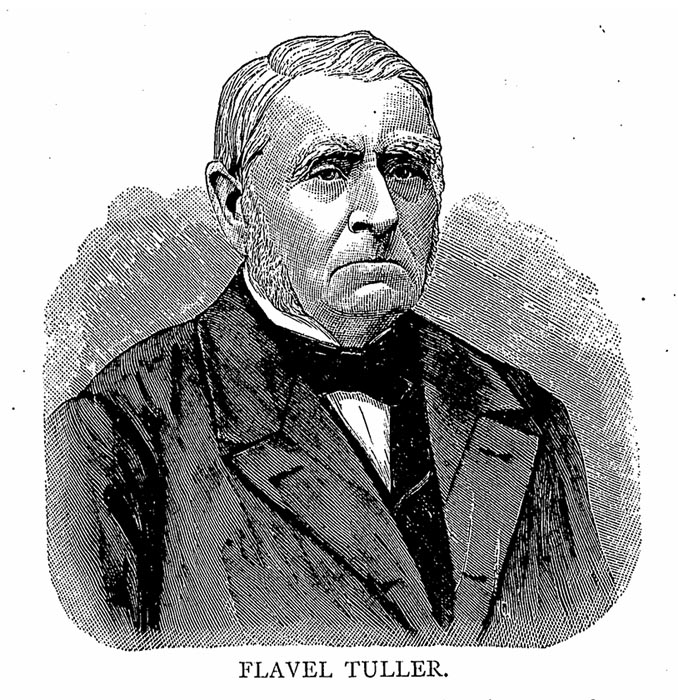
FLAVEL TULLER
The parents of the subject of this
sketch were, Bela M. Tuller,
born June 19, 1773, and Lydia
Holcomb, born June 19, 1776;
both natives of Simsburg, Hartford
county, Connecticut, where they were
raised, and where they were married
on the fifth of November, 1794.
After marriage they remained in the
neighborhood of their home, where
they had five children. In the
fall of 1806, the family removed to
Ohio, and in the latter part of
October joined the colony of eastern
people at Worthington, near which
place they remained until the
following March, when Mr. Tuller
bought one hundred and twenty-five
acres of land in the township of
Perry, and some two miles west of
Worthington. On this land was
a log cabin, a log barn, and a
partial clearing of some twenty-five
acres. Hard labor was yet to
be done to prepare the land for
cultivation; but a strong
constitution, backed by an iron
will, soon forced the mighty forest
to give way, and it was not many
years ere there was a large clearing
and abundant crops growing on the
hitherto uncultivated soil. In
this log cabin home in the woods
were born other children, four in
number, making a family of nine
members besides the parents.
The children were: Flavel, Homer,
Flora, Elvira (who died in
infancy), Lydia, Holcomb,
Achilles, Aurelius, and
Elvira, the second.
Flavel Tuller, the subject of this sketch, was
born in Simsburg, Connecticut, Dec.
7, 1795, and was nearly eleven years
of age at the time the family
settled in Ohio. The duties of
a man fell to him very early in
life, an he soon did his part toward
providing for the necessities of the
family. The land on which
their home was located was on the
main road to Sandusky, and as they
were soon enabled to raise grain and
stock to sell, a ready market was
found at their own door, where
emigrants were glad of an
opportunity to provide themselves
with supplies. In 1812,
Bela M. Tuller sold a load of
flour and agreed to deliver it at
Sandusky, where he arrived in safety
immediately after the receipt of
information that war had been
declared with England. As
teams were needed to work on the
fortifications, he was detained
until September, when he became sick
and was allowed to return to his
home. On his arrival in
Delaware he was so ill as to be
unable to proceed to his
destination, and word was sent to
his son, Flavel, who went to
him, and conveyed him to his home.
He never recovered from the effects
of this sickness, and died in 1821. |
Flavel Tuller engaged as a
teamster, in conveying supplies from
Urbana to the advance posts of the
army, in the war of 1812, in which
service he continued three months.
He then returned to his home, where
he remained until he became of age,
soon after which, with his brother,
Homer, he built a distillery
on their farm. The first
season they run this business they
made nothing, but the second season
they cleared some fifteen hundred
dollars, after which they disposed
of the business. The man to
whom they sold was unable to pay for
the property, and to cancel his debt
sold them his farm. Both were
hard-working, frugal, and honest
young men, and it was not long
before they had a reputation for
fair dealing, that gave them almost
unlimited credit among men of
property. As they were able to
bought land, until they were
possessed of considerable real
estate, which increased in value as
the country became settled.
All was not fair sailing, for they
sometimes met with losses; but in
the end perseverance gained the day,
and they found themselves in the way
to secure a competence.
Sometime after disposing of their distillery business,
Flavel and Homer Tuller
engaged in mercantile business, at
Worthington, where they continued
some twenty years, when they closed
out their stock, and entered into
the work of slaughtering and packing
pork. They labored at this for
some years, when they closed their
labors in this direction, and
transported two loads of pork and
provisions down the river, to the
vicinity of Natchez, Mississippi,
where the cargo was disposed of.
On the twenty-sixth day of January, 1832, Flavel
Tuller was married to Mrs.
Lucinda Holcomb, daughter of
William Webster. To them
were given four children:
Franklin F., and Henry Homer
(twins), the latter died in infancy;
Susan Lucinda, who married
H. H. Hall, and now lives in
Ashtabula; Henrietta S.,
married Horace W. Wright, and
lives in Worthington.
Franklin F., the eldest son,
married Eliza J. Foster, by
whom he had three children.
She died Sept. 15, 1879, at the
early age of thirty-four years.
Flavel Tuller has resided in Worthington, where
he has managed his various
enterprises these many years, and
now, in the eighty-sixth year of his
age, lives with his son ,
Franklin F. Mrs. Tuller,
wife of Flavel Tuller, died
at their home, Oct. 30, 1875. |
these years.
The last work he did in Worthington was to plant
the shade trees in the public square, now the
pride of the town. He was a man of
progressive ideas, and wished to see
improvements carried on. To his great
disappointment, just as the seminary was being
established, he was removed from his charge to
Zanesville, in 1842. In 1862 he was again
stationed at Zanesville and died there from a
stroke of apoplexy. At Zenia, in 1831, he
was married to Mary Ann Perkins, by whom
he had seven children. One of them,
Louisa, is the wife of James P. Wright,
and lives in Worthington.
EARLY
EVENTS.
The first regularly recognized religious society
was the Protestant Episcopal, which was
organized in the winter of 1803-4. It was
incorporated as a church in 1806-7. The
first house for public worship was built by the
Methodists in 1823. The first marriage
took place on the tenth day of February, 1804.
The ceremony was performed by Thomas Stephens,
esq., of Franklinton in the
log school-house at Worthington. The
persons united in marriage were Abner P.
Pinney and Miss Polly Morrison, and
Levi Pinney and Miss Charlotte Beach.
Every person then living in the place was
supposed to be present. The first justice
of the peace was Ezekiel Brown who was
elected in 1803, while what is now Sharon
township was a part of Liberty township.
James Kilbourn was the second justice,
he, also, being elected before Sharon was
set off. The first militia officers were:
James Kilbourn, captain; Aaron Strong,
lieutenant; Abner C. Pinney, ensign.
The first brick house was built by James
Kilbourn, in 1804. It is still
standing near the main street, on the southwest
corner of the public square, and is at present
owned and occupied by _____ Wells, esq.
The first fame house was erected by Ezra
Griswold in 1805. The building of the
Protestant Episcopal church was commenced in the
fall of 1828, and was completed the following
year. The Presbyterian church was built in
1829. The first tavern was kept by
Ezra Griswold, on lot seventy-one, in a
log cabin, in the year 1803. The first
store was kept by Nathan Stewart, in
1804, on lot seventy-one, in the log cabin
occupied the preceding year by Ezra Griswold
as a tavern, he having removed his tavern to lot
number sixty-one. The first distillery was
erected, by Nathan Stewart, in 1804, on
farm lot number twenty-five. The first
temperance society was formed in 1830. The
first grist-mill of any importance to the early
settlers, or, in fact, to Franklin county, was
erected by James Kilbourn, near
Worthington, on the Olengangy river, in, or
about 1805. About the same time a Mr.
Carpenter erected a mill on the same stream,
in what is now Delaware county, but, at that
time, was in Franklin. Another mill was
built on the Olentangy, near the village of
Worthington, in 1807, by Preserved Leonard.
This mill was in operation a number of years.
The motive power was obtained from Rush brook,
by means of a race, and wooden troughs, and was
carried a distance of nearly a quarter of a
mile, and allowed to fall on an overshot wheel.
Mr. Leonard, after running his mill a
number of years, sold it to Joab Hoyt,
who continued it some time, when it was allowed
to go to decay.
Samuel Maynard also built a mill on the
Olentangy, at a later date, still farther down
the stream. This has been rebuilt and
repaired many times since, and is now owned by
Jacob Weisenheimer, who does a good run
of custom, besides manufacturing and selling
flour in Columbus market.
Asahel Benedict had a blacksmith shop in
Worthington before 1812. Jabez
Fairfield worked with him, and was very
expert in shoeing cattle, and when the army
marched from Franklinton toward Sandusky, in
1812, the teams remained here a week until they
were shod.
Indians frequently traveled through the country from
their towns near Sandusky, and often stopped at
the houses of settlers. They were
friendly, and did no harm to the people, but
many were afraid of them. Some time before
the war a report was started that the Indians
were on the war path, and were coming to
slaughter the settlers. The alarm was
caused on the west side of the river at a log
rolling. While the men were at work in the
woods, the women were gathered at the cabin, and
while while they were in one room eating supper,
a girl prepared to sweep the room they had been
sitting in. While doing this, she
accidently knocked down a loaded gun that was
standing behind the door. The fall caused
it to explode, and the women imagined the
Indians were about to massacre them, and raised
the alarm, whereupon the settlers made a
stampede for the village. Messengers were
sent in every direction to war the settlers.
Many stayed during the night at the tavern of
Ezra Griswold, and many in the academy
building. The next morning a stockade was
built around the academy, and the place was
fortified as well as it could be on such short
notice, while men armed with guns, scythes,
pitchforks and such weapons as they had, stood
guard about the town. In a few days the
excitement subsided, when it was ascertained
that there were no Indians within many miles,
and the settlers returned to their homes.
Another story is told of the cause of this Indian
alarm. A company of militia was encamped
at Delaware, and the captain thought to try what
stuff his soldiers were composed of. One
night he posted the entire company on
picket, with instructions to be watchful, as the
Indians would probably attack them before
morning. Some time about midnight, the
captain fired a gun, and gave the alarm that the
Indians were coming. The pickets did not
stop to form the company, but every one broke
for his home as fast as possible. It is
said that one man ran nine miles through the
brush and briars to his home, and when he
arrived there, the only article of wearing
apparel he had on was a shirt collar. The bushes
through which he ran, captured the remainder of
his clothing. No one was left in the camp
besides the captain and officers who understood
the cause of the alarm.
Jedediah Lewis, sr., built a saw-mill on the
Olentangy, in 1807. He came with the
Granville company, but did not like the
location, and remained there but a few months.
He run his saw-mill until his death, which
occurred when he had been here but nine months.
Page 426 -
There was no regular mail to Worthington until
1805. Previous to that time, the mail was
brought from Franklinton by a young man, a clerk
in a store at Worthington. In the year
1805, the post-office was established in
Worthington, and mail was received regularly.
The first postmaster was William Robe,
who was a man of small stature, but well
proportioned; he was well educated and
afterwards became a teacher in the Worthington
seminary. He was then appointed to a
clerkship in the office of the auditor of State.
His death occurred in January, 1823.
JUSTICES.
The following is a list of justices of the peace
who have been elected and served in Sharon
township:
1803, Ezekiel Brown, elected when what is
now Sharon was part of Liberty township;
1805, James Kilbourn, elected when what
is now Sharon was part of Liberty township;
1806, Alexander Morrison, jr., in place
of Ezekiel Brown, after the organization
of Sharon;
1808, Ezra Griswold, in place of James
Kilbourn;
1808, Isaac Case, under an order for
an additional justice;
1809, Alexander Morrison, jr.,
re-elected;
1810, Azariah Pinney, in place of
Morrison, who was elected judge;
1811, Ezra Griswold, re-elected;
1811, Reuben Carpenter, in place of
Azariah Pinney, deceased;
1814, Recompence Stansberry, in place of
Glass Cochran;
1814, Isaac Case, in place of Ezra
Griswold;
1814, Cruger Wright, in place of
Reuben Carpenter;
1815, Ezra Griswold, in place of
Cruger Wright, who was set off to Harrison
township;
1817, Stephen Maynard, in place of
Isaac Case;
1817, Recompense Stansberry,
re-elected;
1818, Ezra Griswold, re-elected;
1819, Arora Buttles, in place of
Recompense Stansberry, appointed judge;
1820, Samuel Abbott, in place of
Stephen Maynard;
1821, Nathaniel Little, in place of
Ezra Griswold;
1822, Arora Buttles, re-elected;
1822, John Goodrich, jr., in lace of
N. Little, deceased;
1823, Samuel Abbott, re-elected;
1824, R. W. Cowles, in place of
Arora Buttles,
appointed judge;
1825, John W. Ladd, in place of
Goodrich;
1826, Samuel Abbott, re-elected;
1827, R. W. Cowles, re-elected;
1828, John W. Ladd, re-elected;
1829, Stephen Maynard, jr., in place of
Abbott;
1830, R. W. Cowles re-elected;
1831, John W. Ladd, re-elected;
1832, Isaac Case, in place of Maynard;
1833, R. W. Cowles, re-elected;
1834; John W. Ladd, re-elected;
1836, R. W. Cowles, re-elected, and
Asaph Allen, elected;
1837, Ira Metcalf, in place of
Ladd;
1839, Stephen Maynard and Levi
Pinney;
1840, George Taylor, in place of
Metcalf;
1842, Stephen Maynard and Philo Burr;
1843, George Taylor, re-elected;
1844, Ezekiel Brown, in place of
Maynard, resigned;
1845, Philo Burr, re-elected;
1846, George Taylor, re-elected;
1847, Ezekiel Brown, re-elected;
1848, Philo Burr, re-elected;
1849, George Taylor, re-elected, and
Luther Case, in place of Brown;
1851, Philo Burr, re-elected;
1852, George Taylor and Luther
Case, re-elected;
1854, I. N. Case, in place of Luther
Case, and P. Burr, re-elected;
1855, George Taylor, re-elected, and
Stephen Hoyt, in place of P. Burr,
removed to Iowa;
1856, Charles E. Burr, in place of
Hoyt;
1857, I. N. Case, re-elected;
1858, George Taylor, re-elected;
1860, C. E. Burr and I. N. Case,
re-elected;
1861, George Taylor, re-elected;
1863, C. E. Burr and I. N. Case,
re-elected;
1864, George Taylor, re-elected;
1866, I. N. Case, re-elected, and G.
H. Griswold, elected in place of C. E.
Burr;
1867, George Taylor, re-elected;
1869, George H. Griswold, re-elected and
C. E. Burr, in place of
I. N. Case.
WORTHINGTON
VILLAGE.
The village of Worthington was laid out in May,
1804, by Rev. James Kilbourn, as agent of
the Scioto company. It was surveyed and
divided into one hundred and sixty-two lots, of
which two were reserved, one for school, and one
for church purposes. The balance were
apportioned among the members of the company,
which, at the division of the property, was
dissolved. The lots were cleared, and
cabins built as suited the needs and the means
of the owners. The school-house was at
once erected, that the children of the community
might at once begin the acquirement of an
education.
The village was incorporated by act of the legislature,
Mar. 9, 1835, which ordered - "that so much of
the township of Sharon, in the county of
Franklin, as is comprised in the town of
Worthington, was originally established, with
the additional streets and lots thereunto
annexed, as recorded in said county, be, and the
same are hereby erected into a town corporate,
to be known by the provided, "that it shall be
lawful for the white male inhabitants of said
town, having the qualifications of electors, to
meet at the usual place of holding elections in
said town, on the second Tuesday in March next
(1836), and elect, by a plurality of votes, by
ballot, a mayor, recorder, and five trustees, to
serve one year, and until their successors are
elected." This act of incorporation was
signed by John M. Creed, speaker of the
house of representatives, and C. Anthony,
speaker of the senate.
An election was held, Tuesday, Mar. 10, 1835, at which
the following officers were elected:
James Kilbourn, Mayor; George H. Griswold,
recorder; Samuel Abbott, William Bishop, Ira
Metcalf, A. H. Pinney, and William S.
Spencer, trustees. After the election,
it was discovered that, by mistake, the charter
would not go into effect until Mar., 2, 1836,
and consequently the officers elect could not
legally perform the duties of their office.
The legislature, at their next sesssion
session (January 26, 1836), passed an amendatory
act, ordering that the original act should be in
force from and after its passage. The
regularly elected council met for business, Feb.
19, 1836, and appointed the following officers:
R. W. Cowles, treasurer; Captain Levi
Pinney, marshal; Captain Chauncey Barker,
street commissioner; Captain Abner Pinney,
Captain Dayton Topping, and D. W.
Harrington, fire wardens. On Mar. 14,
1846, an ordinance was passed by the council,
dividing the town into two wards, and, at the
same time, repealing an ordinance, passed Feb.
19, 1836, establishing three wards. Mar.
4, 1871, the two wards, established in 1846,
were consolidated, by ordinance. At the
regular election, held Mar. 8, 1836, the
officers of the preceding year were re-elected.
In 1837,
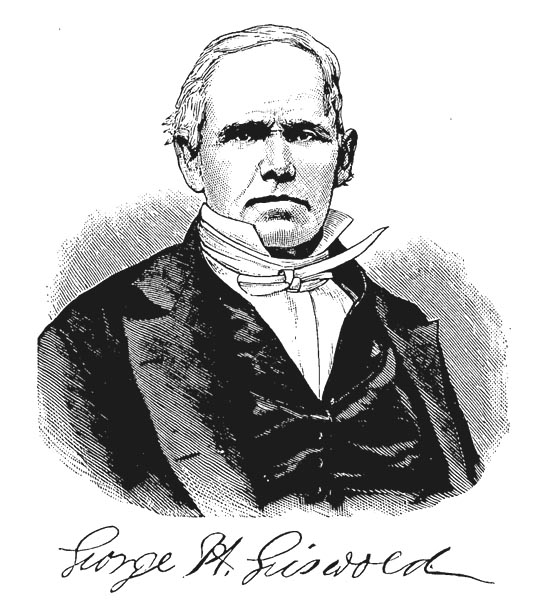
GEORGE H. GRISWOLD
In the summer of 1803 Ezra
Griswold and his family,
consisting, at that time, of his
wife, Ruth Roberts Griswold,
and six children, joined the band of
prisoners, comprising forty families
who organized in the eastern States
under the name of the Scioto
company, and emigrated to the then
wilderness of Ohio. The first
of the company to reach their
destination was the Griswold
family, who arrived on the
ground, where is now the town of
Worthington, Oct. 26, 1803, having
left Simsbury, Hartford county,
Connecticut, September 15th of the
same year. Their journey was
made in a wagon drawn by oxen, over
almost impassable roads, and through
an unbroken forest, and through
other members of the colony were
provided with teams of horses, such
was the condition of the roads that
the naturally slowly oxen completed
the journey the sooner by several
days. Mr. Griswold,
after his arrival, opened the first
public house in Worthington in 1803.
This public house he conducted
during the remainder of his life,
and at his death, was succeeded by
his son, George H. Griswold.
Ezra Griswold died Oct. 2,
1822. His wife survived him,
and died May 31, 1847.
George
Harlow Griswold, son of Ezra
and Ruth Griswold, the subject
of this sketch, was born in
Simsbury, Connecticut, May 21, 1795.
At the time of the removal of the
family to Ohio, he was eight years
of age. He remained with his
parents until he arrived at the age
of twenty-five years, when he was
married May 11, 1820, to Miss
Mila Thompson,
daughter of Judge William
|
Thompson, who
emigrated with his family from
Massachusetts to Worthington in
1803. She was born June 18,
1798. The ceremony of marriage
was performed by Bishop Philander
Chase, first bishop of the
Protestant Episcopal church in Ohio.
After marriage they settled in his
father's house on the northeast
corner of the public square, in
Worthington, where they ever after
lived.
Mr. Griswold, together with each member of the
little community, was much
interested in the cause of
education, and became one of the
founders of the promoters of the
Worthington academy, of which
institution he was the treasurer for
many years. His business,
during his life was of a varied and
general character, in the course of
which, and during a scarcity of
currency, in the year 1819 he issued
his individual currency to a large
amount, all of which he afterward
fully redeemed. He was also
engaged in farming, in addition to
the other pursuits he followed, and
in the course of a long and active
life, accumulated a large property.
For many years he was well known as
General Griswold, a title
obtained from his connection with,
and the interest he had in the
militia service during the old times
of "general master."
A man possessed of superior mental endowments, he
exerted a potent influence over his
fellow-men, and early became a
prominent and influential citizen.
From his well-known character as a
correct business man, he was almost
constantly the recipient of offices
within the gift of the people, and
always discharged the duties
pertaining to them with ability and
fidelity. |
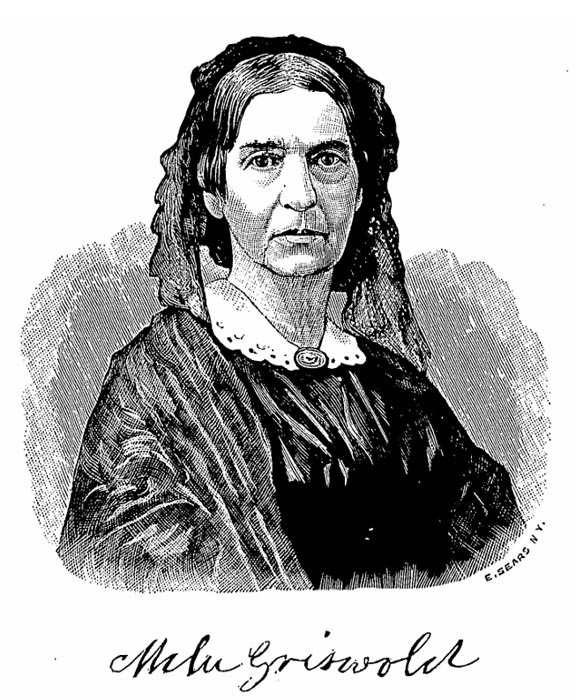
MILA GRISWOLD
|
Both General Griswold and his
wife were early members of the
Protestant Episcopal church, which
Mrs. Griswold joined on the day
of her marriage, and of which
she was a worthy and consistent
member to the day of her death.
She was a true woman as well as a
true christian, always the same -
modest, retiring, gentle, kind,
respected and loved by all who knew
her. She was the mother of
eight children, four of whom, one |
son and three
daughters, are still living.
She died in Worthington, Feb. 21,
1871. General Griswold
survived her, and died Mar. 9, 1876,
at his residence or the residence of
his son, W. F. Griswold, with
whom he made his home after the
death of his wife.
Portraits of George Harlow Griswold and Mrs.
Mila Griswold, his
wife, accompany this sketch.
|
Page 427 -
G. H. Griswold was elected Mayor;
Flavel Tuller, recorder,
Elias
Lewis,
Nathan Mason, George Taylor,
Ansel Mattoon, and Kingsley
Ray, trustees. The corporation
limits were extended Feb. 29, 1856.
In 1873 the corporation and township, jointly, bought a
building from the Worthington school-board, for
use as a town-hall. The cost of the
building was two thousand five hundred dollars.
The upper story was soon afterward sold to the
Independent Order of Odd Fellows, for use as a
lodge-hall. the present corporation
officers are: Dr. W. W. Bickett,
mayor; Dr. O. Johnson, clerk; W. F.
Griswold, treasurer; James Beers,
marshal; Horatio F. Griswold, treasurer;
James Beers, marshal; Horatio Wright,
William Yonel, S. T. Martin, F. F. Tuller, Dr.
T. B. Asbury, and I. N. Wells,
council.
POST-OFFICE
The post-office at Worthington was established
in 1805, in which year William Robe was
appointed postmaster. He continued in
charge until 1815, when Arora Buttles was
appointed. Recompense Stansberry
was appointed in 1821, and remained in changed
of the office until 1841, when R. W. Cowles
was appointed. He died the same
year, and Recompense Stansberry was
re-appointed and continued in the office until
his death, in 1843. He was succeeded by
George H. Griswold, who administered the
office until 1849, when George Taylor
took charge of it. He remained in the
office until 1853, when George H. Griswold
was re-appointed. Charles Martin, jr.,
was appointed in 1857, and was succeeded by
George Taylor in 1861. Since that time
there have been several post-master s: Mr.
Carpenter, A. W. Wood, Mrs. Sanderson, D. H.
Nash, T. B. Randall, T. B. Asbury, and the
present incumbent, F. W. Bishop, who was
appointed in 1877. A money-order
department was established in connection with
the office July 1, 1874.
A railroad station was erected on the Cleveland,
Columbus, Cincinnati & Indianapolis railroad,
three miles north of Worthington, in 1868, and
called Westerville station. The same
season a post-office was established at the
depot, and was named Flint post-office.
A. J. Willoughby was the first postmaster,
but Solomon Timmons, as deputy,
had charge of the office. H. M. & H. C.
Johnson surveyed village lots near the
station the same year. A small store was
opened at this point, in 1869, by Creighton
Eakin. In 1872 H. W. Johnson
was appointed postmaster, and engaged in
merchandising about the same time. The
office has since been kept at his store.
PHYSICIANS
The first physician who practiced medicine in
Worthington - Dr. Josiah Topping - came
with the first members of the Scioto company in
1803. Dr. Lamb came soon after, and
remained until 1806, when his wife died, and he
sold his property, removing to Delaware.
Dr. James H. Hill came to Worthington
about 1810, and practiced medicine until 1818,
when he sold his practice to Dr. Daniel
Upson. Dr. Wetmore practiced in 1820,
and for many years thereafter, until about 1850,
when he removed to Columbus. Dr.
Kinsley Ray came some time after
Dr. Upson, but did not remain in practice
here long. He was of the regular old
school, and the people of Worthington were
favorable to the practice taught in the Medical
College, which was the botanic school. This
was represented by Drs. Morrow, Jones,
Paddock, and others. The present
physicians of Worthington are Drs. Asbury,
Johnson, Bickett, and Lewis. Dr.
George R. Snow came with his father, John
Snow, in about 1816, then a young boy.
He studied medicine in Worthington, where he
commenced practice about 1830. After about
ten or twelve years he moved to Columbus, where
he practiced some ten years, when he returned to
Worthington. In about 1852 he engaged in
mercantile business, and remained at this until
about 1858, when he failed. He died some
ten years later, leaving a widow, one son, and
two daughters. He was a prominent and
successful who stood high in the profession.
WORTHINGTON
MANUFACTURING COMPANY
In 1811, Colonel James Kilbourn and
others formed a stock company, and were
incorporated under the above name, Colonel
Kilbourn being president and general agent
of the company. A tract of land, lying
adjoining the village on the southwest, and
cleared and improved, and in two or three years
the company had a large factory in operation.
They manufactured woolen cloth, run a tannery, a
shoe shop, cabinet shop, hat shop,
blacksmith shop, besides other industries.
They had stores in Worthington, Franklinton, and
Columbus, and issued their own notes, which were
in general circulation. A part of the
stockholders lived in the east, but invested
considerable sums of money in the business.
The factory furnished employment for a large
number of workmen, who were mostly paid from the
stores of the company. In 1819 or 1820 the
concern failed, and those who had invested money
in it were heavy losers. While in
operation, it contributed largely to the growth
and prosperity of the place, and its downfall
forced many of the workmen to change their
vocation, or seek homes in some other place.
The land on which the old factory stood is now
included in the village of Worthington, but no
vestige now remains of the works where so many
busy hands were employed in that early day.
NEWSPAPERS.
The first newspaper published in Franklin
county, was at Worthington, in 1811. It
was started by Col. James Kilbourn, who
was the first owner, and was called the
Western Intelligencer. He continued
its publication but a short time, when he sold
it to other parties, and, in 1814, the office
and material were removed to Columbus, where it
was published by P. H. Olmstead, Joel Buttles,
and Ezra Griswold. Its name was
changed to the Western Intelligencer and
Columbus Gazette. Since that
time it has passed through many hands, and was
the original foundation of the Ohio State
Journal. When published in
Worthington, in 1812, it supported James
Madison for the presidency. About the
year 1818, or 1819, another paper was started in
Worthington - the fourth one published in the
county. Its projectors were Ezra
Griswold, Jr., and Caleb Howard. It
was called the Frank-
Page 428 -
lin Chronicle, and was short lived, being
discontinued in about two years.
SCHOOLS.
WORTHINGTON
ACADEMY
WORTHINGTON
COLLEGE
REFORMED
MEDICAL COLLEGE
PREPARATORY
SCHOOL.
FEMALE
SEMINARY.
OHIO CENTRAL
NORMAL SCHOOL.
In 1871, Messrs. Mitchell and Ogden
purchased the property known as the
Worthington Female Seminary, which included
three acres of land, and a large four-story
brick building, with ample accommodations for
one hundred and fifty or two hundred students.
A normal school was inaugurated in September,
1871, which, from the start, received a large
patronage. The attendance the first year,
was one hundred and eleven; the second year it
had increased to one hundred and seventy-eight,
with a graduating class of eight. The
third year, Professor Mitchell engaged in
another profession, and the school was left in
charge of Professors Ogden and Lewis.
This year the attendance was two hundred and
fifteen, with a graduating class of seventeen.
In January, 1875, Mr. Lewis withdrew, and
Professor Ogden was assisted by Rev.
Charles H. Young, rector of the Episcopal
church, in Worthington; also, by Miss Carrie
Semple, and six members of the senior class,
as tutors. The attendance
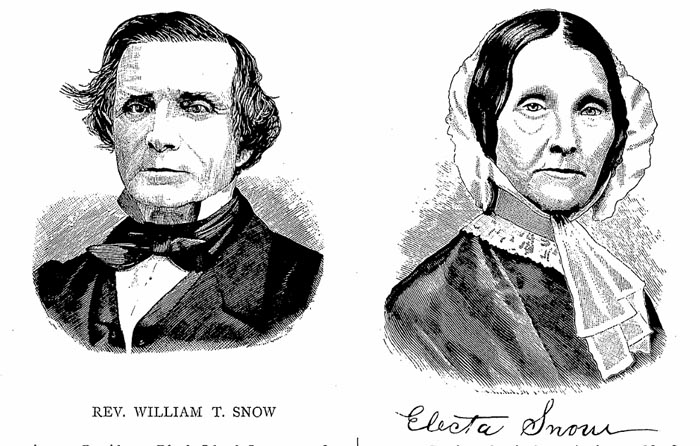
REV. WILLIAM
T. SNOW
ELECTA SNOW
|
REV. WILLIAM T. SNOW
was born at Providence, Rhode
Island, Jan. 1, 1803. He was
the first child of John Snow and
Mary Thurston. When quite
a youth, his father moved with his
family from Providence to
Worthington, Ohio. William
T., after acquiring a liberal
education, returned to the east, and
kept the books of a large cotton
factory, owned by a relative, where
he applied himself with his
accustomed diligence and success to
acquire a knowledge of the art of
manufacturing textile fabrics.
Returning to his home in
Worthington, his mind and soul
became deeply interested in
religion. He was converted,
and soon after was ordained a
minister in the Methodist Episcopal
church. He continued to travel
and labor with great success as an
itinerant minister in Ohio, Western
Virginia, and Michigan, for about
twelve years. During this time
he had married Elicta,
daughter of Captain Gad
Chamberlain, of Rome, Michigan.
Mr. Snow's delicate
constitution gave way under his
great exertions and exposures, so
that in 1836 he retired to his farm
in Oakland county, Michigan.
Here his active mind was at work,
and he was soon a leading citizen of
the county, holding important
positions, and representing his
county in the legislature. In
1855 he removed with his family to
Worthington, Ohio, for the purpose
of educating his daughters.
His untiring industry would not
permit him to remain idle. He
soon after engaged in business in
Worthington, opening a dry goods and
general store, which he continued
until September, 1873, when he sold
|
out to B. Crook,
and retired from business.
Mr. Snow, after giving up the
circuit, continued to preach,
without compensation, an opportunity
offered, while he lived; and was
particularly useful, while in
Michigan, in preaching to and
teaching the Indians. It is
related that an old Indian chief,
who had been converted under Mr.
Snow's ministry, removed some
eighty miles into the wilderness.
He died there, and his last words
commanded his wife to go and tell
Elder Snow, that it was "a good
die." The faithful wife walked
the entire distance to deliver the
message from the dying chief.
Mr. Snow died Jan. 16, 1875, at his home in
Worthington, Ohio, in great peace,
sustained by the faith he professed,
leaving his aged wife, a model of
piety and benevolence, surviving
him. He was the father of ten
children. The eldest, Mary,
wife of Dr. Carr, of
Michigan, died many years ago. Five
survive their father - Lida H.,
wife of John G. McGuffey, of
Columbus, Ohio; Julia C.,
wife of Rev. T. S. Stivers,
of Pomeroy, Ohio, Nettie J.,
wife of C. E. Stivers, of
Chattanooga, Tennessee; Susan B.,
and Jennie D.
The
distinguishing features of Mr.
Snow's character were a bright,
strong, and active mind, industrious
and systematic in business; prompt
and exact in all business
engagements; clear and concise as a
pulpit orator, and an exalted trust
in providence. He was greatly
loved and deeply mourned. |
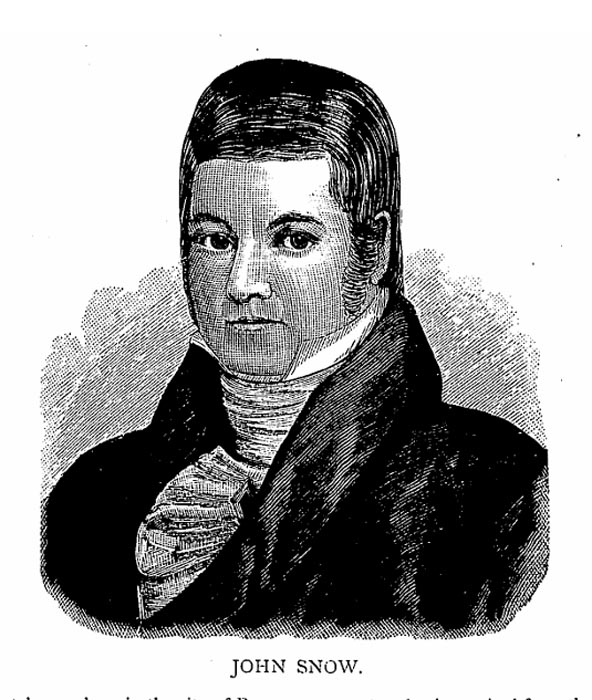
JOHN SNOW
The subject of this biographical
sketch, was born in the city of
Providence, Rhode Island, the
fifteenth of February, 1780.
At the age of fourteen he was
apprenticed to Mr. Dodge, of
that city, who was engaged in the
manufacture of Jewelry, where he
remained for seven years.
After attaining his majority, and
completing his term of service, he
removed to Newport, in the same
State, where he prosecuted the
business of manufacturing jewelry
for two years. The close
application he was required to give
to his work injured his health, and
he was advised to engage in some
less sedentary avocation. He
then returned to Providence, where
he engaged in the mercantile
business, at which he continued
until 1817, when he emigrated to
Ohio.
He was married, Mar. 22, 1802, to Mary Thurston,
a grandniece of E. Wanton,
first colonial governor of Rhode
Island. To them were born four
children, three of whom lived to
maturity: William T.
who became a respected and honored
minister of the Methodist church,
and died at Worthington; George
R., who became a physician and
druggist, and also died in
Worthington; and John W., who
went to New Orleans, where he died.
John Snow was initiated into the mysteries of free
masonry in Mount Vernon lodge,
Providence, Feb. 14, 1809. In
the second year of his membership,
he was elected as master of the
lodge, which position he continued
to occupy, with honor to himself and
great benefit to the craft, until he
removed to his new home and the
scene of his future labors in the
new State of Ohio. His
earliest masonic record after his
settlement in Ohio, appears on the
minutes of a special meetings of New
England Lodge, No. 4, at
Worthington, Sept. 29, 1817, where
he was registered as a visiting
member. Thomas Smith Webb,
an early and life-time friend, and
his masonic preceptor, was also a
member of the same lodge. On
the seventh of October, 1818, he was
elected as master of New England
lodge. It was while he
occupied this position that the
masonic fraternity of the State
availed themselves of his eminent
qualifications, and assigned him to
the onerous duties of grand master
and grand lecturer for the State.
In this character, he was required
to visit every lodge in the State,
inspecting their records, correcting
irregularities, and reducing the
work and lectures to a system of
harmony and order. By a
succession of re-elections, he
continued to hold the office of
master of New England lodge until
Oct. 30, 1822, when he made an
eloquent address to the lodge on the
subject of electing officers, and
concluded by declining further
service as master of the lodge.
Notwithstanding his declination to
serve, he was unanimously
re-elected; but, positively
declining to serve further, James
R. Pearce was elected his
successor. Subsequently to
this time the lodge voted --
"That Brother John Snow, our late worshipful
master, ahs manifested an
extraordinary attachment to the
principles and institutions of
masonry, and zeal for the stability
and honor of the order, during the
time he has acted as presiding
officer of the lodge; and that he is
eminently entitled to our gratitude
for the masonic knowledge he has
diffused among us, and for having
originated and prosecuted the
undertaking of erecting the Masonic
hall in this town." |
In 1827, having retired from the
chair he had so long occupied in the
grand lodge, he again accepted the
office of master of New England
lodge, which he held continuously
until 1832, when he again declined
to serve. His masonic zeal was
not confined to the duties connected
with the lodge, nor was it limited
to "ancient craft masonry." He
was prominent as a Royal Arch mason,
and was the first grand commander of
the first encampment of christian
knighthood northwest of the Ohio
river. He was elected to the
office of high priest of Horeb
Chapter, No. 3, of Worthington, Nov.
17, 1818, which position he filled
with zeal and faithfulness until
1822, when, for the same reasons
that he declined office in the
lodge, he refused to succeed to the
office of high priest of the
chapter. He was again elected
to the same office in 1827, and
served in this connection three
successive terms, and during this
time was voted, by his companions, a
silver cup, as a testimonial to his
services in the erection of Masonic
hall.
On the fourteenth of March, 1818, Sir John Snow
received from M. E. Thomas Smith
Webb, deputy-general grand
master of the general grand
encampment of the United States, a
dispensation authorizing him to
assemble together, in the town of
Worthington, in the State of Ohio, a
sufficient and legal number of
Knights Templar, Knights of Malta,
and of the Red Cross, and open a
council and encampment in said town,
and therein confer said orders upon
such tried and worthy companions of
the Royal Arch, as may make
application for the same.
Accordingly, all knights residing
within the distance of forty miles
were summoned to convene with him on
the fifteenth of March, 1818, at
which time and place appeared Sir
Thomas S. Webb, from the general
grand encampment of the United
States, and grand encampment of
Massachusetts and Rhode Island;
Sir John Snow, hailing from St.
John's encampment, Rhode Island; and
Sir Frederick A. Curtis,
hailing from _____ encampment,
Ireland. On the twentieth of
March, 1818, an encampment of
Knights Templar was opened, and
sundry applicants were admitted to
the order.
On the twenty-seventh of January, 1822, the general
grand encampment of the United
States, Sir Dewitt Clinton
presiding, granted to Sir John
Snow, and his associates, a
charter "to from, open, and hold an
encampment of the valiant and
magnanimous orders of R. C. K. T.,
and K. of M., or order of St. John
of Jerusalem, by the name, style and
title of Mt. Vernon
encampment." To this
encampment, Sir John Snow was
appointed first grand commander, to
which office he succeeded until
1830, when the infirmities of age
admonished him to retire from the
active duties pertaining to the
order.
During his declining years Mr. Snow devoted his
time to the management of the drug
business, which he opened in
Worthington, and at which he
continued during the remainder of
his life, which closed at
Worthington, May 16, 1852.*
---------------
* The biography of Sir John Snow has been
compiled from the printed records of
the proceedings of the grand lodge
of Ohio, for the year 1853, aided by
such additional information as he
could be obtained from family
records. |
Page 429 -
that year was two hundred and fourteen, with a
graduating class of twenty. The course of
study embraces a review of the common branches,
the higher branches, and the languages. In
addition, there is a professional course,
embracing the whole doctrine of educational
growth and progress. Two new departments
have recently been added to the school, viz.: a
model school, composed of three grades -
primary, intermediate and high school, and a
genuine Kindergarten, for the purpose of
training teachers, as well as exhibiting the
true methods of culture for little children.
A normal institute, of five or six weeks, in
July and August, of each year, is an important
feature of the school. For the year 1879,
the school is under the care of John Ogden,
A. M., as principal, and W. H. Tibbals,
A. M., as assistant principal. The school
ahs been re-organized the present season, by
Professor Ogden, who is now the owner of the
property.
PUBLIC
SCHOOLS
CHURCHES.
ST. JOHN'S
EPISCOPAL CHURCH.
METHODIST
CHURCH.
Page 430 -
PRESBYTERIAN
CHURCH.
THE
METHODIST CHURCH.
THE
UNIVERSALIST CHURCH.
CEMETERIES
Several meetings of citizens of Worthington were
held, in November and December, 1858, and a
committee was appointed to examine grounds for
use for cemetery purposes, and to make a report
as to the terms of purchase of a suitable tract.
They reported, in December, in favor of a ground
on the land of Mr. Hoyt. The report
was favorably considered, and a meeting of the
citizens, on the proposed ground, was held Jan.
20, 1859, which was largely attended. At
this time the committee perfected arrangements
for the purchase, from Mr. Hoyt, of fifty
dollars, with the view of selling all but ten
acres. These grounds are situated within
one mile of Worthington, and south from the
village, near the east bank of the Olentangy
river, and in full view from the pike leading to
Columbus. They contain a little more than
ten acres of land, and are covered with a growth
of young walnut, trees, from which the cemetery
is appropriately named.
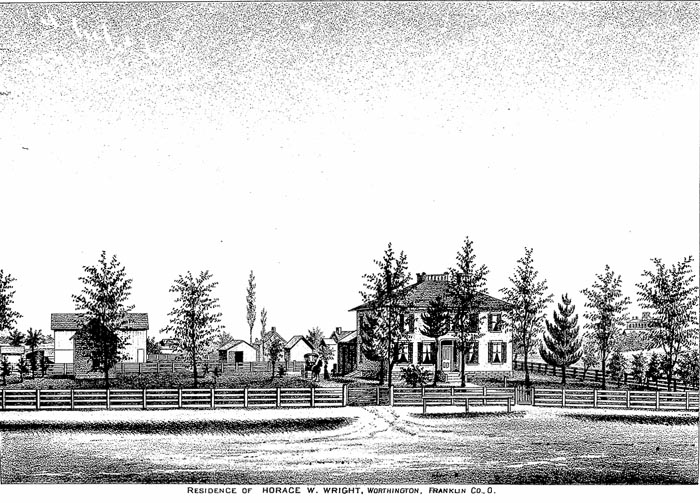
RESIDENCE of HORACE W. WRIGHT, WORTHINGTON,
FRANKLIN CO., O.
Page 431 -
Immediately after the purchase of the grounds,
the labor of improving them was commenced.
The first burial, that of James N. Taylor,
took place Feb. 1, 1859. In June, 1861,
the corporation of Worthington added some three
acres to the cemetery, on the east, which was
purchased from Mr. Park. They also
secured a road on the south line of Mr. Peck's
land. the grounds have been considerably
improved since their purchase, and many bodies
have been removed from the old grounds to the
new.
SOCIETIES.
THE MASONIC
FRATERNITY.
New England Lodge, No. 4, at Worthington, was
organized June 28, 1808, under a charter issued
by the grand lodge of the Free and Accepted
Masons, for the State of Connecticut, and dated
October, 1803. At the same time a
charter was granted for the organization of Erie
Lodge, No. 47, in Trumbull county. The
lodge at Worthington was designated, in the
original charter, as New England Lodge, No. 48,
and its charter was to continue to force until
one year after the institution of a grand lodge
in the State of Ohio. Rev. James
Kilbourn was appointed first master of this
lodge. No record appears of the formation
of this lodge until 1808, at which time Ezra
Griswold and James Kilbourn were
appointed delegates to visit Chillicothe, and
assist in the formation and institution of the
grand lodge of Masons in Ohio. Th_ first
officers of New England Lodge, No. 48, were:
James Kilbourn, W. M.; Zopher
Topping, S. W.; Josiah Topping,
J. W.; Ezra Griswold, secretary;
Israel Case, treasurer; Stephen
Maynard, S. D.; Roswell Wilcox,
J. D.; Azariah Pinney, tyler.
At the meeting to consider the organization of a
grand lodge in Ohio, the delegate from New
England lodge, James Kilbourn, was
not allowed to sit in the convention, the reason
assigned being that the lodge itself had not
been formally organized. On June 28, 1808,
Thomas Worthington, of Chillicothe,
conducted the ceremonies of installation of the
officers of New England lodge.
During the years 1808 and 1809, the lodge
continued to work under the Connecticut grand
lodge warrant. In September, 1809, in
response to an invitation from the grand lodge
of Ohio, it was resolved to unite with them, and
in January, 1810, the lodge made returns, and
was represented in the grand lodge by Rev.
James Kilbourn, then chaplain of New England
lodge. In 1814, six years after the
formation of the grand lodge of Ohio, this lodge
obtained its rank and number - four.
Number one was left blank for American Union
lodge, which was chartered in 1776; number two
was Nova Caesarea lodge, of Cincinnati; No. 3,
Erie lodge, of Warren, Trumbull county, and No
4, New England lodge, of Worthington. Many
men of Ohio, eminent of civil life, was well as
Masonry, have been members of New England lodge,
among them are John Snow, Thomas Smith Webb,
both of whom held high offices in the grand
lodge and grand chapter of the United States;
Chester Griswold, Aaron L. Buttles, Rev.
Philander Chase, first Episcopal bishop of
Ohio, and many others, who have held important
places of trust in the State and nation.
In 1820, the Masonic fraternity of Worthington
erected a substantial brick hall for lodge
purposes, which is still used at this time -
1879.
Mt. Vernon Commandery, No. 1, of Columbus, was
organized at Worthington, Mar. 15, 1818, under a
dispensation issued by the general grand
encampment of the United States, Mar. 13, 1818.
this commandery was organized by Sir Knight
John Snow, from St. John's encampment, Rhode
Island, Sir Knight Frederick A. Curtiss,
from _____ encampment, Ireland, and Sir
Knight Thomas S. Webb, from the general
grand encampment of the United States. A
charter was granted by the general grand
encampment of the United States, Sept. 16, 1819,
the Hon. De Witt Clinton then presiding
over that body. The first officers under
the charter were: John Snow, G.
Com.; Chester Griswold, Gen.; James
Kilbourn, Capt. Gen.; Joseph Hughes,
prelate. At a regular conclave, held on
the twenty-second of February, 144, it was
"unanimously resolved to accept the order of the
grand encampment, made at its late meeting, at
Lancaster, authorizing and empowering this
encampment to hold its meetings, a portion of
the year, in Columbus, and has, since that date,
been kept in the capital city. No order
was ever again issued for the assembling of the
encampment at Worthington.
"In looking through its records, it is found that royal
arch masons from Indiana, Missouri, Kentucky,
Tennessee, and Louisiana, received orders from
this commandery. All the grand masters of
the grand lodges of Ohio, for nearly fifty
years, with one or two exceptions, were knighted
at this commandery."
Horeb Chapter, No. 3, of Worthington, was organized
under a dispensation from the deputy grand high
priest of the grand royal arch chapter, of the
State of Maryland and District of Columbia, Dec.
18, 1815. Its first officers were James
Kilbourn, H. P.; Chester Griswold,
K.; Abner Lord, S.; Solomon Smith,
secretary; Moses Byxbee, P. S.; H.
Hyre, C. of H.; N. Potter, R. A. C.;
A. Buttles, V. Shaw, S. Smith, M.
of V. The officers for 1879, were: F.
A. Bull, H. P.; Horace W. Wright, K.;
S. S. Pinney, scribe; J. P. Wright,
treasurer; T. B. Asbury, secretary;
George Clark, C. of H.; J. R. Topping,
P. S.; W. R. Bartles, R. A. C.; E.
Weibling, Charles Clark, R. Osborn, M. of
V.; R. N. Richardson, guard.
INDEPENDENT
ORDER OF GOOD TEMPLARS.
Ark Lodge, No. 270, Independent Order of Odd
Fellows, was chartered by the Grand Lodge of
Ohio, Feb. 22, 1855. The charter members
were Isaac N. Case, Anssel Mattoon, Isaac
Thompson, Almon S. Wood, and James M.
Fuson. The lodge was instituted Apr.
16, 1855, by Thomas J. McLain, grand
master of the State. It has now a
membership of sixty, composed of the best
citizens of Sharon township. In 1873 the
lodge purchased the upper story of the town hall
building for a lodge hall, which is now neatly
fitted up and supplied with the proper emblems
of the order. It is in a prosperous
condition, financially, having a surplus of over
one thousand dollars, and no debt. The
present officers are Thomas Bonner, N.
G.; J. B. Stewart, V. G.; W.
Page 432 -
W. Bickett, P. S.; Adolphus Tuller,
treasurer; H. W. Wilcox, recording
secretary.
OLENTANGY
ENCAMPMENT.
Olentangy Encampment of Patriarchs, No. 149, was
chartered May 8, 1872, and was instituted May
31st of the same year, by Joseph Dowdall,
R. W. grand scribe. The charter members
were L. T. Gardner, J. M. Fuson, D. M. White,
W. W. Fuson, H. Chambers, J. E. Wright, H. B.
Stickney, A. Tuller, A. S. Wood, and J.
T. Bowen. the first officers were
D. M. White, C. P.; H. B. Stickney,
H. P.; H. Chambers, S. W.; W. W. Fuson,
S.; J. M. Fuson, treasurer; A. Tuller,
J. W. Meetings are held at Lodge
hall of the Independent Order of Odd Fellows.
GRANGE.
Sharon Grange, No. 690, was organized under a
dispensation from the State Grange, Mar. 14,
1874. It received its charter July 1st of
the same year, at the time having twenty-five
members on the roll. The grange rapidly
grew until in December, 1875, it had one hundred
and six members. Regular meetings are held
twice every month, in the town hall. The
first officers of the grange were: H.
W. Wright, master; Marcus Case,
overseer; G. B. Goodrich, lecturer; S.
S. Pinney, steward; E. M. Stanley,
assistant steward; J. P. Wright,
treasurer; J. M. Fuson, secretary;
Samuel Watson, chaplain; George Lewis,
gate-keeper; Mrs. H. W. Wright, ceres;
Mrs. George Lewis, pomona; Mrs. S. R.
Holt, flora; Miss Ella Stanley, lady
assistant steward. Master for 1879 is
Dr. T. B. Asbury; secretary, M. Case.
CELEBRATION.
The first celebration of Independence Day in the
new colony took place July 4, 1804. The
brush was cleared out from the space now
occupied by the public square, and rude seats of
logs arranged for the assembled people to sit
upon. An address was delivered by Col.
James Kilbourn, and a national salute given
by falling seventeen large trees, in honor of
the seventeen States of the Union, instead of
firing so many cannon.
SURVEYOR'S
MARKS.
As late as 1832, there was still standing, on
the southwest corner of this township, a tree,
marked "No. 1, T. 1, R. 19, I. L." (Israel
Ludlow, all of which appeared very ancient,
though no date appeared. In making a
survey in the settlement of a dispute as to lot
lines, the fourth day of April, 1834, Ezra
Griswold found, at a distance of forty-six
rods west from the corner ascertained as the
right hand lower corner of this plat of the
Scioto company, another corner, or center of the
township, near which was a tree, marked: "No. 4,
T. 2, R. 18, I. L." Another, marked: "No.
3, T. 2, R. 18." Another marked: "No. 2,
T. 1, R. 18., I. L." The initials, "I. L.,
" it is presumed, means Israel Ludlow,
who surveyed here, about 1798.
GAME AND
FISH.
For many years after the first settlement of the
county, the rivers abounded in fish, and the
forests were the haunt of a great variety of
game. Fish were caught by means of nets,
and sometimes with a brush seine, which required
from ten to twenty men to handle. Large
quantities of excellent fish were caught, there
being at that time no obstruction to prevent
their coming up all the streams.
Hunting was followed by many from a love for the chase,
for purposes of food, and for the protection of
the crops. A grand ring or drive hunt was
organized before the country became very thickly
settled. A day was appointed, and a line
formed at Columbus, and extending across the
country from the Olentangy river to Alum creek,
on the east. Another line was formed near
the Delaware county line, when the two parties
commenced their march, meeting below
Worthington. On the conclusion of the
hunt, it was found that five hundred wild
turkeys, thirty deer, and several bears had been
killed. The wolves escaped to the swamps,
and none were brought in. In early times
the squirrels became so plenty as to be a
positive nuisance, and committing great damage
to the corn. A notice was accordingly published
in the Columbus Gazette, of Aug. 29,
1822, calling for a grand squirrel hunt of all
the people in the vicinity, said hunt to
continue two or three days. The hunt took
place Saturday, Aug. 31, 1822, and when the
report of the slaughter was brought in it
figured up to nineteen thousand six hundred and
sixty scalps that were produced. Very many
of the hunters did not report, and it was
impossible to give the exact number that were
killed.
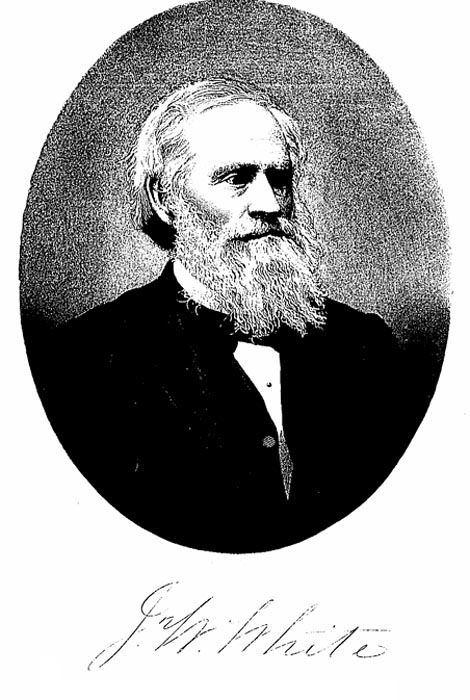
J. W. WHITE
REV. J. W. WHITE
the subject of this sketch, was born in Palmyra,
Maine, Nov. 2, 1813. He was the eldest of
the six sons of Deacon John White and
Betsey White; three of whom have passed
away, while each of the three remaining are
ministers of the gospel. Deacon White
was a man of large frame, broad intellect, fixed
principles, deep piety, and of great
hospitality. He was widely known, held
many offices both in church and State, and, at
eighty-seven years of age, called to his
death-bed his children, and his children's
children, blessed them, and passed peacefully to
the home of the just. His mother,
Betsey Jewett, was one of the numerous
Quaker Jewetts, of New Hampshire; a woman of
culture and great sweetness of disposition.
She never struck one of her six sons or three
daughters, and, after living happily with her
husband for sixty-three yeas, and seeing well to
the affairs of her household, she sweetly passed
to a rich reward, at eight-three years of age,
loved and mourned by all who knew her. Her
memory, to her children, is as a sweet perfume,
lingering around a broken vase.
Mr. White was raised in true New England style.
The first lesson taught him was that there were
just as many months already as the barren soil
could fill, and if he ate, his own hands must
earn his subsistence. He worked on a farm,
or in a boot and shoe shop, in summer, and
attended a district school in winter.
Fifty years ago, even a New England common
school, with its broad seats without backs,
mysterious text-books, and cheap, incompetent
teachers was but a sorry place in which to gain
knowledge. In boyhood, a love of books
became a passion. At fifteen years, he had
literally devoured the family library, which
consisted of such works as "Baxter's Call,"
"Edward's Sermons," "Bunyan's
Pilgrim's Progress," "Robinson Crusoe," and the
writings of John Calvin; while in poetry
was "Rouse's Version of the Psalms" and "Watt's
Hymns." The first books he ever owned were
bought with money resulting from a patch of
potatoes raised by working early in the morning
and late in the evening. They were a novel
by Walter Scott, "Pollok's Course
of Time," "Milton's Paradise Lost," and "Blackstone."
With these, and a tallow candle, when his day's
work was done, he held nightly converse.
Scott fired the imagination, Pollok
soothed, while the grand numbers of Milton
awoke reverence, and Blackstone came in
to hold the boy level, and save him from poetic
frenzy.
In 1832, Mr. White began to cough, and it was
thought best that he leave the farm and engage
in a business where he would not be liable to so
much exposure; he accordingly entered a store,
as clerk. His employer was a man of
culture, and kindly aided him in his studies.
Here he made rapid progress. During the
fall and winter he recited to a college
professor, and paid for text books and tutelage
by chopping cord-wood, at thirty-seven cents a
cord. These were real life struggles, but
to him they were what friction is to the diamond
- they polished and brought out the lustre
within him. Achillean invulnerability can
only be possessed by frequent baptism in the
seas of difficulty. Veterans are only made
upon the battle-field. The truest and
grandest manhood is developed by early and
heroic struggles.
In 1833, he came in Ohio. While in Granville,
Ohio, under the preaching of Rev. Lyman
Beecher, of precious memory, he sought the
Savior, and made a public profession of faith in
Christ. He proved that He was able to save
to the uttermost all who came unto Him.
The same year, while attending a protracted
meeting, in Newark, he united with the Methodist
Episcopal church. In the fall of 1844 he
was licensed to exhort, and preached his trial
sermon in the Town Street church at Columbus.
He was licensed to preach, and was recommended
as a suitable person to be received into the
traveling connection, by the conference then
sitting in Circleville. In five days from
the date of his license he had settled his
business, equipped himself with saddlebags,
bible, hymn-book, "Watson's institutes,"
"Fletcher's Appeal," the "Methodist Discipline,"
and "Butler's Analogy," and without theological
training, had taken up his line of march to the
then wild hills of the Hock-hocking, to enter
upon his life work. In 1836, he passed
creditably an examination in his course of
study, and was elected and ordained deacon.
In 1838, he had completed his course to the
satisfaction of the conference, and was ordained
elder.
In June, 1840, he was happily united in marriage with
Anna C. Williams, eldest daughter of the
late Judge Hosea Williams, of Delaware.
Although reared amid luxury, she entered
heartily into the arduous and difficult duties
of the wife of an itinerant, aiding and cheering
her husband, and patiently and heroically
sharing his wandering life, and now shares his
retirement in their beautiful home.
Thus for forty years he has trod on in the active
ministry; seven years on circuits, twenty-two
years in city stations, and eleven years on
districts as presiding elder. In the fall
of 1874, weary from long and active duties of
his ministry, he asked and obtained a
superannuated relation. He then bought and
refitted his first home, which he named "Maple
Home," furnished it comfortably, and retired in
the quiet village of Worthington.
Their three children, all they have had, are living,
happily married, and well settled. We
found this aged couple in their beautiful home,
cheerful, hopeful and happy. They have
fought and won. Blessed with plenty,
surrounded with friends, and being of cheerful
and grateful dispositions, very sunny is life's
afternoon. For such an evening one can
afford to do battle all the live day. the
results of such lives may not be measured in
time.
_______________
HORACE W. WRIGHT
The subject of this sketch was born in
Worthington, Ohio, Jan. 30, 1830, and here he
has since lived. In his youth, he attended
the schools of his native town, but did not
pursue any prescribed course. During the
winter of 1849-50, he studied at Kenyon college,
Gambier, and on his return worked for his
father, on a salary, until the death of the
latter, Sept. 3, 1855. Potter Wright,
the farmer of Horace W. Wright, came from
Providence, Rhode Island, to Worthington, about
the year 1815, in charge of machinery for a
cotton-mill, which it was designed, and the
owner shipped it to another point. Mr.
Wright came to the new country, owning to
the glowing descriptions of the prosperity of
the community and the grand future in store for
the embryo town. He expected to find a
thriving village, already in a fair way to
become a great city, but was disappointed when
he saw it in a crude shape, and yet to be hewn
out of the forest. For some time after his
arrival, he worked for Worthington Manufacturing
company, on a salary, but eventually withdrew
from their employ, before the affairs of the
company became hopelessly deranged, and in
payment for his services received a house and
lot in the village, which afterward became his
home, and is now occupied by his daughter,
Cynthia. After leaving the service of
the company, he erected a shop, and engaged in
the manufacture of carding and spinning
machinery, and other machinery used in cloth
making and cloth dressing. Here he built
up a business that extended to many States, and,
during his lifetime, accumulated a considerable
property, which, at his death, was administered
by his son, Horatio, and was divided
among his children. His wife was Lovisa,
born eight children: Horatio, Mason M.,
Cynthia, James P., Horace W., Henry, George,
and Sarah, six of whom are now living,
one at Danville, and one at Paxton, Illinois,
and three sons and one daughter in Worthington.
Mr. Wright used, as a motto on the
machinery he manufactured, the legend: "Flourish
ye western manufacturers."
Horace W. Wright, of whom previous mention is
made, engaged in farming, which avocation he has
followed during his life. To this he has
also added the care of the saw-mill in
Worthington, which he has owned and managed
during the past five years. On Oct. 29,
1862, he was married to Henrietta S. Tuller,
daughter of Flavel Tuller. To them
have been born five children - Kate, Frank,
Albert, Bernard, and Helen.
Three of these, Albert, Kate and
Bernard, were attacked by that dread
disease, diphtheria, and all died within one
week, on the ninth, tenth, and sixteenth of
November, 1876. Mr. Wright had been
successful in his business life, and has
accumulated a good property as the result of a
life conducted under strict principles of
integrity. He built his present fine brick
dwelling house, a representation of which
appears herewith, in 1861.
<
CLICK HERE to RETURN to TABLE of CONTENTS
> |