|
Madison, in territorial extent, exceeds any
other township in the county, and, with the
possible exception of Hamilton, is also the best
agriculturally. It is within the tract
denominated Congress lands, and was organized as
a township in 1809. By an act of the
legislature, passed at the session of 1850-51, a
range of sections, being a strip one mile wide
and six miles long including the town of
Winchester, was taken from Fairfield county and
annexed to the east side of Madison, making the
township, eight miles in extent, north and
south, and seven miles east and west, with the
exception of the jog in the southeast corner.
The township is well improved, the farms and
orchards of moderate size, being generally owned
by their occupants, and containing good
dwellings, barns and other improvements.
STREAMS.
Madison is among the best watered townships in
the county. Big Walnut (or, as now called,
Gahanna river) enters the township a short
distance west of the center of the north line,
and Alum and Black lick creeks in nearly the
northwest and northeast corners, respectively.
The three streams unite their waters in section
seventeen, of the northwest quarter, the stream
thence flowing a southerly direction until
reaching section twenty, where it turns
southwest and flows in that direction into
Hamilton township. Little Walnut creek
reaches the township just south of Winchester,
from Fairfield county, flows thence a generally
western course through the south half of the
township, until south of Groveport, when it
takes a southerly course, flowing into Pickaway
county.
PIONEER
SETTLERS
The first settlements
in Madison township were commenced as early as
1803 or 1804. One of the earliest of the
pioneers was George Tounge, who settled
on the run, where Wesley Lawrence now
lives. He subsequently removed to Carroll,
Fairfield county, and died there.
JOHN WRIGHT, sr.,
came from Pennsylvania, with his parents,
David and Sarah Wright, who settled in Bloom
township, Fairfield county. He married
Catharine Dildine, and a short time
afterward removed to Franklin county, and
located on the farm now owned by Jeremiah
Kalb; he died there, in 1815, at the age of
about thirty three. His widow subsequently
married Joseph Dunnnck, whom she
also survived. She finally went to Hancock
county, where she died, in 1878, at her
daughter's (Mrs. Wiley), at the
advanced age of ninety-three. She had, by
her first husband, three children, viz: John,
who still resides in Madison, where he was born,
in 1805, being one of the first children born in
the settlement: David, who lives in
Hancock county, and Sarah (Mrs.
Wiley), in Wood county. By her second
husband, Mrs. Dunnuck had four children,
the only survivor of whom is William Dunnuck,
attorney-at-law in Columbus.
JAMES RAMSEY, a
native of Pennsylvania, went to Virginia, when a
young man, and there married Ruth Van Meter.
They moved to Kentucky, then called the
"backwoods," and a few years afterward removed
to Ohio, with two children. They settled,
and remained for two years, on the Scioto river,
in this county, and, about 1805, moved to this
township, entering a half section, where
Edward's station now is. At first they
occupied a rough log cabin; afterwards, a hewed
log house, built as early as 1810, which is
still standing, and occupied. James
Ramsey died in April, 1828, aged sixty-two
years, his wife surviving him some ten years.
They had a family of twelve children, only two
of whom now survive - Nancy, widow of
Jacob Andreck, in Lancaster, and Susan,
wife of Kalita Sallee, near Groveport.
SAMUEL and
ROBERT RAMSEY, the former an elder, and the
latter a younger brother of James Ramsey,
same out at the same time. Samuel
took up a quarter section just north of his
brother, James. He remained single
until about the age of sixty-two, when he
married Mrs. Margaret Karshner of
Hamilton, and lived in this township until his
death. Robert Ramsey settled just
over the line, in Hamilton, on the bank of Big
Walnut, and is further mentioned in the history
of that township.
STAUFFEL KRAMER
moved in about 1805 or 1806, and located on the
run where David Martin now lives.
He died there not long after his settlement, and
his death was one of the first that occurred
among the pioneers. His sons, John,
Daniel, and George, married, and
resided in the township for a number of years,
but finally moved west.
Another family by the name of
KRAMER -
LOUIS, PHILIP, JOHN, MICHAEL, ADAM, JACOB
and
GEORGE, all brothers, moved in with
their families from Pennsylvania, in 1807.
Louis, who was a preacher of the United
Brethren church, settled on Little Walnut Creek,
south of where Canal Winchester now is, and soon
after erected a saw and grist-mill there.
Philip located in the same vicinity, but
afterwards removed to Hancock county. John
settled a short distance north of Winchester,
and lived in the neighborhood until his death,
in 1853. His son now living in Canal
Winchester, was born in this township, in 1808,
and assisted in clearing much of the land north
of the village. Michael and Adam
also settled in Madison, and Jacob and
George in Plain township.
In the spring of 1805,
GEORGE KALB, sr., and
family, consisting of his wife and four
children, and his father, John Kalb,
emigrated to Ohio from Frederick county,
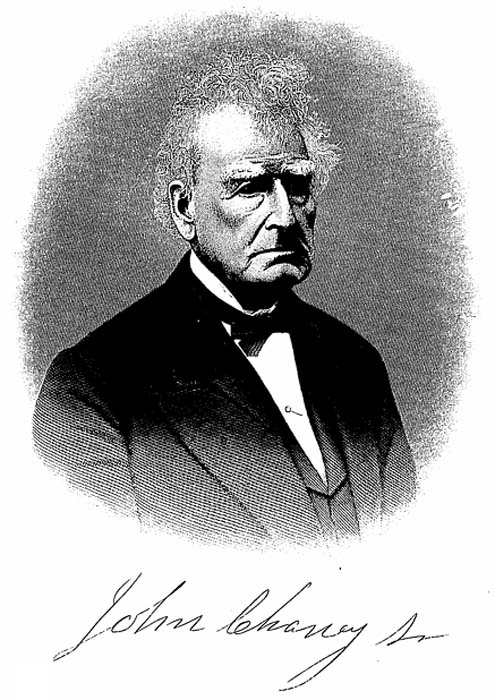 | |
John Chaney, Sr.
Pg. 441 -
Maryland. They remained in Lancaster,
Fairfield county, until August of the same year,
when they moved to this township.
George Kalb located on the northeast quarter
of section fourteen, and his father, who resided
with him, took up the northwest quarter of
section thirteen. The family, the first
two years of their settlement in the Madison
wilderness, lived in a cabin constructed of
puncheons, set up on end, and covered with
clapboards. George Kalb, sr., and
wife, on coming, got lost in the woods only a
short distance from their home, and so dense was
the forest in every direction, that they were
unable to find their way out, and they
consequently had to make a night of it in the
woods. George Kalb, sr., was born
June 1, 1760, and died Mar. 20, 1836. His
wife, whose maiden name was Mary Kiefer,
was born June 26, 1774, and died May 9, 1846.
Their children were Catharine, John,
Margaret, George, Mary, Anna, Elisha, Jeremiah,
Susan, Caleb, and Isaac, all now dead
except four, viz.: Margaret (now
Mrs. Ruse), George, Jeremiah, and
Susan (Mrs. Gill), all of whom reside
in this township; John Kalb, sr., died in
1815.
Among the earliest and most prominent of the
pioneers of Madison were the
STEVENSONS.
John Stevenson came from Baltimore,
Maryland, as early as 1805, and bought one
thousand acres of land, mostly in sections eight
and n ine. He built his log house on the
bank of Black lick creek, in section eight.
In this house, some of the earliest meetings
were held, as mentioned elsewhere. He was
buried in the old burying ground, on Black lick,
the first regular burying place in the township.
William Stevenson, a brother of John,
came about the same time, with his family, from
Baltimore, Maryland. He settled where
Irvin Stevenson now lives, and resided there
until his death. The family consisted of
five daughters and two sons. Joshua
occupied the homestead after his father's death.
The present wife of Judge Chaney, of
Canal Winchester, is a daughter of Joshua
Stevenson. The other son, George K.
Stevenson, is still living, and a resident
of the township. He is now about
ninety-two years of age. The daughters
were: Sarah, Susan, Jemima, Mary B., and
Ann B. Sarah married Zachariah
Stevenson, her cousin, and lived most of her
married life in Madison, but finally removing
west. Susan and Jemima, who
became the wives respectively of Robert Bowen
and a man by the name of McKelvey, both
died in this township. Mary married
Samuel Taylor, a tavern-keeper, in Canal
Winchester, in an early day. Ann
married Nicholas Hopkins, and, after his
death, her cousin, Joshua Stevenson, and
resided, during the most of her life, in the
township, dying Apr. 13, 1873. Her oldest
daughter, Mary B. Hopkins - now widow of
John L. Stevenson - is a resident of this
township.
CHARLES RAREY
settled in Madison township in 1806, removing
from Virginia, whence he came from Germany.
He settled about two miles south of where
Groveport now stands, purchasing the north half
of section number four, and the south half of
thirty-three. He occupied the farm on
which he settled until his death. His
children were: John, Adam, Charles, Benjamin,
Parker, George, William, Catharine, Elizabeth,
and Christina, all now deceased.
Catharine became the wife of Philip
Pontius; Elizabeth married Thomas Harmon;
and Christina married Rev. John
Solomon, an early Methodist preacher of
Madison; John Rarey removed to Indiana;
Charles, Benjamin, William, and Parker,
all reside where the family first settled,
William occupying the homestead; George
lived in Pickaway county; Adam Rarey
married Catharine Pontius, and settled
where the Rarey mansion now stands, in
Groveport. He kept a tavern there in his
log house when the road was only marked by
blazed trees. He afterwards erected a
brick tavern. He was the father of John
S. Rarey, the celebrated horse tamer.
Two daughters of Adam Rarey, Mrs.
Jones and Mrs. Whetsel, now reside
near Groveport.
MATTHEW TAYLOR,
and family, emigrated from Nova Scotia, in 1800,
and settled in Chillicothe, where they remained
until 1806, when they removed to this county.
Mr. Taylor entered several sections of
land, and settled near the mouth of Alum creek,
in this township. He erected a grist- and
saw-mill a short distance above the mouth of the
creek, and continued their operation until his
death, in 1812, his wife died the same year.
They were buried on their farm, and were the
first persons buried in that vicinity.
They had a family of eleven children.
John A. married Elizabeth McKnight,
of Greene county, Ohio; afterwards, came to
Columbus, and was an early surveyor, being with
General Foos; eventually, he removed to
Missouri, where he died in 1823; his widow
returned to Franklin county, and died here.
They had three children, the only survivor of
whom is Mrs. James Taylor of Truro
township. The other children of
Matthew Taylor were: James,
Matthew, Elizabeth (Mrs. Wood), David, William,
Robert, Samuel, Rebecca May (wife of
Edward Elsey), Jeannette (wife
of Samuel Crosset), and Isaac.
All are now deceased, except possibly,
Robert, who is supposed to be living in
Illinois. James was a captain of
infantry, and was stationed, with his company,
at a block-house in Delaware (now Marion)
county, shortly after Hull's surrender;
William and Samuel were ministers,
the former a Methodist, and the latter a
Presbyterian.
SAMUEL TAYLOR,
a brother of Mathew, removed from Nova
Scotia, at the same time, and settled on the
farm now owned by Z. Vesey. His
children were: Rebecca (Long) Matthew, John,
David, Samuel, Elizabeth (Faulkner), James
and Eleanor (Griffith). It is said
that the average length of life of the Taylor
families was over seventy years.
JOHN SWISHER
and family came to Ohio from Sussex county, New
Jersey, in 1805. They first settled in
Fairfield county, where they remained until
1807, when they removed to this township.
Mr. Swisher located northeast of where
Groveport now is, on land belonging to hsi
father-in-law, Frederick Peterson.
He afterward changed his location to the school
section, where he resided for upwards of forty
years, finally removing to near Dublin, this
county, where he died. His wife, Mary,
died in 1836, and he afterward married Mrs.
Shepherd, of Wash-
Page 442 -
ington township. There are six children of
John Swisher now living, as follows:
Jacob, in this township; Thomas in
Crawford county; Frederick, in Groveport;
Fama, wife of Absolom Peters, of
Walnut township, Pickaway county; Maria
(now Mrs. Miner), living in Hamilton
township; (she married Michael Plum, and
after his death David Miner who is also
deceased), and Mrs. Hoover, in Bucyrus,
Ohio.
The DECKERS four brothers, Elias, Esau,
Isaac, and John - emigrated to this
county from the Shenandoah valley, Virginia.
Esau came out first in 1805, making the
journey on foot. Before starting on his
long journey, he went into the woods, and cut a
willow cane which he carried with him.
After selecting and entering his land, he stuck
his cane into the ground, and returned for his
family, with whom he arrived the next year.
When he came back, he found the green
willow stick had taken root, and wsa growing.
It continued to flourish, and is now a large
tree on the land now owned by some of the
descendants. Some time previous to his
death, he expressed the wish that his coffin be
made from the tree, but his sons persuaded
him to let it stand. Mr. Decker
raised a family of three sons and two daughters,
all of whom settled and died in the vicinity of
their father's settlement.
ELIAS DECKER
came soon after his brother Esau, and
bought the southeast quarter of section
thirty-six, where he made a home. He
served as a soldier in the war of the
Revolution, and was also in the war of 1812.
Before his death he received a pension for his
services in defense of his country. In
about 1830, he removed to Hancock county, where
he died at teh age of ninety-nine years.
He had nine children - Andrew, Coonrod,
Elisha, Agnes, Catharine, Annie, Mary, Effie,
and Penelope. All married and
settled about here, at first, but after a time,
three daughters moved west. The sons all
died here, Andrew on the home place.
He had four children, two of whom are still
living - Elias, on the southwest quarter
of section thirty-six, and Elizabeth, in
Illinois.
ISAAC DECKER
came out in 1811, and made his location on the
southwest quarter of section one where, in 1817,
he laid out the town of Middletown, afterwards
called Oregon. The town did not improve,
and remained but a small settlement.
Mr. Decker opened a tavern in his log
hosue at an early day, which he continued some
thirty years. He was by trade a shoemaker,
in which he was assisted by his wife, who had
learned to patch and half-sole shoes.
Their patrons paid them in clearing and logging.
They raised children, six of whom are living -
two sons and two daughters in the northern part
of the State; Mrs. Ellen Seymour, and
Isaac F. Decker, in this township, the
former on Walnut creek, and the latter in Canal
Winchester.
JOHN DECKER, of the brothers
mentioned, settled in Washington township.
WILLIAM D.
HENDREN, accompanied by his wife and one
child, came to Ohio from near Front Royal,
Virginia, in 1806. He entered the east
half of section thirty-five, in Madison
township, Franklin county, and cleared a part of
the land, on which he remained some five years,
when he bought a quarter section belonging to
Mr. Hushour, and situated a mile and a half
northwest of Groveport. There was a small
clearing on the land at the time of his
purchase, and he continued the work until he had
a good farm under cultivation. His
children were Thomas C., Louisa, Daniel C.,
Samuel O., William, Mordecai, Isaac, who
died in infancy, Sarah Ann, and Robert.
Three of the children died in childhood; the
others grew up in the township, and settled
there. Samuel O. is the only one of
the children now living. After his
father's death, Samuel O. bought the
interest of his brothers and sisters in the
first purchase made by his father, which he now
owns. Thomas remained on the old
homestead, northwest Groveport, where he died.
His wife and two sons still occupy the property.
Another son lives in Minnesota, and one in the
northeast part of the State. A son of
Daniel Hendren owns a farm near the canal,
southwest of Groveport.
WILLIAM FLEMING, and a
family by the name of Hesnauer, were
early settlers on the Hendren place, but
left many years since.
FREDERICK
PETERSON came to Madison township in 1807,
from Sussex county, New Jersey, and located
about a mile and a half northeast of Groveport,
where he entered a half section of land.
He died some ten years after his settlement, and
none of the family are now left.
THOMAS GRAY was
among the early pioneers of Madison township.
HE came from Maryland, when a young man, and
married here Theodosia Huff soon after
his arrival. They settled on the place now
owned by their son, Alfred Gray - the
southeast quarter of section four. He died
in December, 1850, aged seventy-three years.
His first wife died young, and he afterward
married Harriet Hughes. By his
first wife he had eight children, and seven by
his second. Four of his first wife's
children are living as follows: Rebecca,
wife of William Powell, in Missouri;
Alfred, who married Rachel M.,
daughter of Archibald Powell, and lives
on the old homestead; Harriet, widow of
John Millburn, resides in Jefferson
township; Jedediah, lives near Groveport.
The children of the second marriage are
scattered.
GEORGE SMITH
settled at an early date, on the west side of
Walnut creek, in the south part of the township,
where he cleared some land and planted an
orchard, and had the first apples known in the
country. He lived but a few years, and
left a widow, Mrs. Abigil Smith, who
occupied the place many years after his death.
BILLINGSLY BULL,
was a very early settler near the present
village of Groveport. In 1810 he was a
justice of the peace in Madison township.
At the present time, none of the family remain
in the country, and but little information can
be obtained regarding them.
JACOB WEAVER owned a
small farm, on the second quarter of section
twenty-three, at an early day. He removed
to Indiana many years ago, with his entire
family.
EZEKIEL GROOM, born in
New Jersey, in 1767, and his wife, Rhoda,
a native of the same State, born in 1773,
removed soon after their marriage, in 1790, from
New jersey, to Hampshire county, Virginia.
There they lived until 1804, when they emigrated
to Ohio, and took up
Page 443 -
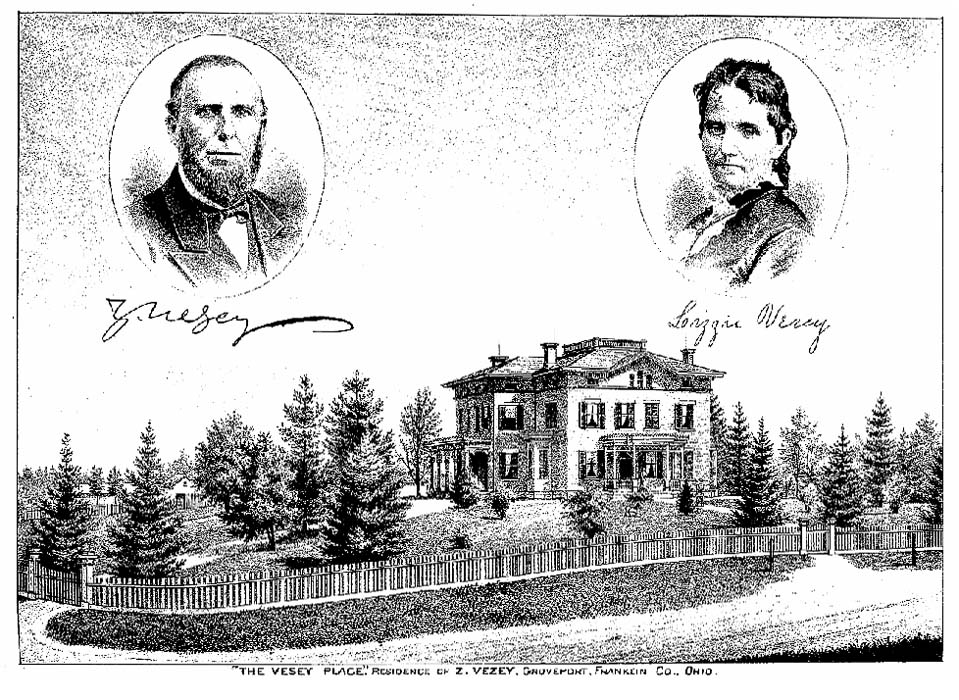
Z. Vezey
Lizzie Vezey
"THE
VESEY PLACE" RESIDENCE of Z. VEZEY, Groveport,
Franklin Co., Ohio
Pg. 443 -
their abode in the wilderness,
on the waters of Walnut creek, now Pickaway
count. Their location was that now
occupied by Vause Decker, of whose father
(Luke Decker) Mr. Groom rented.
In 1807 they removed to this township, and
located in section nine, near where the bridge
crosses the creek. He died there Aug. 1,
1836, and his wife Nov. 13, 1859. They
were both zealous christians, and active members
of the Methodist Episcopal church, and were
among the original members of the Hopewell
class. They had a family of nine children,
of whom Thomas, now living in Columbus
with his daughter, Mrs. Chamberlain, in
his eighty-fifth year, and Mrs. Hosea
Britton, of Hilliard, and the only
survivors.
PHILIP PONTIUS came from
Berks county, Pennsylvania, in about 1807, and
settled with his father on Kinnikinnick creek
near Kingston, Ross county. He married
Catharine Rarey, and in 1809 settled on the
second quarter of section nine, which he bought
and improved. they raised four children:
Christine, Charles, Elizabeth, and
John. the latter was killed, at the
age of eleven years, by the running away of a
team of horses, near Delaware, Ohio;
Christine was twice married, and died at
Lockbourn; Elizabeth first married Dr.
Guard, and after his death married
Richard Long - she died at Columbus;
Charles married Elizabeth Sharp, and
owns the home farm, where he was born and
raised. Their children live near by - one
on the home farm.
JOHN TALLMAN came from
Virginia in 1808, and settled on the property
now occupied by his son, Nathan now among
the older inhabitants of the township. Two
sons of Nathan Tallman have an
agricultural implement store in Canal
Winchester.
ABRAHAM HARRIS was also an early settler in
the same vicinity.
JOHN SHARP, and wife
came from Berks county, Pennsylvania, in 1808,
and bought the second quarter in section
thirty-three. He afterwards increased his
possessions until he owned some four hundred
acres of land, which he cleared and improved.
His wife was Mary E. Harbine, from
Reading, Pennsylvania, by whom he had nine
children, all of whom lived to maturity.
There were five daughters and four sons, but few
of whom are now living. Elizabeth
married Charles Pontius home, on section
nine. The other children of John Sharp,
with one or two exceptions, settled in Franklin
county, where they remained during their life.
Mr. Sharp died in 1863, aged eighty-two
years. His wife died in 1839, aged
fifty-seven.
SAMUEL BROWN,
originally from Pennsylvania, came to Ohio when
a single man, and in 1809, married in Pickaway
county. Margaret Kelley, who came
from Pennsylvania to Lancaster, Ohio, with her
parents when twelve years of age. Soon
after their marriage, they removed to this
county, and settled in Madison, where their son,
Matthew, now lives, on a quarter section
of land. They built a rude log cabin in
the woods without a floor, in which they spent
the first five years of their married life.
Mr. Brown's experience of pioneer life
was in strange disproportion to that of his
wife. In 1816, while at work in the
clearing, he was killed instantly by a falling
tree, leaving his wife with three little
children. Seven years afterward, she
married Olivia Codner, sr., whom she also
survived. After her first husband's death
Mrs. Brown dreamed that an angel appeared to
her and comforted her with the assurance that
she would life to be over ninety years of age,
and to see her descendants in the fourth
generation, which dream was more than fulfilled.
She died in the summer of 1879, at the age of
nearly ninety-three. She was born in Bucks
county, Pennsylvania, Nov. 28, 1787. She
possessed an excellent physical constitution,
and during the early years of her married life
in addition to her household duties, assisted
her husband in the work of clearing the land and
bringing it under cultivation. Of her
three children born of her first husband, two
are now living, viz: Matthew, on the old
homestead, born June 22, 1811, and Elizabeth,
wife of Jacob Powell, now living in
Jackson county, Missouri. By her second
husband, Mrs. Codner had four children.
EMMOR COX, settled on
number two, section thirty, as early as 1810.
He owned the entire quarter section, which he
cleared and improved. He had a family,
consisting of four sons and five daughters.
Mr. Cox and two of his sons died on the
property, and at his death it fell into the
hands of his son, John Cox, who was a
well-known and capable surveyor. He also
died on the property, which was then sold.
A son of John Cox now lives in the
vicinity.
HENRY BUNN came to
Ohio in about 1810, and located in Ross county,
where he remained until 1814, when he settled on
land in number two, section six, Madison
township, Franklin county, then owned by his
wife's father, Mr. Pontius. He
afterwards bought the north half of section
eight, which land he cleared and improved.
His wife was Elizabeth Pontius, to whom
he was married in Ross county, and who became
the mother of six children: Nancy,
Frederick, Mary, Sarah, Henry, and
Elizabeth. Henry and Sarah went
to Lafayette, Indiana, where they now live;
Nancy married Samuel Lautis, and
settled in Jackson township; Frederick
married Charlotte Rarey by whom he had
eight children - five now living; Nelson H.
and Jefferson L. live on the home farm,
and the others near by. Mrs. Bunn,
now a widow, lives with her son, Jefferson L.,
on the home farm. Of the two remaining
children of Henry Bunn, sr.,
Mary married Joseph Sharp, and
settled in the township, and Elizabeth
married Daniel Groom, and died in 1878.
HENRY WHITSEL,
from Maryland, settled near Tarlton, Pickaway
county, before 1800. His brothers,
Isaac, John, Samuel, and Daniel,
settled near him, about the same time. He
married Elizabeth Saylor, and, in 1810,
removed to Madison township, Franklin county,
where he entered land south of Emmor
Cox; he died in 1855, leaving several
children, most of whom are now living in the
west. His son, David, married
Elizabeth Rarey, and has lived in the
township since birth, in 1810.
HENRY DILDINE
settled on the southeast quarter of section
number two, in the fall of 1810. Harmon
Dildine also settled, at an early date, on
the southeast quarter of
Page 444 -
section three, where he raised his family,
consisting of six sons and one daughter.
Robert F., his youngest son, now resides
near Groveport; a daughter of the village, and
another son at Hilliard. Andrew, Daniel,
and John Dildine, moved out at the same
time as Henry and Harmon.
JAMES McCLISH moved in at an early
date, and located on eighty acres of land, which
is now owned by Charles Pontius. A
son, William McClish, now lives in
Hamilton township.
SAMUEL BISHOP
removed to this State, from New Jersey, in 1807.
He first settled in Pickaway county, but a few
years afterward, came to this township and
settled on one hundred and sixty acres, in
section four, which he cleared and improved.
He afterward sold this farm to Philip Pontius,
and moved to the west side of the creek, where
he died, about the year 1842. Two of his
children are at this time residents of Franklin
county, viz: Mrs. Young, living in
Hamilton, and William H., in this
township, on the homestead.
ABEDNEGO DAVIS
was a very early settler on the third quarter of
section twenty-six, which he partially claimed.
He sold the property to William Seymour,
and moved from the neighborhood.
JOHN GANDER came
before 1812, and settled on a quarter of section
twenty-nine, where he made a clearing and lived
twenty or twenty-five years. He raised a
family of seven children, several of whom
married while living there. They finally
sold the property and went to another locality -
some in Hardin county.
JACOB GANDER was
also an early settler at Middletown, and served
as justice of the peace in 1825, and again in
1828. None of the family have lived in the
township for many years.
JACOB RHOADS and
family, came from Pennsylvania, and were among
the early settlers in Madison township.
They located in the northeast past of the
township, on Black lick, near where S. Hempy
now resides. John, a son of
Jacob Rhoads, built a grist- and saw-mill on
the creek, both of which were run until about
1844, when they went down. The Rhoads
removed to Van Wert county, after selling to a
man named Peters.
SIMON HELPMAN
came from Pennsylvania in 1840, and located in
Violet township, Fairfield county. The
part of the township in which he settled, was
afterwards set off into Franklin county.
He married Eve, daughter of Elias
Decker, in 1812, and raised ten children,
four of whom are now living; one in Hancock
county; one in Indiana; one in Iowa, one,
John, in Winchester; where he is engaged in
business.
MICHAEL ROHR and wife,
and their sons, George and John,
with their families, their son-in-law, John
Smith and family, and Thomas Rothwell
all moved in together from Bucks county,
Pennsylvania, in the summer of 1816. The
company, with one four-horse team and two
two-horse teams, left their eastern homes on the
fifty day of July, and were some six weeks on
the way. Mr. Rohr, sr. bought the
whole of secton six which had been previously
occupied by Henry Bunn, and on which a
little improvement had been made. Mr.
Rohr, at his death in 1818, divided his land
among his three children above named, and some
of it is still in possession of his descendants.
George Rohr had a family of two sons and
two daughters, the daughters dying when quite
small. The two sons are still living:
John, on a portion of the farm in
grandfather originally owned, and William,
in Hamilton township. The children of
John Rohr, sr., were: Jacob, Charles,
Samuel, Michael, John, and Sarah.
Charles owns a farm of two hundred and
fourteen acres in the eastern part of section
six, and resides in the north part of the
township, and John near Canal Winchester.
Samuel lives in Wisconsin.
Michael and Sarah are dead.
JOHN, GEORGE, PHILEMON, ANDREW AND
CUBBIDGE NEEDELS emigrated to Ohio
from Delaware. John and Philemon
removed in 1802. John, then single,
came down to Ohio river to Louisville in a
canoe. He married there, and afterward
came to this State; locating in Fairfield
county. In 1811 he moved to this township.
Philemon came a few years after John,
and first settled in Fairfield county. In
1812, or 1813, he took up his residence where
Mrs. Eliza Needels now lives, having
purchased, in connection with his brothers,
John and Andrew, the whole of section nine.
He died in 1851. He had a family of
thirteen children, of whom all are now dead,
except three; Rachel Needels, widow of
Thomas Needels, now nearly seventy-seven
years of age; Anna, widow of Littleton
Gray, both residing in this township; and
Mrs. Rebecca Daily, living near Des Moines,
Iowa. George Needels settled in
Fairfield county, but removed later to Knox
county. Cubbridge Needels moved out
from Delaware in 1810; resided in Fairfield
county two years, when he came to this township
and took a lease of some land of his brother,
Philemon's. Afterwards he leased a
farm on the school section, on which he resided
until 1821, when he removed to Plain township.
His wife died soon after their removal to Ohio,
in November 1810, and he was afterwards again
married. He died in 1840.
WILLIAM ELDER
settled on the first quarter in section eleven,
about 1813 or 1814. He cleared and
improved a farm, and built a brick house.
His family consisted of three sons and two
daughters, none of whom are now living.
Mr. Elder's place of nativity was Scotland.
JOHN KILE settled
northwest of Groveport at an early day. He
bought land which he cleared, and where he made
a farm. Some of his descendants now live
in the township.
ALEXANDER CAMERON
came from New Jersey, and bought land in the
third quarter of section ten. Here he made
a home and raised a family. One of his
daughters married Mr. Ramsey; another
married Cornelius Black, and now lives in
the township. Still another, married
William P. Sharp, and died in Hamilton
township.
ADAM HAVELEY
bought number three, in section three, where he
made a home. He was a hard working man,
and paid for his purchase by making and selling
maple sugar.
ADAM SARBER came from Pennsylvania to Ohio,
in
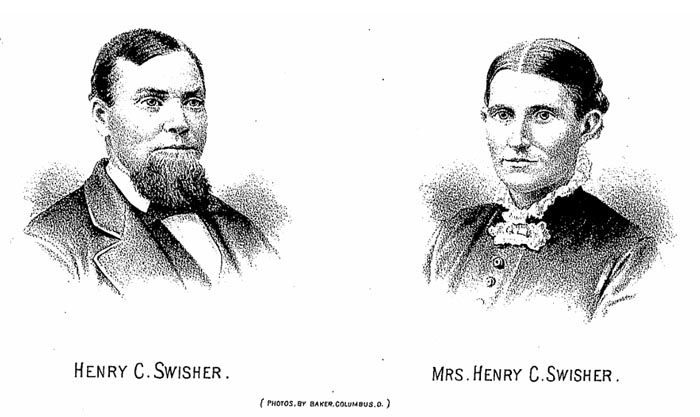
HENRY C. SWISHER and MRS. HENRY C. SWISHER
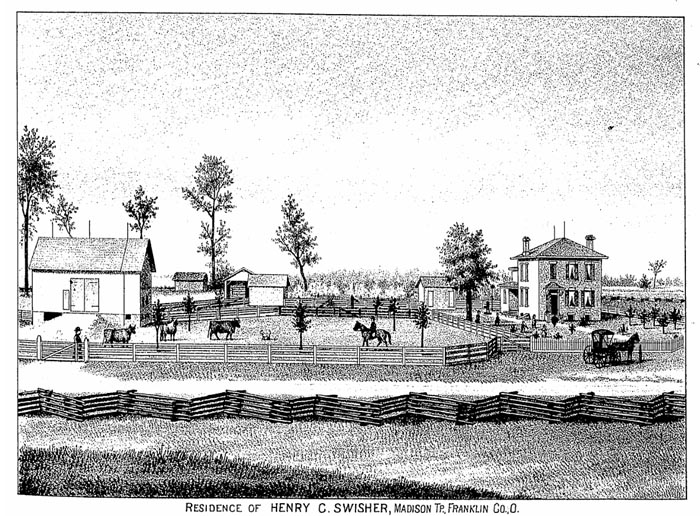
RESIDENCE of HENRY C. SWISHER, Madison Tp.,
Franklin Co., O.
Page 445 -
1812, and bought the second quarter of section
thirty-three, which he partially cleared and
improved. After his death the property was
divided among his children, five of whom
afterwards went west; one settled in Columbus,
one in Winchester, and one in Groveport.
CHRISTIAN SARBER came in 1818, and located
on the first quarter of section three, where he
cleared the land and made a farm. In about
1836, he removed to Putnam county. A part
of his former land is now owned by Daniel
Leigh.
The
DAYLONGS were among the first settlers on
the first quarter of section thirty-four, but
none of the family are now living in the
vicinity.
JOHN RAGER came from
Pennsylvania to Pickaway county, with his
father, who settled on Pickaway plains.
While living there he married Catharine
Valentine, and in 1814 he settled in Madison
township, Franklin county, where he bought the
first quarter of section twenty-six, which he
improved. He died in Marion county,
Indiana. His children were Lanah,
Elizabeth, Mary, Sophia, William, and
John. The daughters all married and
settled in different parts of the country;
William died in Allen county, Indiana;
Elizabeth died in Madison township; John
married Elizabeth Conkle, by whom he
had fourteen children, ten of whom lived to
maturity. His wife died in 1857, and he
married Mrs. Nancy Rower. They
occupy the old home place.
ZEBULON S. LEIGH
came from New Jersey to Ohio in 1817 or '18,
accompanied by his brother, Elias.
He settled on the farm of Luke Decker, in
Madison township, Pickaway county, as a renter,
and afterwards rented land of John Welton
in Madison township, Franklin county, where he
died in 1841. He was married in New
Jersey, and left a wife and nine children:
Samuel, Phebe, Mary Ann, Matilda, Luisa, Huldah,
Charles, John S., and Daniel.
Mrs. Leigh, with her daughter, Huldah,
lives with Samuel on the southeast corner
of section thirty-four. Daniel owns
a farm in number one, section ten, which was
originally entered by Mr. Pilcher, and
was partially cleared by Adam Sarber.
GEORGE SEYMOUR,
who was one of the early settlers of Madison
township, came from Hampshire county, Virginia,
in about 1818 or 1820, the date not being
exactly known. Immediately after his
arrival, he bought the fourth quarter of section
twenty-seven, and soon afterwards added to them
the second and third quarters of section
twenty-six. His son, Moses,
inherited number two, and Jesse, number
three in section twenty-six; william had
number four in section twenty-seven.
John had the quarter cast of Jessse's,
where he died, leaving a widow and three
children, one of whom married Andrew Wilson,
and now lives on the place. Moses
raised eight children, several of whom have died
since arriving at maturity. Two live in
Groveport. William married, and
raised seven children. His widow and three
children live on the home farm; the others
in the township. Jesse raised eight
children, of whom one son, Miner, lives
on the home farm, and two others live near by.
WILLIAM PATTERSON
came from Pennsylvania in about 1820. He
bought the west half of section three, where he
built a home, and raised a family. He
finally removed to Columbus, Indiana, but came
back and died in Madison township. The
only one of the family now living here is
Thomas Patterson.
JAMES SANDY settled
in Ross county in 1821. He remained there
but a short time, when he went to Pickaway
county, and from there to Washington township,
Franklin county, in 1824. He lived there
until 1862, when he removed to Madison township,
with his son-in-law, Sylvester Crothers,
where he died, aged eight-one years. He wa
a soldier in the "Virginia Blues," during the
war of 1812, and ws encamped one winter at
Franklinton. His children were:
William, Eliza, Philip, Wesley, Uriah,
Charlotte, James, Ermine, Erastus, Rebecca,
Isacca, Delilah, and Albert. Mrs.
Crothers (Delilah), and Mrs. Young
(Rebecca), live in Madison; Charlotte
lives with her brother, James on section
twenty-five, east of Groveport; Albert
lives in Groveport.
SAMUEL MURPHY was
an early settler on the southwest quarter of
section eight, which he cleared and improved.
The place is now owned b his son, Samuel, F.
M. Murphy lives on the northwest quarter of
the adjoining section, seven.
PETER LONG was an early settler in the
southwest corner of the township, on section
twelve. His son, George, now owns
the property.
WESLEY TOY came to
Pickaway county in about 1826, where he leased
land until 1828, when he bought eighty acres of
land south of Groveport. While there he
married, and in 1836 or 1837, he sold his land
and bought in Madison township, Pickaway county.
He remained there about nine years, when he
again sold and returned to Franklin county, in
1848, and purchased a quarter-section of land in
section thirty, where he died in 1861. At
his death the property was divided between his
three sons, and is now owned by his son,
Charles, who purchased the interest
belonging to the other heirs.
GEORGE EDWARDS
came to Madison from Bucks county, Pennsylvania,
in 1827, and settled where his son, John,
now lives. He died about a year after his
settlement, and his widow was subsequently
married to Alexander Cameron. Mrs.
Daniel Hendren, John, and Stephen S.
Edwards, are the children of George
Edwards now living. The first two live
in this township, and the latter in Marion.
PHILIP KING settled
settled on the farm now occupied by Solomon
and Daniel Detwiler, at an early date.
He died in 1846. Samuel Detwiler
moved on to the farm in 1854, having emigrated
from Franklin county, Pennsylvania in 1852.
He died in 1874.
JAMES B. EVANS
located in Winchester, in 1832, and engaged, as
a tailor, with Thomas Kelley; he was born
in Western Pennsylvania, and passed his early
life there. In 1833, he left Winchester,
and engaged in business in Pickerington, where
he remained until 1836, when he returned to
Winchester, where he served as justice of the
peace from1843 to 1849, being the first
magistrate
Page 446 -
elected in the village; he was, also, the first
postmaster, a telegraph operator on a line from
Lancaster to Columbus, in 149, and the first
mayor of Winchester. He was connected with
the telegraph office in Winchester six months,
and was then operator at Circleville for two
years. He is now the mayor of Winchester,
a justice of the peace, and conducts a tailoring
business. Mayor Evans has been
actively identified with almost every enterprise
tending to the geneal improvement of Winchester,
having been, for years, an efficient member of
the village government, of the board of
education, and other organizations.
SAMUEL GARES came
from Bucks county, Pennsylvania, to Ohio, in
May, 1855. For a number of years he kept
hotel at Reynoldsburg, where he remained until
1847; he died in Groveport, in 1859. He
raised a family of six children, all of whom
were born in Pennsylvania, and all of whom are
now living - Mrs. Mary Ann Long, Mrs.
Catharine Root and Snyder Ganes
in Columbus; A. Bennett Gares, in
Indiana; and Mrs. Anna Galbraith,
in Bellefontaine, Ohio. Edmund
married Mrs. Amelia Rarey, by whom he had
four children; she died, and he married Miss
Jennie Perrill, a daughter of Hon. A. L.
Perrill, of Madison township, Pickaway
county, by whom he has one child.
PIONEER
TIMES IN MADISON
EARLY
SCHOOLS.
The first
school in the township was kept in a log cabin
on the farm of the pioneer, George Kalb.
Children liv-
Page 447 -
CHURCHES.
THE LUTHERAN
CHURCH.
HOPEWELL
CHURCH
Page 448 -
THE
METHODIST EPISCOPAL CHURCH.
THE UNITED
BRETHREN CHURCH.
[PORTRAIT of
GEORGE NEEDELS]
Page 449 -
TRURO
PRESBYTERIAN CHURCH.
THE
PRESBYTERIAN CHURCH
THE REFORMED
CHURCH
THE
MENNONITE CHURCH.
ST. MARY'S
CATHOLIC CHURCH
Page 450 -
day of September, were dedicatd with appropriate
ceremonies.
MILLS AND
OTHER ENTERPRISES.
VILLAGES.
In
the year 1817, the now almost vanished town of
OREGON was laid out by Isaac Decker.
It was first called MIDDLETOWN, but in 1830 or
1831, the name was changed to OREGON. The
first post-office in the township was
established there in 1829, with Dr. Thomas
Hersey as postmaster. He held the
office until 1833, when he resigned, and
Isaac D. Decker, was appointed. when
the post-office at Groveport was established, in
1844, that at Oregon was discontinued.
CANAL WINCHESTER is a well-built, stirring little town,
of about one thousand inhabitants, situated on
the east line of the township. The town
was laid out on the east side of High street,
south of the canal, by Reuben Dove, n the
year 1826, or 1827. A short time
afterward, John Coleman laid out a number
of lots on the opposite side of the street, and
subsequently an addition was made on West street
by David Dixon. Other additions
have since been made. Henry Dove,
the father of Reuben was the original
owner of the land on which the town is located,
having entered a quarter section in 1806 or
1807. The town was originally named
WINCHESTER, after Winchester, Virginia, from
the vicinity of which the Dove family had
emigrated. The word "canal" was added to
distinguish it from other places in the State of
the name of Winchester. The village was
embraced within the bounds of Fairfield county
until 1851, when, by the annexation of six
sections to the east side of Madison township,
it was thrown into Franklin county.
The first store was opened by Jacob L. Vance, a
contractor on the canal. He kept a small
stock of goods, suitable for the demands of the
laborers in his employ, in a log house south of
the canal.
In 1832 Jacob Carty and Israel Julian
started a store, which was afterwards continued
by Carty alone for many years.
David Dixon brought ni a stock of goods, and
opened a store about 1832, and in 1839 John
F. and Samuel Bartlit commenced in
trade. Samuel Bartlit, after a few
years, bought out his brother, and continued
the business alone until the fall of 1856, when
he sold to his nephew, Samuel Pond, who
died in August, 1857. In the fall of that
year, Christian and David Gayman
established a store, and hae continued in
merchandise from that time to the present, with
substantial success. The Gaymans,
five brothers - Daniel, David, Christian,
Israel, and Moses - came to Canal
Winchester in 1843, and they are all now
residents of the town. Tallman, Allen
& Co., afterwards firm of Canal
Winchester, and they erected, about 1852, the
building now occupied by
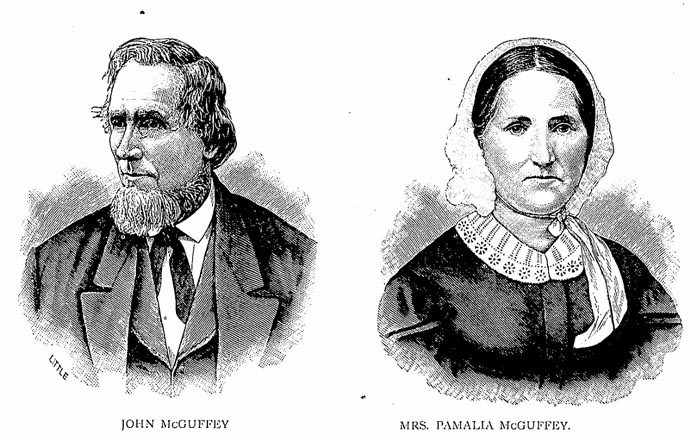
JOHN McGUFFEY and MRS. PAMALIA McGUFFEY
|
was born in Madison township,
Franklin county, Ohio, Aug. 26, 1810. His
father, John McGuffey, came to Madison
township in 1803, from Limestone, Kentucky, and
his mother, Elizabeth Sworden, from
Virginia, in 1805. He is descended on his
father's side from the McGuffeys and
McDowells, who came out from Scotland in
1845-6, and settled in the mountains of
Pennsylvania, and from there removed to
Kentucky, immediately after the war of the
Revolution. At the time of his birth, in
1810, there were but few families in the
township, the Indians being more numerous than
the whites, and all the wild animals that were
common to the forest before the advent of the
white man, were still abundant and troublesome.
The streams were full of drifts, and
no bridges or highways. Mills
and other conveniences were scarce.
The subject of this sketch endured
all the privations and hardships
that were the common lot of the
children of poor people at that
early day, and grew up in the midst
of the wilds of the magnificent
forests of that fertile region, with
but little opportunity for obtaining
the learning of the schools, but
having the great book of nature
about him, which he carefully
studied, and which expanded and
strengthened his naturally strong
and vigorous mind. From the
age of nine years he had to rely
entirely upon himself for his
support. Being strong,
intelligent, and willing, he found
abundant employment; and by the use
of hickory bark, for a light at
night, while others slept, he
acquired sufficient knowledge of the
common branches of education, so
that at seventeen years of age he
engaged during the winter season in
teaching school. During the
spring, summer, and autumn he would
take jobs of clearing and work in
the woods. At nineteen years
of age he was married to Pamalia,
daughter of Richard Courtright,
esq. This was the great
good fortune of his life. His
young wife was one of the most
beautiful, modest, industrious, and
lovable of maidens, and two years
his junior, and of a very superior
family of Holland Dutch.
The young couple at once engaged in
farming leased lands, with great
success. The husband spent his
evenings and leisure hours in
reading aloud to his wife from good
books and papers, while the good
wife busied herself with the
household cares. they had born
to them eleven children, eight of
whom grew to man-and womanhood, and
to whom they were enabled to give
the advantages of academic and
collegiate educations. By
integrity, industry, and economy,
from tenants they became owners |
of
thousands of acres of land in
Franklin and other counties in Ohio.
They lived together, as man and
wife, for nearly forty years, when
on the thirteenth of September,
1869, the dear wife and mother
passed to her last rest.
Mr. McGuffey, now in his
seventieth year is a vigorous,
intelligent, strong man. While
he has acquired a large landed
estate, he has not neglected the
cultivation of his mind by the study
of mathematics, astronomy,
philosophy, chemistry, and other
branches of natural science, and the
careful study of ancient and modern
history and current events. He
is really, although a quiet farmer,
one of the learned men of his time.
He has given great attention to the
subject of underdraining and the
reclaiming of wet and low lands.
Indeed, he is a pioneer in the mode
of improvement, having commenced in
1839. His has given much
thought and had large experience in
both surface and underdraining.
He has long advocated that it is the
duty of the State and local
authorities to organize such a
system of drainage as would prevent
all water from becoming stagnant,
thereby making all land productive,
and thus removing all miasms, which
have been man's greatest enemy, from
our beautiful State.
From his childhood, until he arrived at the age of
thirty years, he was intimately
associated with grandparents who had
taken a prominent and active part in
all the stirring scenes, and had
vivid recollections of all the
incidents and hardships of pioneer
life in Western Pennsylvania,
Kentucky, and Ohio, from 1770.
They were strong, brave, and hopeful
people, knowing no fear, and
shrinking from no difficulties.
Descended from such parentage, and
under such influences, he naturally
sought great and difficult
undertakings, and is beat satisfied
when he has on hand some enterprise
taxing to his utmost extent his
mental and physical abilities.
His latest great enterprise was to
deepen and widen the bed of the
Scioto river, in Hardin county,
Ohio, thereby reclaiming many
thousands of acres of very rich
soil, which, to be successful, his
clear mind saw must be done by a
slow and gradual process. For
twenty years he has devoted his
time, his thoughts, and large sums
of money to his favorite
undertaking, until now he can
pasture five thousand head of
cattle, and he confidently expects
to see three hundred thousand
bushels of corn produced annually
upon his lands, and that in future
generations that which he has
reclaimed from the waste of waters
shall make homes for and sustain
five hundred families. |
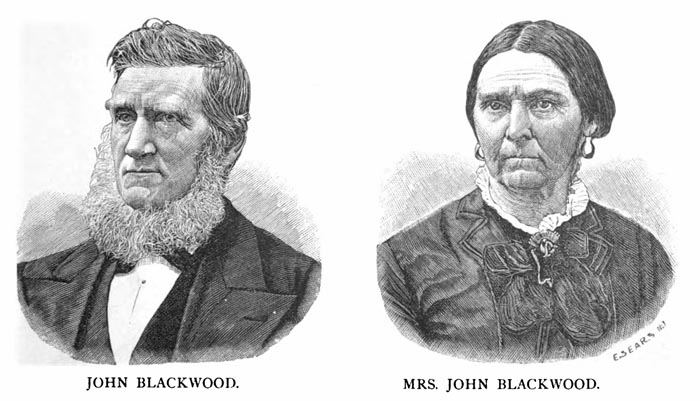
JOHN BLACKWOOD and
MRS. JOHN BLACKWOOD
THE
BLACKWOOD FAMILY
|
The estate of Hollywood, in county
Down, near Belfast, Ireland, and
known as the Blackwood estate,
being an entailed property, fell to
the eldest son of the family, and
the youngest son, as is always the
case where an estate is entailed,
was left the alternative of becoming
a clergyman in the established
church, or of entering the military
or naval service of the government.
The younger son of the Blackwood
family, in 1736, entered the
English navy and embarked as an
officer under Commodore Anson,
in the voyage of discovery and
conquest around, the world.
Previous to this he was married, and
he left behind a wife and two sons,
James and Robert, with no
provision for their support other
than his pay as an officer in the
navy. The voyage was a
successful one, and from his prize
money, added to his pay, he was able
to support his family. These
prizes were taken from among the
Spanish fleet and merchantmen, and
from enforced contributions levied,
as was then a custom, on seaports
and cities captured. He again
sailed, under Commodore Drake,
and on the return of the ship from a
seven years' voyage, as they were
entering the port of Carrickfergus,
Ireland, whence they sailed, he was
struck from the bulwarks by the main
boom, and sent to a watery grave.
The widow of this brave officer, with her sons,
James and Robert Blackwood, were
left almost destitute, while the son
of the heir to the estate became a
wealthy member of the Irish
parliament, and on June 7, 1800,
from his energy in supporting the
Act of Union, was created a peer of
the realm. The heir of the
title and estate of Blackwood is now
Lord Dufferin, late governor
general of Canada.
The two sons of the naval officer, James and Robert
Blackwood, were apprenticed to
the linen manufacturing business, in
which James became very
expert in the making of fine work.
Robert followed plain
weaving, and after a time invented a
machine for warping the linen, which
worked to perfection. He took
a farm and bought yarn at the
markets. He also had seven
looms in his house, and became quite
an extensive linen manufacturer.
After engaging in business he
married Miss McCullen, by
whom he had fourteen children.
His wife died, and in the course of
time he married Ellen Berry,
by whom he had four children; one
died while young, and the others
emigrated to the United States where
they now live. Jane
married Neil Shannon, and
with him settled in Canada in 1833,
and in 1838 they came to Franklin
county, and located in Lockbourne.
James came to the United
States in about 1865, bringing his
wife at the same time. They
settled near Eddyville, Iowa, on
land given his wife by deed.
John Blackwood was born in
county Antrim, at Crossmary, in
Ireland, June 27, 1815. His
parents lived three miles from the
sea-port of Carrickfergus, a walled
city. He obtained a limited
education at the free schools of the
time, and when sixteen years of age,
in company with a neighbor boy,
Hugh Semple, influenced by the
glowing accounts they heard of
America, |
sailed for the land they wished to
see and know. They left
Belfast May 12, 1832, and arrived in
Baltimore, Maryland, July 3, of the
same year. For some time they
wandered the country over, making a
temporary home at Pittsburgh.
Their intention was to settle in
Ohio, of which State they had heard
glowing accounts before leaving
their native country. During
the winter of 1832-3 they worked on
the construction of the National
road, through the State, under the
superintendence of General Scott,
Commodore Stockton and
Colonel Brewerton, the
engineers. Mr. Blackwood
was promoted to the place of a
foreman in the work, at which he
continued until the work was
completed to Jefferson, and the work
was suspended by the government in
1835.
After leaving his work for the government he secured a
school in the neighborhood wherein
he now lives. While teaching
school he met, and married,
Christine Smith, a daughter of
Jacob Smith, who was a very
early settler in Pickaway county.
After marriage he taught school
during the winter season, and worked
at house building and carpenter work
during the summer, continuing the
latter business for about forty
years. In 1841 he bought a
farm of one hundred and seven acres,
part in the southeast corner of
Madison township, Franklin county,
and a part across the line in
Fairfield county. They settled
on this farm, where they have since
lived, with the exception of five
years spent in Lithopolis, Fairfield
county. Mr. Blackwood
invented a corn planter in 1855, and
the time spent in Lithopolis was
devoted to the manufacture of this
machine, in connection with other
agricultural implements, and
conducting a blacksmith shop.
Though never an apprentice to any
trade, he has grat ingenuity, and
has applied it in many directions.
Since he came to this country he has
been a close student and observer,
and has acquired a good
understanding of all subjects that
attract general attention.
The children of John and Christine Blackwood
were: Reuben, born July
29, 1839, who married Jennie E.
Welton, May 22, 1862, and now
conducts a hardware and stove
business in Lithopolis; James M.,
born Feb. 6, 1841, who married
Barbara Whaley, Sept. 2, 1862,
and who is now postmaster, and owns
a grocery store in Lithopolis;
Sarah A., born Jul. 20, 1843,
who married Henry M. Brown,
June 23, 1863, and now lives in
Iowa; Jacob Smith, born Mar.
16, 1845, who married Maggie L.
Glick, Sept. 24, 1868, and they
now live near Columbus, Indiana,
where they were married; Mary
Christine, born Aug. 24, 1847,
and who died June 12, 1848;
Pauline, born May 28, 1849, who
married Samuel W. Woods, near
Montmouth (probably Monmouth),
Illinois, Feb. 6, 1868, and have
since removed to Cass county, Iowa,
where they now live; Samuel W.,
born July 30, 1851, who now lives at
home; Henry Caleb, born July
4, 1853, who is now a salesman in
Osborn's carpet store, in
Columbus; Marion Elizabeth,
born Sept. 5, 1855, who married
John L. Green, Aug. 31, 1876,
and who now lives in Lithopolis. |
Page 451 -
the dry goods store of Spielman Bros.,
who began here under the name of Weisman
& Spielman, in the spring of 1872.
A post-office was established in the year 1841, and
James B. Evans, the present mayor and
justice of the peace of the village, was
appointed the first postmaster. The office
was kept in a frame building on Waterloo street,
which is now used for a dwelling. Mr.
Evans held the office nine years when he
resigned, and removed from the town. His
successors have been Dr. J. B. Potter, Peter
Koag, David Gayman, and the present
incumbent, J. K. Miller. Mayor Evans
was the first justice of the peace in Canal
Winchester, and he has been identified with the
town in some official capacity, almost
continuously, since his location here in 1832.
The first tavern in the village was opened in a
two-story frame building on what is now Columbus
street, near the site of the present residence
of John H. Spielman. It was opened
by Peter C. Benadum, soon after the town
was laid out. The next tavern was kept in
the lot now owned by the corporation, of which
Ira Mason was the first proprietor.
The Commercial hotel, now conducted by J. M.
Schoch, was elected about the eyar 1852, by
Peter Koag. The Merchants hotel was
built in 1871, by Isaac Ebight, and kept
by him some three years, when he sold to
Jonathan Boyer, who leased it to Aaron
Feustermaker. L. W. Boyer, the present
proprietor, purchased the property in 1877.
In 1876 Mr. F. Leonard made considerable
additions to his one-story frame dwelling, and
in February, 1879, opened it as a hotel.
It is known as the Leonard house.
Canal Winchester
has always been an important point with respect
to its grain business. The first warehouse
erected was a log structure, built in 1833 or
1834, just north of the basin. In 1837,
Hathaway & Glendening, put up a frame
warehouse, east of the basin, and in 1847 or
1848, Samuel Bartlit erected a large
buildings, then belonging to O. P. Chaney,
were destroyed by fire, June 2, 1878. This
was the most extensive fire the village has ever
sustained. As early as 1834 or 1835,
Carty & Rogers built a frame warehouse,
where the large elevator now stands, just west
of the bridge, which said elevator was erected
about the year 1841. The present
grist-mill of Whitehurst, Lehman & Carty was
built in 1868, and the large and excellent
elevators of O. P. Chaney in 1878.
A prominent early business man of the village was
Hiel Brockway, who ran a daily line of
packets from Lockbourn to Cleveland, with his
headquarters at Canal Winchester. He
erected the old yellow warehouse, south of the
canal. Brockway finally removed to
Brockport, New York, where he died. A
large portion of his property here was
subsequently purchased by Mr. Bartlit.
SCHOOLS.
The
first school in the village was held in a frame
building, which stood on the site of the present
residence, formerly a school-house, of J. S.
Stevenson. The frame building was
replaced, about 1848, by a one-story brick
school-house, which was used until 1862, when it
was sold, and afterwards converted into a
dwelling. It is now occupied by Mr.
Stevenson, as before stated.
The town constituted the eighteenth school district of
Madison township, until April, 1868, when a
school was organized under the Union school law.
The first school board elected was composed of
the following members: James H. Somerville,
and James B. Evans, elected for three
years; D. A. A. Short, and Christian
Gayman, for two years; C. P. Rees,
and M. Allen, for one year.
Somerville was chosen president of the board;
Evans, secretary, and Gayman,
treasurer. The present school building was
erected in 1861, but has since been remodeled
and additions made. The cost, with the
grounds, was about eight thousand dollars.
The successive principals of the school have
been as follows: D. T. Clover, one year;
G. W. Buck, one year; J. W. Rutledge,
one year; James Heffley, two years;
Frank M. Kumler, two years; L. R. Powell,
one year; J. F. Maxwell, one week; W.
C. Campbell, two terms; David O. Brien,
the unexpired term of that year, 1876; and P.
R. Mills, the present principal, who was
employed in 1877. The school, in the
various departments contains, at present
writing, two hundred and fifty pupils. The
present members of the school board are: John
Helpman, president; a. Starr, clerk;
W. T. Conklin, treasurer; O. P. Chancy,
J. K. Miller, and A. A. Short.
PHYSICIANS.
The
oldest physician in the village is Dr. J. B.
Potter, who located here in 1838, and has
continued in practice until the present, with
the exception of the years from 1861 to 1865,
during which he was in the army. Dr. A.
A. Short has been engaged in the practice of
his profession in Canal Winchester since 1856.
He came from Vermont, to Ohio, in 1849, and was
subsequently connected with the infirmary
hospital, in Columbus, for two years, he formed,
in 1859, a partnership with Dr. Potter,
which continued until 1874, except during the
four years that Dr. Potter was in the
army. the other physicians of the village,
at the present time, are Dr. A. Starr and
Dr. V. A. Valentine. Among the
doctors who have, at one time or another, been
located here, we have the names of Drs.
Chapin, S. H. Potter, Titus, L. A. Pierce, J. B.
Pierce, Langworthy, Blake, and Clemens.
INCORPORATION.
At
the session of 1865-6 the town was incorporated,
and at the first borough election a corporate
government was organized as follows:
James B. Evans, mayor; C. W. Speak,
recorder; John Chaney, sr., R. Trine, John
Helpman, E. B. Decker, and M. C.
Whitehurst, trustees. John Helpman
was, at this time, justice of the peace.
The present officers of the village are the
following: James B. Evans, mayor;
T. F. Ungemach, clerk; W. M. Game, I.
L. Decker, John W. Griffith, John R. Clement, H.
H. Dibble, trustees; and John Gehm,
treasurer. Mayor Evans has been at
the head of teh village govern-
Page 452 -
ment since his first election in 1866, with the
exception of four years, during which John
Helpman, J. S. Stevenson, and
Charles B. Cowan, successively filled the
position.
SOCIETIES.
LEE LODGE,
FRANKLIN
ENCAMPMENT,
DAUGHTERS OF
REBECKAH.
MADISON
GRANGE,
MILITARY
ORGANIZATION.
A
company of militia was organized under the laws
authorizing the formation of the Ohio National
Guard, Mar. 2, 1878. It was, at first,
known as the Winchester guards, and was assigned
as Company N, 14th O. N. G. the officers
elected on the organization of the company, were
Philip Game, captain; Brice Taylor,
first lieutenant; William Schrock, second
lieutenant; all of whom hold their commissions
at this time. while in camp in 1879, the
name of the company was changed from Winchester
Guards to the Potter Light Guards.
In 1869 the first train of cars ran through Winchester,
over the Hocking Valley road. The town
had, however, as early as 1849, a telegraph
line, extending from Columbus to Lancaster, the
first operator of the office here being
Squire Evans.
The town has a weekly paper - the Winchester Times
- which made its first appearance Mar. 16, 1871,
as a prohibition paper, with Major J. W.
Stinchcomb as editor. In the summer of
1872 it was purchased by C. M. Gould, who
published it as a Democratic paper until
November, 1876, when it passed into the hands of
J. Heffley, one of its present
proprietors. It is now published by
Heffley & Gayman, as an independent paper,
and has a good patronage.
In addition to the enterprises already referred to, the
village contains three churches (spoken of more
fully under the head of Churches), and the
various business places common to a place of its
size and prosperity. what the town, at
present, particularly needs is a good bank.
GROVEPORT.
The
beginning of Groveport dates back to 1833.
In that year Jacob B. West came and
leased some land on the canal from Adam
Rarey, and erected the old warehouse,
still standing, near the bridge, and also a
store building at the west end, in which, in the
spring of 1834, he opened a stock of goods.
In September, 1843, he laid out that part of the
town lying west of the street runing past
the Methodist church, and named his town "Wert's
Grove." Subsequently, in February, 1844,
that portion of the town lying east of said
street was laid out by William H. Rarey,
to which he gave the name of "Rarey's
Port." Messrs. Wert and Rarey
were each ambitious of perpetuating his own
name, in connection with the town. In
1844, Mr. Wert secured the establishment
of a post office, under the name of Wert's
Grove, with himself as postmaster, but Mr.
Rarey was a prominent business man in the
town, and the name of Rarey's Port was
perhaps more extensively known than that of
Wert's Grove. Letters were frequently
received through the post-office thus directed.
The desirability of a common name soon became
manifest to the citizens, and a public meeting
was finally held for the purpose of making a
choice, when a compromise was effected by
discarding the personal part of the two names
and retaining the latter part of both, and hence
the town came to be called Groveport.
Mr. Wert continued in business until 1847,
or 1848, and did much toward building up the
town which he had founded. He was engaged
in merchan-
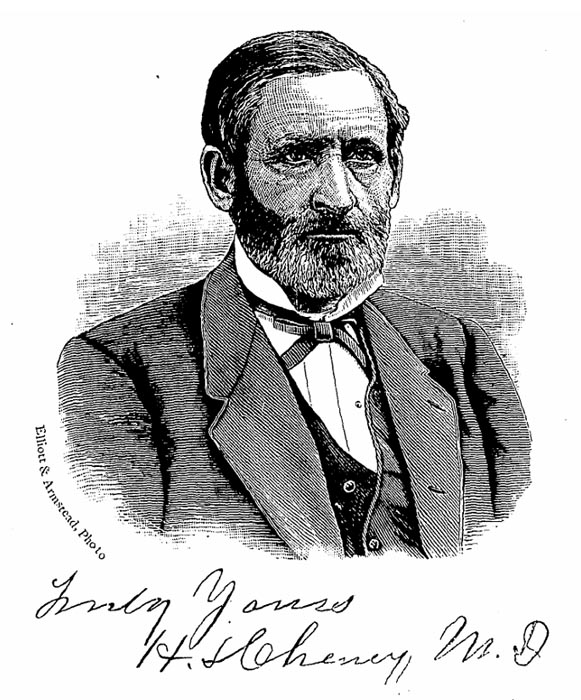
H. L. CHENEY, M. D.
|
H. L.
CHENEY, M. D.
By Dr. R. M. Denig.
There is nothing, perhaps, which so clearly
indicate the character and intelligence of a
community as its ability to discriminate between
charlatanry and pretension in the medical
profession and solid, real merit. Nor is
there anything which tends more to strengthen
and develop the native resources of a physician,
and prompt him to arm and equip himself with the
vast resources of his profession than this
confidence of which we speak, when extended to
him by the thinking and influential part of the
community, in which he has chosen to practice
his ministration.
In this respect Dr. H. L. Chaney has been
singularly fortunate. It has fallen to the
lot of few physicians, in rural districts, to
enjoy a more unbounded and entire confidence
than has been misplaced, or without its effect
upon its worthy recipient; it has stimulated him
to ceaseless activity, to intense and exhaustive
study, and unrelaxing exertions to meet the
severe demand made on his time and services.
We offer, then, no apology for giving in the records an
dhistory of this county a brief notice of one
who has responded so nobly to the claims of an
arduous and honorable profession, and ever
exerted an elevating influence in social life.
The history of a county or State is made up of
the history of its individual members, and none
are more worthy of a notice in its pages than
the high-toned, honorable physician, who has
attained a well-merited and extensive
reputation.
Dr. H. L. Chaney, son of John and Mary Chaney,
was born Aug. 20, 1820, in Fairfield county,
Ohio. He assisted his father on the farm
during the summer, and in the winter he enjoyed
the advantages and privileges of the district
school. This, with a subsequent two and a
half years spent at the academy of Greenfield -
supplemented by one year as teacher in the
district school, embraces all the facilities he
enjoyed for acquiring a preliminary education.
Limited, however, as were these opportunities,
the doctor entered upon his professional studies
with as much preparation as the ordinary run of
medical students, and with an ardent love for,
and enthusiastic devotion to, the calling he had
chosen. |
His preceptor was the amiable and
accomplished Dr. George E. Eels,
late of Lithopolis, whose urbanity
of manner, widely extended
knowledge, as well as ability and
skill, will long be remembered both
by his professional brethren and the
community in which he resided.
During the three years spent in the office of Dr.
Eels, part of which time he
was able to take a considerable
share in the practice. Dr.
Chaney attended two full and
two preliminary courses of lectures
at Ohio Medical college. Cincinnati,
and graduated with honor in
February, 1847.
In the summer of the same year, he commenced practice
in Lockbourne, Franklin county, and
in March, 1848. he was married to
Miss Mary Mook, daughter of
Thomas Mook, esq., of New York
city, and shortly after, removed to
his present place of residence.
Groveport.
This was the doctor's second marriage - his fist wife,
Miss Mary Cunningham, to whom
he was wedded before commencing the
study of medicine, having died
during the first year of their
wedded life, and leaving no
children. Four of his second
wife's children are living.
In politics, as in medicine, the doctor's position has
always been sharply defined -
Democratic to the core. In
1858 he was chosen a member of the
state legislature, and served two
sessions. Although his
constituents would have had no
difficulty in again returning him as
a member, or giving him any office
in the county he may have desired,
his political aspirations seem to
have culminated, and he returned
to his first love - his profession,
resuming its duties with increased
energy and zeal.
Dr. Chaney was a member of the old State Medical
convention, when the present State
Medical society which grew out of
it, was organized, and has been an
active member of the latter ever
since. He is also a member of
the Columbus Academy of Medicine,
and of the Columbus Pathological
society.
For the past two or three years the doctor's impaired
health has greatly impeded his
performance of active duty, and yet
under all his afflictions, and
knowing but too well the gravity of
his troubles, his mind has always
been clear, and his judgment sound,
and even with his wasted strength,
his indomitable will has enabled him
to perform an amount of active
labor, from which many a sound and
healthy city doctor would shrink. |
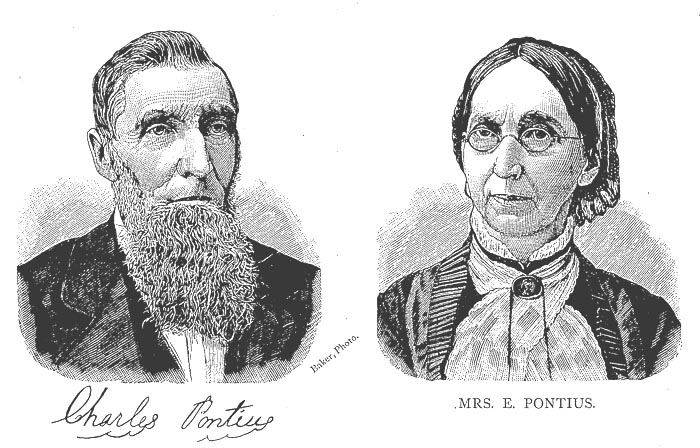
CHARLES PONTIUS and MRS. E. PONTIUS
|
THE PONTIUS
FAMILY.
Frederick Pontius was born April 4, 1759, in
Buffalo valley, Northumberland county (now Union
county), Pennsylvania, where in course of time
he married, and raised a family of four
children, as follows: John, born
Dec. 10, 1782, who died Feb. 27, 1837; Philip,
born Jan. 24, 1784, who died May 28, 1845;
Catharine, who married Adam Rarey, in
Ross county, and in 1808 settled in Madison
township, Franklin county; Elizabeth, who
married Henry Bunn, in Ross county, and
settled in Madison township, near her sister,
where she died in August, 1860. The wife
of Frederic Pontius died in their home in
Pennsylvania, and he afterwards married
Catharine Reedy. In 1807 the family
emigrated to Ross county, Ohio, arriving in July
of that year, and immediately settling on a
large tract of land purchased the preceding year
by Frederick Pontius, who came to Ohio
for that purpose.
Philip Pontius was twenty-two years of age when
he came with the family of Ohio. He had
obtained a limited education in the German
language in the schools of his Pennsylvania
home, but possessed no knowledge of the English
language, which, however, he learned to speak
fluently during his later years. He was
married, in 1809, to Catharine Rarey, who
was born in Virginia, Dec. 25, 1778. Her
father, Charles Rarey, was the German
birth, and emigrated to Virginia in a very early
day, whence he came to Ross county very early,
and from there to Madison township in 1806.
On his first arrival in America he was sold as a
servant to serve until able to pay the sum
required as passage money. This he earned
in a short time, besides accumulating enough to
enable him to make a visit to his native land.
After his return to this country he was married
to Margaret Wolf, by whom he had ten
children, Catharine being the second.
Immediately after marriage Philip Pontius
and wife came to Madison township, Franklin
county, in the winter or spring of 1807, where
they settled on a lot of eighty acres, in
section thirty-two. They lived on this lot
several years when it was exchanged for other
land on the northwest quarter of section nine,
on which they located in about 1811. Here
he built a hewed log house of one room, and
entered upon the labor of making a permanent
home in the forest, and here, with the help of
the children born to him, he cleared during his
lifetime, one hundred and sixty acres of land.
During the early part of the war of 1812 he
teamed supplied to headquarters of the army at
Franklinton, and while thus engaged was free
from the draft which called out most of the able
bodied settlers. His life was spent in
redeeming a naturally fertile soil from the vast
forest which covered it, and truly did he and
his wife perform pioneer labors in the
wilderness, often working at burning brush and
log-heaps until far into the night in order to
prepare ground where they could raise grain and
vegetables for the sustenance of themselves and
their little ones. Their house was
|
the home of itinerant
Metheodist Methodist
preachers, who visited every section
of the country, and no one, however
humble or degraded, was turned from
their door. Both early became
identified with the Methodist
Episcopal church, and both
exemplified the true teachings of
christianity in their lives and
work. Mr. Pontius died
May 28, 1845. His wife died
Nov. 2, 1854.
The children of Philip and Catharine Pontius
were: Christine, born Nov.
27, 1809, who married Abraham S.
Rainier, and settled with him on
the line of Franklin and Pickaway
counties, their home being in the
latter. He died leaving two
children, and she married Joseph
Hulva, whom she also survived,
and died in Lockbourne, June 2,
1842. Charles, who was
born Apr. 19, 1812, passed his
youthful days at the usual
avocations of the time,and aided
much in the labor of clearing the
land and cultivating the crops.
His education was obtained at the
subscription schools, at that time
the only place for obtaining and
education. He was married,
Sept. 19, 1833, to Elizabeth
Sharp, a daughter of John
Sharp, who settled in Madison
township in 1808. She was born
Aug. 1, 1811. Her father,
John Sharp, was born in
Heidelberg township, Berks county,
Pennsylvania, Apr. 28, 1781, and was
married Jan. 31, 1808, to Mary
Elizabeth Harbine, who was born
in Barn township, the same county,
May 3, 1782. They raised a
family of nine children, as follows:
Mary C., Elizabeth, Samuel,
Joseph, John, Ann, Catharine,
Abraham, and Huldah,
three of whom are now living -
Elizabeth (Mrs. Charles Pontius),
Samuel, and Abraham.
The other children of Philip
Pontius were: Elizabeth,
born in 1814, who married Dr. B.
F. Guard and settled in Pickaway
county, near Lockbourne, were she
died, and John, born in 1816,
who died from injuries, caused by a
runaway team, when but eleven years
of age. Charles Pontius
became a member of Hopewell
Methodist Episcopal church in1834.
His wife had joined the Truro
Presbyterian church in 1831,
previous to their marriage, and
retained that connection a number of
years. She then joined
Hopewell church, of which both have
remained consistent, useful and
efficient members to the present
time. Mr. Pontius has
for the past forty years been leader
of one of the two classes in the
church, and before that time was one
of the stewards about two years.
He has always that time was one of
the stewards about two years.
He has always been a liberal
supporter of the church, and has
ever been ready to assist a needy
congregation in the effort to built
a church home. In his business
habits he has been careful and
methodical, and, assisted by his
wife, by economy and hard labor, has
secured a comfortable competence for
their declining years. The
children born to Charles and
Elizabeth Pontius were:
Franklin G., born June 8, 1836,
to married Mary E. Rainier,
and lives on the southwest quarter
of section five; Philip, born
Mar. 27, 1840, who married Anna
A. Perrill, and lives on the
died Nov. 12, 1842; Charles L.,
born May 1, 1845, who married
Fannie C. Perrill, and lives at
the old Pontius homestead. |
Page 453 -
dising, grain, and largely in pork-packing.
One year he killed thirty-five thousand head of
hogs. He died at Groveport in the spring
of 1850, and left to his family a fine property.
William H. Rarey and James Cooken
established the second store in the village, in
the building in which Mr. West first
opened his. They carried on business
together for a number of years, finally taking
into the firm John Courtright.
Cooken subsequently sold to his partners,
and removed to Columbus. The Eberlys
(now of Columbus), with A. C. Headley,
and William and Salem Darnell were
among the early and leading merchants of
Groveport for several years. After Mr.
Wert, the successive postmasters have been
the following named gentlemen, viz: Edward
Garres, A. C. Headley, Samuel Sharp, John L.
Champ, Henry Long, and Cornelius Black,
jr., (the present incumbent), appointed in
1878. The first tavern in Groveport was
the Campbell hotel, built by John Campbell
in 1839-9, and kept by him as a public house for
twelve years. The present dwelling of
Mrs. William Peer was built for, and opened
as, a hotel by Alexander Fleming, about
the year 1845.
The Railroad House, of M. Corbett, was built in
1869.
Rarey's grist-mill was erected, in 1871, by
Rosenfield, Seymour & Co., and the old
saw-mill, on the canal, was built by Moses
Zinn, about 1848 or 1849.
The village was incorporated at the session of 1846-7,
and the following village officers were elected
in the spring of 1847, viz: A.
Shoemaker, Mayor; Samuel Sharp, E.
M. Dutton, J. F. Bywaters, C. J. Stevenson,
and William James, marshal. Since,
Mr. Shoemaker, Henry Long, Z. P. Thompson, E. W.
Edwards, Jeremiah White, Z. P. Thompson, N.
Steel, L. Sarber, W. W. Kile, Henry Long, George
Adel, F. M. Senter, and Robert A. Shaw,
(present incumbent), have officiated as mayors,
in the order named.
THE
PHYSICIANS.
of Groveport, at the present
writing, are: Drs. Cheney, Smith,
Saylor, Morden, and McCollom.
The oldest of these, in point of practice, in
the first named - Dr. Hugh L. Cheney.
Dr. Cheney read medicine with the well-known
Dr. George E. Eels, of Lithopolis, and
graduated at the Ohio medical college,
Cincinnati, in 1847. He practiced in
Lockbourn ten months, and, in 1848, settled in
Groveport, where he has since followed his
profession with signal success. Dr.
Smith and Dr. Saylor have also been
residents of Groveport for many years, and have
built up a good practice. Of the
physicians who formerly resided in this village,
we have the names of Drs. Abel Clark, Joseph
Bywaters, and _____ Bolen.
SOCIETIES.
GORDIAN
LODGE,
GROVEPORT
LODGE,
BIOGRAPHICAL
SKETCHES.
SAMUEL
BARTLIT - 454
MRS.
ELIZABETH B. POLLAY
GENEALOGICAL NOTES. - 454
GEORGE
NEEDELS
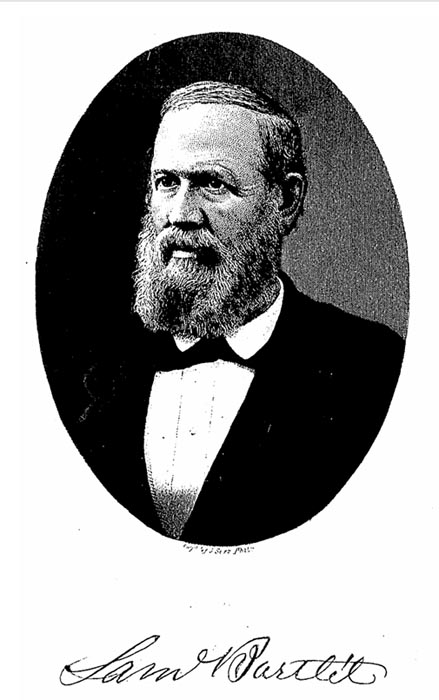
SAML BARTLLIT
ELIZABETH B. POLLAY
Page 455 -
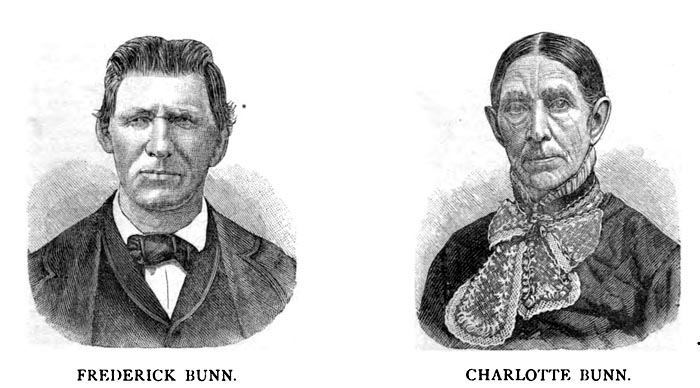
FREDERICK BUNN and
CHARLOTTE BUNN.
THE BUNN FAMILY.
JEREMIAH KALB.
Pg. 456 -
SAMUEL HEMPY.
S. O.
HENDREN.
GEORGE W.
NEEDELS.
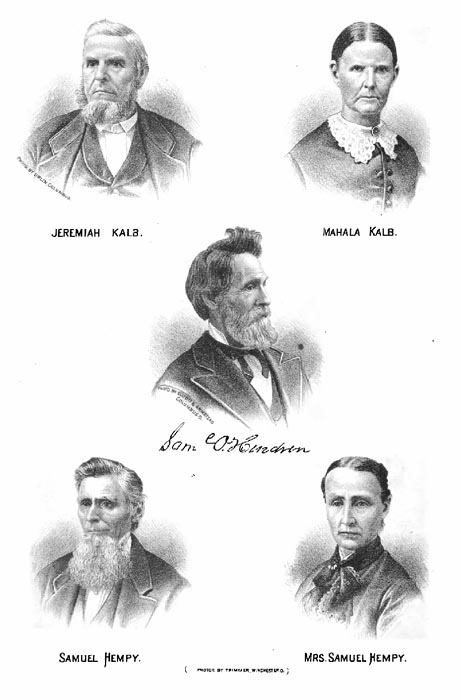
JEREMIAH KALB - MAHALA KALB -
SAM'L O HINDREN
SAMUEL HEMPY - MRS. SAMUEL HEMPY.
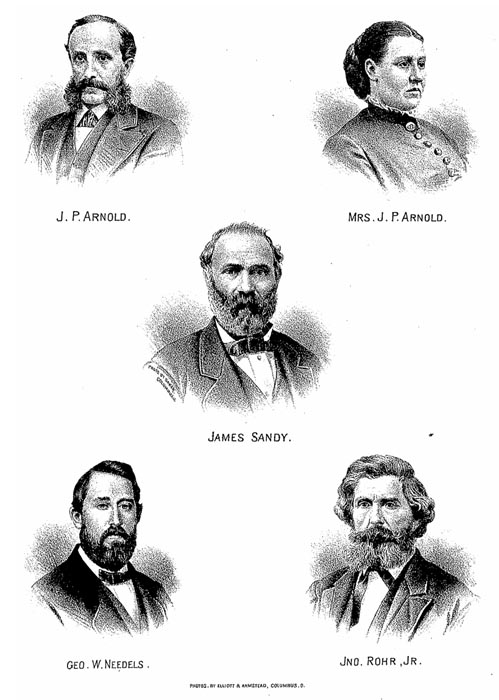
J. P.
ARNOLD MRS. J. P. ARNOLD
JAMES SANDY
GEO. W. NEEDELS JNO.
ROHR JR.
PHOTOS BY ELLITT & ARMSTEAD, COLUMBUS, O.
THE ARNOLD
FAMILY.
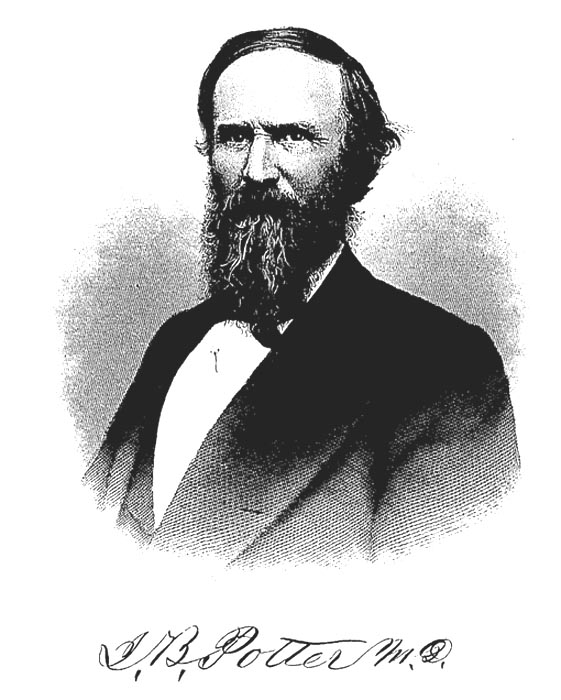
J. B. POTTER, M. D.
JOSEPH B.
POTTER, M. D.
Z. VESEY.
Page 459 -
HON. JOHN
CHENEY, SR.
Page 460 -
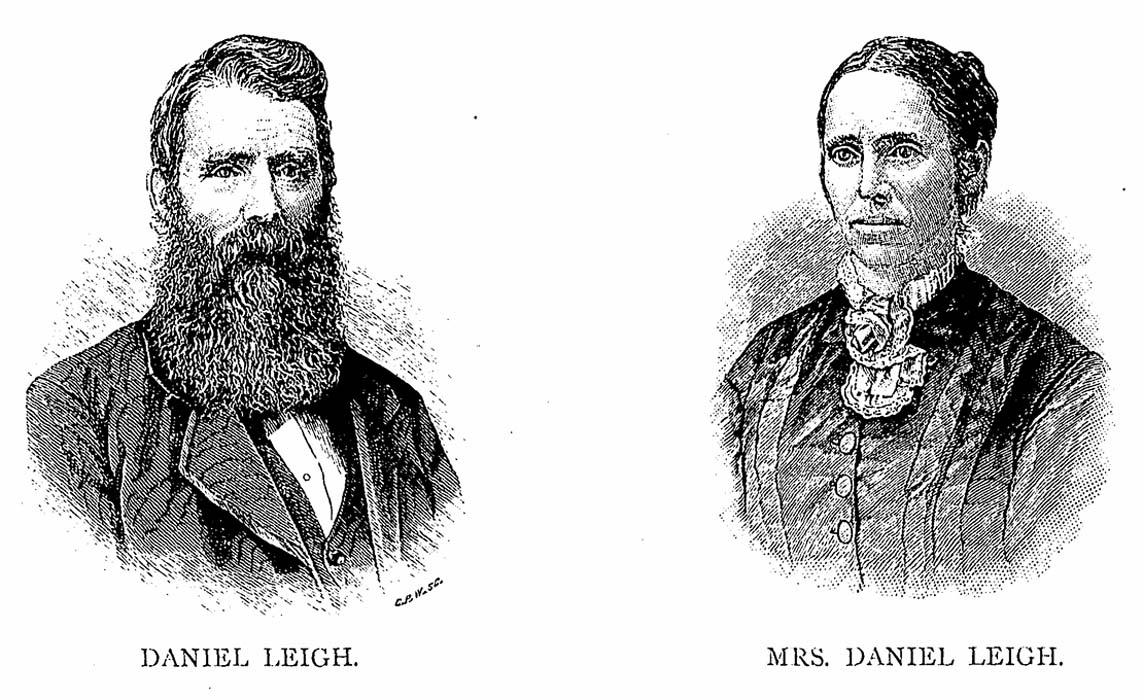
DANIEL LEIGH and MRS.
DANIEL LEIGH.
|
THE LEIGH
FAMILY.
Daniel Leigh, a native of New
Jersey, born in 1756, emigrated to
Madison township, Pickaway county,
Ohio, in 1823, where he died a few
years after his settlement. He
was a soldier of the Revolutionary
war. He was the father of six
children: Zebulon S., Charles
Watrous, Elisha, Sarah and
Eliza - all now deceased except
Watrous, a wealthy farmer now
living in Lynn county, Iowa, aged
about eight-six years.
Charles died in Madison
township, Pickaway county, soon
after the death of his father.
Elisha died in Illinois.
Sarah, wife of Samuel
Savage, remained in New Jersey.
Eliza became the wife of
Captain Buzzenbarger, and
settled in Indiana.
Zebulon Stout Leigh, the oldest of the family,
was born in Allentown, New Jersey,
in the year 1790. He learned
the saddler's trade of hsi father,
but not liking it, he chose the life
of a farmer, which he afterward
followed. He married, in New
Jersey, Amy Laning, and
Removed to Madison township,
Pickaway county, Ohio, in 1818.
His wife was the daughter of
Samuel Reed Laning, who
emigrated to the same township from
Trenton, New Jersey, with his family
in 1819. They were five weeks
in making the journey from
Philadelphia to |
Decker's mill, on Little
Walnut creek, where they permanently
settled.
Mr. Laning died about two years after his
arrival. His wife, whose
maiden name was Huldah Pierson,
survived him some eighteen years.
Zebulon Leigh settled on Walnut creek, in the
Decker neighborhood, where he
lived several years; then moved to
Madison township, Franklin county,
Ohio, and located on the farm of
John Welton where he died in
1841. His widow is yet living,
and is one of the oldest inhabitants
of the township, being nearly
eighty-eight years of age.
They were the parents of nine
children, to wit: Samuel, Phebe
(afterwards Mrs. English),
Mary Ann, Matilda, Huldah, Louisa,
Charles, John S. and Daniel.
All are now dead except Samuel,
Huldah, and Daniel, who
reside in Madison township, Franklin
county.
Daniel, whose portrait appears, with that of his
wife, herewith, was born Mar. 1,
1834, and married, Dec. 29, 1867,
Margaret E. Copland, daughter of
Joseph and Mary Ann (English)
Copland of Auglaize county,
Ohio. She was born Oct. 6,
1841. To them have been born
three children, namely: Joseph S.,
born Nov. 1, 1870; Mary Amanda,
born Apr. 1, 1873; and Olin
Copland, born Feb. 25, 1876. |
<
CLICK HERE to
RETURN to TABLE of CONTENTS >
|