|
The surface of this township is generally level.
The principal stream is Big Walnut creek, or,
more properly, Gahanna river, which flows
southwardly, through the central portion of the
township. Black lick creek, a branch of
the Gahanna, runs in a southeasterly direction
through the eastern part.
SETTLEMENT *
The first settlements in the township were made
in the year 1805. Among those who moved
into the Truro woods, in that year, were John
and Charles Medford, from Pennsylvania, and
Thomas Palmer, from Maine. The
Medfords settled in the southwest corner of
the land on which John Edgar and family
located in 1806 - on Black lick creek, a short
distance, north of Reynoldsburg. Palmer
was then a single man, but afterwards he
married, and lived in the township until his
death.
JOHN EDGAR, of whom
mention has been made, came from Pennsylvania.
His eldest son is now a resident of Jefferson
township.
In 1806, JOHN
LYNCH, originally from Pennsylvania, removed
to this township from Lancaster, Ohio, where,
with his wife, Mercy, he had settled in
1799 or 1800. He settled at the north end
of what is called Sprague's Hill. He
served a few months in the war of 1812. He
was the father of six children, namely:
Jonathan, John, Cornelius, Daniel, William,
and Mercy. Daniel lived and died in
Sandusky. Cornelius removed to
Indiana, and William to Illinois.
Mercy married a Mr. Boyd, and now
lives in Illinois. Jonathan is
supposed to have lost his life in the Seminole
Indian war, as he was never heard from after he
entered the service. John, about
the year 1820, married Nancy Scott, and
resided in the township until 1850, when he went
to California, where he died, in 1863. His
son, John H. Lynch, is now living in
Reynoldsburg, where he is engaged in the marble
business. He is also a justice of the
peace of the village, in which position he has
served for several years.
The same year
BENJAMIN CORNELL moved in from Virginia.
They located just east of Walnut creek, on the
National road. Benjamin sold out to
Captain John Hanson, in 1812 or '13, and
removed to Urbana. The widow of William
Cornell still resides in the township.
MATTHEW LONG,
from Nova Scotia, also joined the settlement in
1806. He located in section twenty-two,
and subsequently erected a saw-mill and a
grist-mill, which he operated until 1825, when
he died. He left a wife and four sons.
Robert, Edward, and George were
raised by David Taylor, and Henry
by A. Vinton Taylor. Henry
Long is now engaged in business in Groveport,
and Edward and George reside in
Portland, Oregon. Robert is deceased.
John Long, a brother of Matthew,
was also a pioneer of Truro.
Prominent among the
pioneers of the township were the TAYLORS.
Robert Taylor, of Truro, Nova Scotia,
having entered or purchased lands in this
townships, removed with his family in the fall
of 1806, to Chillicothe. He resided there
until the spring of 1809, when he came and
settled on Walnut creek, having, the previous
summer, erected his dwelling - the first framed
house in the township. The old structure
is still standing, and is in a pretty good state
of preservation. Robert Taylor died in
1828. His children were Abiather
Vinton, Elizabeth, and Margaret (both
of whom married into the Long family),
Lydia (who married her cousin, Matthew),
Jane (afterward Mrs. Thompson),
James W., David, and Susan, who
married Gilbet Green. The only
survivors are David and Mrs. Green, the
former residing in Columbus, and the latter, who
is now a widow in Truro.
WILLIAM McINTIRE,
now living a short distance from Reynoldsburg,
has been a resident of the township since 1808
or 1809. His father came from Virginia,
with his family, in the above year, and settled
on the old Hebron road, where William Ashton
now lives. He had a large family of
children, of whom eight are yet living.
William, the oldest, married, for his first
wife, Mary Frazer, who died, of cholera,
in 1834. In 1840 he was again married, to
Sarah Longshore, who died in the year
1857. He has three surviving children, and
two deceased. Mr. McIntire
purchased the first lot in Reynoldsburg after
the town was laid out.
In
1810 or 1811, ZACHARIAH PAUL removed to
this township, from Virginia, and located on
Walnut creek, about a mile and a half south of
the National road, where he resided until his
death. Two sons and a daughter (Mrs.
Stigle, in Mifflin township), are now
living. The oldest son, John, died,
in 1879, on the homestead. His widow now
resides in Columbus.
About
this time WILLIAM THOMPSON came from
Pennsylvania, and settled just below Paul.
In 1820 he sold to William McComb, of
Washington county, Pennsylvania, and removed to
Indiana.
CAPT. JOHN HANSON came to
Ohio, from Virginia, with his wife and two
children, about the year 1806. In 1812 he
bought out Benjamin Cornell, on the
National road, just east of Walnut creek.
Capt. Hanson was born, in Virginia, in
1799, and died, in Reynoldsurg, in 1861.
His widow - second wife - now lives in that
avillage.
-------------------------
* For the facts concerning many of the early settlers
herein mentioned, the writer has relied upon the
recollections of Mr. David Taylor, now of
columbus, bu one of the earliest pioneers of
Truro township
Pg. 462 -
In 1812 DANIEL ROSS
and his sons, James, Alexander, Hugh, Daniel,
Fulton, and Edward, removed to this
township, from Nova Scotia. The father
died in Truro, but the
sons finally moved out of the county.
RICHARD RHOADS,
with his family, which consisted of his wife and
three children, came to Ohio from Pennsylvania
in 1807. He remained four years in
Bloomfield, Pickaway county, when, in 1811, he
moved to Truro, and settled on the place on
which his son, Lambert, now lives.
He died in 1851, at the age of seventy years.
His wife died in 1870, at the age of
ninety-three. They raised nine children,
as follows: Margaret (Mrs. Johnson),
and Philip, who live in Reynoldsburg;
Lambert P., who married Sarah Cornell,
and lives on the old homestead; Elizabeth,
who remains unmarried, and lives with her
brother, Lambert; Isaac, deceased;
John, who was killed on the railroad at
Pataskla, Licking county, in 1873; Richard,
who also resides in Reynoldsburg; Mary (Mrs.
Doren), who lives in Iowa; and Matthew H.,
deceased. The family is remarkable for
longevity - the ages of the six surviving
children aggregate four hundred and twenty-four
years, or an average of nearly seventy-one
years.
DAVID
and NANCY GRAHAM, of Reynoldsburg, are among
the oldest residents of the township - being
aged, respectively, sevent_-nine and seventy-six
- and were also among its early pioneers.
Mrs. Graham came with her parents,
James and Margaret Graham, from Washington
county, New York, in1811. Her father
bought from John Logan one hundred acres
of land, just east of where Reynoldsburg now
stands, and resided there until his death, Aug.
7, 1835, the mother having died previously.
Mr. Graham came to Truro when seventeen
years of age, in the year 1817. His
father, George Graham, settled about a
mile north of where Reynoldsburg now is, and
died there some twenty ears ago. His wife
survived him, and attained the age of
eighty-five. Mr. and Mrs. raham
have now eight children (two having died),
fifty-one grandchildren, and eighty great
grandchildren. Mr. Graham was
engaged in merchandising in Reynoldsburg, for
twenty-five years.
In 1812 JOHN
CAMBRIDGE moved in from Pennsylvania, and,
in 1814, Elias Chester and Jeremiah
Nay, from New York.
GEORGE POWELL and
family, earlier settlers in the adjoining
township of Madison, settled in this township
together with his brother, Archibald and
family, in the year 1815. They erected a
cabin, on the place now occupied by James N.
Peters, and the two families occupied it,
together for about a year, when Archibald
built where his son, Joseph B. Powell,
now lives. He died there, in 1868, at the
age of nearly eighty five. His wife
survived him about ten years, and was nearly the
same age at her death. Six of the family
are now living - William and Jacob, who
live in Missouri; Mrs. Alford Gray, who
lives in Madison township, this county;
Joseph B., who lives on the homestead, in
Truro; and James N. Peters, who lives in
the same neighborhood.
In 1815 or '16 DAVID
PUGH, a native of Wales, moved into the
township from Delaware county, and located on
the place now occupied by the Enlows.
He kept a tavern there for many years. His
wife, before marriage, was Jane Murphy,
whom he married in Delaware county. They
had a family of seven children, the youngest of
whom is Judge Pugh, of Columbus.
David, the eldest son, was born in 1814, and
died in 1877. He married, first,
Elizabeth Whetsel, and after her death,
Hannah Phillips, his cousin, in 1861, who
still survives. He lived, during the
greater part of his life, on the farm now
occupied by his sons, David S. and
John M. The other children of David
Pugh, sr., are Mrs. Robert Shields,
of Columbus, Mrs. Jane Hudson (widow), in
Truro, Andrew, who lives in the west, and
Margaret and Isabel (twins),
deceased.
THOMAS ENLOWS
came from Baltimore, Maryland, in
1816 or 1817, and purchased one hundred acres on
the east side of Big Walnut. He sold to
David Taylor, and died shortly afterwards.
He was the father of three daughters and one
son, James, who was raised by Mr.
Taylor. He married Jane Wolf,
and settled on Broadway, a mile west of Big
Walnut, where he raised his family. He
finally purchased the farm now occupied by his
family - five unmarried children. He was
in the war of the Rebellion, and died at
Vicksburg in October, 1863. His body was
brought back to Truro, and buried in the same
grave with that of his father on the Hanson
place. Mr. Enlows was one of
the best as well as one of the most influential
citizens of the county.
DANIEL WHETSEL,
a native of Pennsylvania, was one of the early
pioneers of Pickaway county, settling in the old
Indian town of Westfall, Wayne township.
In 1823 he moved to Franklin county, and located
on the land now owned by his daughter, Huldah.
He died December 1868, at the advanced age of
eighty-seven years, his wife preceding him many
years. There are now seven of the family
living, four of whom reside in the west.
Of the remainder, Huldah, unmarried,
occupies the homestead; Elisha M. is a
resident of Columbus, and Mrs. Martha Taylor,
in Blendon township.
JACOB WOLF and
family came to this county from Hardy county,
Virginia, in 1831. Mr. Wolf settled
in the Powell settlement, where he lived about
six years, when he bought the David Pugh
place, on Broadway, which he made his permanent
residence. Four of the family are
yet living, viz: Mrs. Staley, in the
adjoining township of Jefferson; John,
who married Ann Cornell, near
Reynoldsburg; Mrs. Shull, in Mifflin
township; and Levi, in Hibernia.
BENJAMIN V. LUNN
came from Bucks county, Pennsylvania, in 1833,
and located on the National road, near where
Dr. Lunn now lives. He died the next
year after his arrival, and was the first person
buried in the Baptist church burying ground.
His widow is still living in the township, and
is now aged seventy-three. Josiah R.
Lunn, and Benjamin V. Lunn, her only
children, also reside in this township.
The former married a daughter of David and
Nancy Graham.
WILLIAM E. BULLEN,
emigrated from England, in 1832, and remained in
Canada until 1836, when he bought one hundred
acres of land in Truro township. He had a
OLIVER P.
HINES.
|
Oliver Perry Hines, the
subject of this biography, is a
descendant of an old family, of
Doylestown township, Bucks county,
Pennsylvania. His ancestors
were among the early land
land-holders, in Warrington, in that
venerable county; and his
grandfather, William Hines,
was a soldier in the war of the
Revolution. Oliver was
the third son of John and Mary (Callander)
Hines, and was born near
Doylestown, on the twenty-sixth of
March, 1812. His father
combined the callings of farmer,
saddler, and merchant, and became
possessed of considerable property,
which, however, was alls wept away
by unfortunate ventures during the
last war with Great Britain.
His son, born in the first year of
that war, originally received
another name; but, after the gallant
fight and brilliant victory of
Commodore Perry, at Put-in-bay,
Sept. 10, 1813, the admiration of
his parents for the young hero of
that action became so great as to
induce them to change the name of
their child; and he was accordingly
named Oliver Perry Hines.
He remained with his father,
assisting in the labors of the farm,
and also to some extent, in the
saddlery shop, attending the
district schools, as he could, from
time to time, until the age of
seventeen , when he began to learn
the trade of a bricklayer. At
this he worked until the early part
of 1834, when, in his twenty-second
year, he determined to push his way
westward, to the land of promise, in
Ohio, then a frontier, to which so
many emigrants from the older
regions along the Atlantic seaboard
were looking. Columbus, then a
rising young city, was his objective
point, and he reached there Apr. 26,
1834. Here he took up his
trade, and many buildings still
standing in the city are the
monuments in whole, or in part, of
his handiwork. About 1839, in
company with another young
brickmason, named Crosswell,
he contracted for the brickwork upon
the Franklin county court house, the
same edifice now occupied for county
purposes on High street, in
Columbus, between Mound and Court
Streets. Some time afterward,
his ambition and success led him to
extend his enterprises, and he
became a brickmaker, occupying for a
yard premies on, what is now,
Llivingston avenue, within the city
limits, but was then some distance
outside of the corporation. He
was prospered inthis business and
remained at it until about 1850.
A Democrat in his political
convictions, and somewhat "in
politics" his services to the party
were recognized, in 1848, by an
election as county commissioner, in
which office he served until 1851 or
during the fall term of three years.
The next year after his retirement
from the brickyard, he was chosen
county treasurer, and his service in
that office was endorsed by a
re-election in 1853. Four
years afterwards he again became a
county commissioner, by appointment
to fill a vacancy caused by the
death of Mr. Willis Mat- |
toon, and served until the end of
the term for which Mr. Mattoon
was elected. About 1858,
Mr. Hines, in copartnership with
Mr. William Miller, built and
stocked the Columbus paper mill, as
their own enterprise, and conducted
it successfully for a number of
years, when they sold the property
to its present owner, Mr. Yeatman
Anderson. For a year
subsequently Mr. Hines rested
from active business, and then
engaged in banking with the firm of
Sparrow, Hines & Company, occupying
the building on the corner of High
and town streets, now occupied by
their successors, Messrs. Brooks,
Butler & Company. Upon the
dissolution of the former firm,
Mr. Hines became the head of the
concern, which now took the name and
style of Hines, Taylor &
Company. In July, 1877,
the entire business was transferred
to Brooks, Butler & Company,
the head of which firm had been a
member with their immediate
predecessors. Since then
Mr. Hines, feeling somewhat the
weight of years and the oncoming of
age, has retired altogether from the
active pursuits of finance and
trade, and is quietly enjoying the
fruits of his long and manifold
labors, in a spacious and pleasant
home, at No. 454 east Rich street,
in Columbus, his declining years
made comfortable by the possession
of a handsome property, and the
attentions of many relatives and
friends. He has never been
much engaged in municipal affairs,
but served three yeas (1838, 1839,
and 1840), in the city council.
Apart from this and the offices he
filled, as before noted, he has not
suffered public matters greatly to
disturb the tranquility of his
private life. He has, however,
for twelve years past, consented to
act as a trustee for the Green Lawn
cemetery, Columbus, and was for
several years, until his retirement
from the banking business, its
treasurer.
On the seventh of February, 1837, Mr. Hines was
united in the bonds of matrimony to
an early friend and associate,
Miss Mary Thomas, daughter of
Mr. William Thomas, also an old
resident of the Doylestown region,
in Pennsylvania, who had emigrated
to Columbus the year before Mr.
Hines came. They have had
five children, two of whom died in
infancy. The remaining
offspring are: William Thomas
Hines, the oldest, a bachelor,
long resident in Memphis, where he
carried on a flourishing dairy
business, but, driven north two
successive summers by the yellow
fever, he has permanently abandoned
that city, and is now building upon
and otherwise improving a farm given
him by his father, in Mifflin
township, in this county; Mary
Alice, the next oldest, now
Mrs. Benjamin F. Reed, of
Cincinnati, wife of an employe of
the Cincinnati Southern railroad;
and Oliver, who owns and
occupies a five hundred and fifty
acre farm, in Truro township,
Franklin county. |
---------------
For the facts concerning many of the early settlers
herein mentioned, the writer has relied upon
the recollections of Mr. David Taylor,
now of Columbus, but one of the earliest
pioneers of Truro township.
Pg. 463 -
family of six children, five of whom settled in
the immediate vicinity. Two sons now live
in the township - John, and
William. John married Mary Wallace,
in 1843, and has had eight children, six of whom
are now living. He has worked hard in
grubbing out the tough beech roots and clearing
his place, and by industry and economy has
secured a comfortable home. William E.
Bullen, his father, died in 1844.
BASIL BATCHELOR,
originally from near Syracuse, New York, moved
in from Licking county, Ohio, in 1846, and
located on Broadway, about four miles from the
city, in Truro township. He died in 1870.
His wife, Nancy Batchelor, is still
living. A son, Lemuel, resides in
Bluffton, Indiana, and is county treasurer;
another son, Basil, is a resident of
Delaware county; Alonzo, and Rhoda,
reside in Union county; Lucy married
Elias Chrysler, now deceased, and lives in
Mifflin township, this county.
FIRST
SCHOOL.
The first school in this township, as now
remembered by Mr. Taylor, was kept in a
log cabin on the east bank of Big Walnut, just
south of where the Livingston road now crosses
it. The first teacher was a man by the
name of McAfferty, who taught about the
year 1820. There was an earlier school on
Alum creek, in Montgomery township, taught by
Helen Tappan, which the children of Truro.
CHURCHES.
THE UNITED
PRESBYTERIAN CHURCH,
BAPTIST
CHURCH.
THE
METHODIST CHURCH.
THE
PRESBYTERIAN CHURCH.
THE
UNIVERSALIST CHURCH.
July
22, 1848, at a meeting in the village
school-house a large number of those interested
being present, there was organized what was then
termed the First Universalist Society of
Reynoldsburg, now called the First
Page 464 -
Universalist church ............................MORE
TO COME
A constitution for the government of the society
was drawn up and signed by about forty members,
the original signatures or those of first
members, being: John Miller, E. P. Bull,
Joathan Looker, Vincent Hudson, T. Broomback,
John Wright, John T. Cookus, Noah Powers, Amanda
Miller, E. S. Miller, Eliza Cookus, Elizabeth
Scott, Martha Looker, Reuben Schofield, Isaac
Powers, Jacob Schaffer, A. J. Moore, J. M.
Allen, N. C. Mason, D. C. Vandugyn, Lot Davis,
C. Keiser, and George Taylor.
The church building was erected in 1849, at a
cost of about one thousand five hundred dollars,
and upon a lot donated for the purpose by
John Ricketts. The first regular
pastor employed was the Rev. Henry Gifford.
Varying degrees of prosperity have been passed
through by the church, but it has been during
most of the years of its existence, ina very
flourishing condition. It has at present
about forty members. The present pastor is
the Rev. W. B. Woodbury; and the trustees
of the church are: Charles G. Hutson,
M. M. Mason, and Samuel Parkerson.
POWELL
CHAPEL.
THE DESCIPLE
CHURCH
MILLS.
REYNOLDSBURG
was laid out
in the fall of 1831, by John French, who
owned the land on which the village is located,
and the place was first called Frenchtown.
Soon after the town was laid out, James C.
Reynolds, afterwards General Reynolds,
then a young man, from Zanesville, came and
opened a store with a small stock of
miscellaneous goods, suitable for the wants of
the laborers upon the National road, then in
process of construction, and the name of the
village, not being entirely satisfactory to the
inhabitants, it was changed, at a public meeting
of the citizens, to that which it now bears.
Reynolds had, at that time, no interest
in the project of building up a town, except the
increase in his business which would naturally
follow. He subsequently married in, and
became identified with the place that bore his
name, and was one of its leading citizens, and
most prosperous business men. He resided
there for a number of years, was once appointed
postmaster, built a steam mill, and was
generally active in public as well as private
affairs, but finally removed to Carroll,
Fairfield county, where he died.
The town had, for a few years, quite a rapid growth,
during which time it attained to nearly its
present size. Its greatest prosperity was
probably attained in about 1846 or 1847, and it
continued to hold considerable importance as a
place of trade until the Baltimore & Ohio
railroad was built, in 1853, when the stages
were discontinued upon the National road, and
the village ceased to have that element of
support. Then, too, the little station
village of Black Lick was developed upon the
Baltimore & Ohio railroad, and to it was
diverted a portion of the patronage that
formerly sustained Reynoldsburg, in its best
days. The village still retained, however,
a
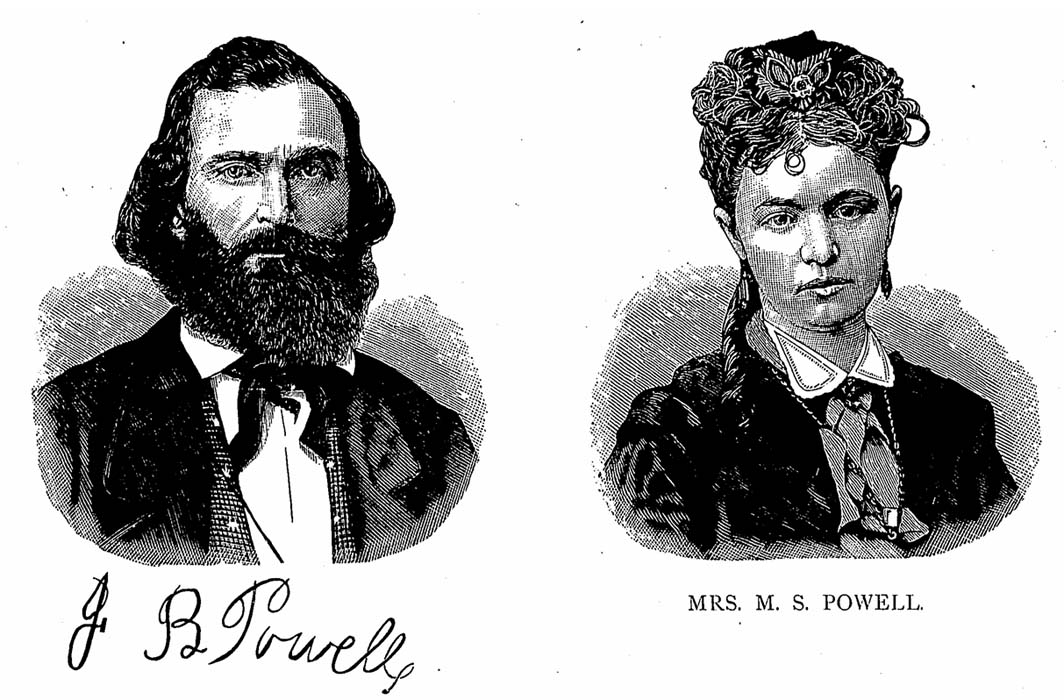
J. B. Powell
Mrs. M. S. Powell
|
THE POWELL
FAMILY.
Joseph Powell was born and
married to a daughter of
Archibald McCoy, in the State of
Maryland, removing thence to Bedford
county, Pennsylvania, in 1794, where
he remained until his death.
The children born to this couple
were: Mary, born Aug.
3, 1781; George, born Feb.
19, 1783; Archibald, born
Dec. 1, 1784; Joseph, born
Dec. 7, 1786; Sarah, born
Feb. 2, 1789; Elizabeth, born
Mar. 10, 1791; Thomas, born
Feb. 2, 1793; Mary (second),
born Nov. 17, 1798; Rachel
born Dec. 27, 1799; John,
born Sept. 3, 1801; Jonathan,
born Mar. 23, 1803; William,
born July 1, 1805; Robert,
born Sept. 15, 1807; Susannah,
born Mar. 5, 1809; Nancy,
born Nov. 6, 1810; and David,
born Jan. 6, 1813.
Archibald Powell, the third child in this
family, married Elizabeth Adams,
in Bedford county, Pennsylvania,
Jan. 29, 1808, and in 1815,
accompanied by his family, removed
to Ohio, and settled in Truro
township, Franklin county. The
year after their arrival they built
a cabin on the farm now owned by
J. B. Powell Their
children were; William born
Aug. 5, 1809; Mary, born Dec.
5, 1810; Jacob, born Jun. 2,
1813; George, born Jan. 25,
1815; Malinda A., and
Rachel M. (twins), born Dec. 7,
1818; Joseph B., born Mar.
27, 1822; Elizabeth J., born
Oct. 30, 1824; and Clarissa A.,
born Nov. 19, 1828.
Archibald Powell died Sept. 3,
1868. His wife, Mrs.
Elizabeth Powell, lived until
nearly eighty-six years of age, and
died Apr. 29, 1878. Before her
death she had one hundred and
sixty-three descendants, as follows:
Nine children, sixty-eight grand
children, and eighty-six great
grandchildren.
Joseph B. Powell, son of Archibald and
Elizabeth Powell, was married to
Lucinda T. French, Aug. 12,
1863. She was born Apr.
3, 1842. To them were born
three children: Clement M.,
born June 3, 1864; Wil |
liam A., born Sept. 21, 1866;
and Andrew J.., born May 12,
1869. Mrs. Powell died
Oct. 6, 1870, and on the
twenty-fifth of January, 1876, he
was again married, to Mary S.
Fancher, who was born Sept. 26,
1852. They have one child:
Gerda M., born May, 7, 1878.
Mr. Powell has passed his life
on the home farm, with the exception
of two years and three months spent
in the gold mines of California,
during the years, 1850, 1851, and
1852. He was able to bring
home a quantity of gold from the
mines, but has found a more
profitable and pleasant business and
home on his farm, where he has since
remained. A representation of
his home accompanies this sketch.
THE FANCHER FAMILY.
William Fancher was born July
6, 1764, and was married in
Pennsylvania, where he had a family
of nine children, as follows;
Henry, born Jan. 25, 1786;
Nancy, born May 5, 1790;
Samuel, born Feb. 16, 1792;
William, born Nov. 8, 1793;
Amy, born in 1798; Polly,
born Apr. 25, 1800; Nehemiah,
born May 7, 1804; David, born
July 16, 1806; Rebecca, born
October, 1809. The family came
to Plain township, Franklin county,
in an early day, and after their
arrival, William, Henry, and
Samuel served in the war of
1812.
William Fancher, jr., was married, in 1815, to
Selina Cook, by whom he
had three children: David,
born Oct. 15, 1816; James, Dec. 10,
1817; William, Nov. 1 6,
1819. Mrs. Fancher
died, and he married Eveline
Brown, who was born Apr. 22,
1825. Their children were:
George, born Oct. 26, 1847;
Joseph, May 7, 1849; John,
Dec. 11, 1850; Mary Selina,
Sept. 26, 1852; Josephine,
July 26, 1854; William C.,
Mar. 13, 1856; Isaac, May 5,
1858; Samuel, Sept. 15, 1860;
Henry, Sept. 13, 1862;
Ulysses Grant, Oct. 27,
1864; Lorenzo Dow,
Nov. 29, 1868. |
Pg. 465 -
considerable portion of its prestige, and has
done so to the present.
As has heretofore been stated, Mr. Reynolds, had
the first store in the village - in fact, had
one upon the site before there was a village
there. The building was a hewed log house,
which stood where the United Presbyterian church
now is. The second store was occupied by
B. B. Bronson. Next in order, after
Mr. Bronson, came the store of Rhoads
& Clendenning, and their successors,
Metler & Clendenning. Then came
Rhoads & Hutson, and then Elias Weaver.
The first hotel was that now known as the
Central house, built by Mitchel Demorest,
in 1832. He sold to Benjamin Sills
who conducted the little tavern for some time.
In 1833, Mr. Demorest built what is now
the McEwen house, and of which Louis
Sells, a nephew of the proprietor of the
other house, was landlord. Emanuel
Rhoads, in 1835, built the third hotel,
which is also still standing, but not in use.
THE
POST-OFFICE.
of
Reynoldsburg was established in 1833, and
James C. Reynolds was the first postmaster.
He was succeeded, in 1840, by Hiram Sibel,
and he, in 1841, by E. G. Hardesty. Mr.
Reynolds was reappointed in 1842, and served
four years, when he gave place to John
Miller. Lewis Sells succeeded him in
1847, and, in 1849, was himself succeeded by
L. P. Rhoads. In 1853, R. R.
Johnson obtained a commission, and, in 1855,
John Cookus. John Wright was the
postmaster in 18356, and those who have followed
him, down to the present time, have been John
Lynch, R. R. Johnston, Richard Roe, Vincent
Hutson, and Mr. Mason.
PHYSICIANS.
INCORPORATION.
Reynoldsburg came into being, municipally,
in 1839, being then chartered by the
legislature, and its corporation government was
organized in 1840, Abraham Johnston,
being at that time elected mayor, with the
following board of trustees: D. K. Wood,
Samuel Garres,, John W. Thompson, Mark Evans,
James O'Kane, and Archibald Cooper.
Beginning with Johnston, the mayors
elected from 1840, to the present, have been as
follows:
1841, Daniel Taft, re-elected in 1842 and
1843;
1844, Robert Shield;
1845, Archibald Cooper;
1846, James O'Kane;
1847, R. Shield;
no elections were held from this time to
1853, when R. Shield was again chosen;
1854, J. B. West;
1856, Richard Rhoads;
1857, J. B. West;
1858, M. H. Rhoads;
1862, John Schoonover;
1869, A. J. Graham;
1872, H. Wilson, and W. W. Johnson (to fill
vacancy);
1873, W. W. Johnson, regularly elected;
1876, John H. Lynch;
1878, J. B. West, the present incumbent.
The other officers now in position, are:
Harvey Nichols, clerk; C. J. Huston, F.
W. Norris, J. P. German, T. W. Alberry, Samuel
Chandler, William Rhoads, councilmen; J.
A. Frazier, marshal.
SOCIETIES.
MASONIC.
INDEPENDENT
ORDER OF ODD FELLOWS.
REYNOLDSBURG
ENCAMPMENT.
was instituted
June 1, 1875, and was originally composed of the
following members: John D. Nourse, William
Pg. 466 -
Rhoads, O. F. Coons, Jacob Pickering, W. E.
Ashton, William Hunt, C. S. West, George Stoner,
Charles Fishbaugh, David Pugh, P. W. Strahl.
Soon after the village of Reynoldsburg was laid
out, Thomas Armstrong sold a few lots,
where the National road crosses Big Walnut.
These were improved and formed the nucleus of
the little hamlet, called Hibernia. The
place was not platted, nor did the proprietor
intend it for a village. A post-office,
however, was established there in 1849, and
William F. Armstrong, appointed postmaster,
who continued to hold the office until 1857,
when he resigned, and the office was
discontinued.
TOWNSHIP
ORGANIZATION.
Truro was organized as a township in 1810.
It originally formed a part of the old township
of Liberty. The first election for
township officers was held at the residence of
the Taylor family, who had the honor of
giving the township its name. That of
"Truro" was selected after a township of that
name in Nova Scotia, in which they had formerly
lived.
The township records not having been preserved, we are
unable to give the names of the first township
officers elected, except the justice of the
peace, who was Ebenezer Richards.
Township officers, in those times, served
without compensation, and such was the practice
until about the year 1850.
By an act of the legislature, passed the 27th of
January, 1857, nine half sections were detached
from the south-west corner of Licking county,
and annexed to Franklin, which caused the jog in
the southeast corner of Truro township, as shown
by the county map.
The present township officers are as follows:
William Rhoads, clerk; J. R. Lunn, J. B.
Powell, and John Townsend, trustees;
W. W. Johnson, treasurer; Wm. Swonger,
assesor assessor, and John
H. Lynch and James Taylor, justices
of the peace.
__________
BIOGRAPHICAL
SKETCHES.
__________
JAMES ENLOWS.
GILBERT
GREEN.
THE WOLF
FAMILY.
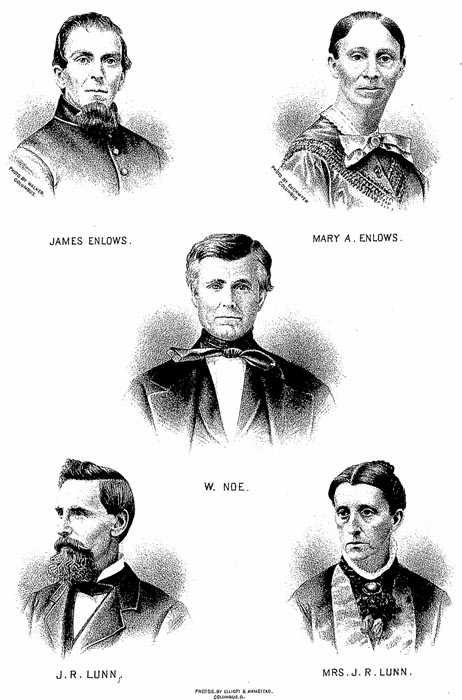
JAMES ENLOWS.
MARY ENLOW
W. NOE.
J. R. LUNN
MRS. J. R. LUNN
Photos by Elliott & Armstead,
Columbus, O.
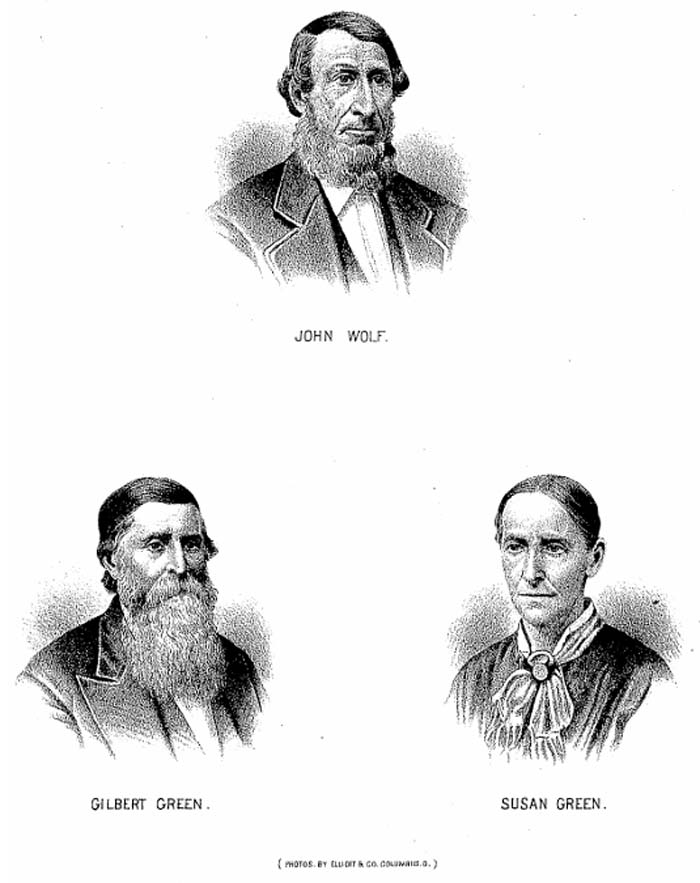
JOHN WOLF.
GILBERT
GREEN
SUSAN GREEN
(Photos By Elliott & Co. Columbus, O.)
Pg. 467 & 468
-
THE LUNN
FAMILY
THE GRAHAM
FAMILY.
WILLIAM NOE.
<
CLICK HERE to
RETURN to TABLE of CONTENTS > |