Mifflin was, originally, a portion of the old
township of Liberty, erected at the time of the
division of the county, in 1803. It so
remained, until 1811, when the township was
established and organized with its present
boundaries. It is just five miles square,
and is one of the townships of the United States
military lands, known, in early times as
township number one, range seventeen.
The land in this township is level, or slightly
undulating, except along the two principal
streams - Alum and Walnut creeks, which flow
through its teritory territory
from north to south, the former in the western,
and the latter in the eastern part. The
beds of these streams are quite banks of a shaly
slate formation. Along Alum creek, the
greatest unevenness is exhibited. The
bottom lands of this stream and Big Walnut,
contain the richest soil in the township.
The uplands are also fertile, and produce fine
wheat, being composed of what is generally known
as the "yellow oak soil," which originally bore
a heavy forest, in which that variety of timber
prevailed.
NAME
The
township was first settled by emigrants from
Pennsylvania, and they gave the place of their
choice the name of their old governor -
Mifflin.
CIVIL
BEGINNING.
The township was organized and established
within its present limits in 1811, previous to
that time having been in common with Blendon and
Jefferson, attached for civil and judicial
purposes to Plain. The first justices of
the peace were Frederick Agler and
John Scott. In 1815 John Scott
was re-elected, and Stephen Harris was
chosen in Agler's place.
The first fall election of officers shown by the
records is that which occurred in 1815. At
that time the election was held at Frederick
Agler's house, William Read, John Turney,
and Agler acting as judges, and James
Shannon and Henry Hawken as clerks.
Following is the full list of officers elected;
William Read, John Turney, and James
Price, trustees; Geo. Baughman and
Asa Roberson, supervisors; Hugh Price
and Asa Roberson, constables; James
Shannon and Jacob Isanheart,
overseers of the poor; John Agler and
Geo. Ridenour, fence viewers; Henry
Hawken, clerk; Stephen Harris,
treasurer; James Shannon, lister;
Stephen Harris, house appraiser.
The present officers are: David Beers, William
Shephard, and William A. Stygler,
trustees; John Zuber, clerk; Thomas D.
Cassady, treasurer; Eli Chrysler and
David Beers, justices of the peace;
Levi Benedict and Daniel Beers,
constables.
PIONEERS AND
EARLY SETTLERS.
Mifflin township was settled in 1799 or 1800.
The exact time cannot be stated, nor can it be
said definitely who was the first settler.
Many of the earliest families have no
representatives left in the township or county,
and others, who are still represented by their
descendants, cannot be definitely placed.
WILLIAM READ, who
was , in all probability, the first, owned
several hundred acres in the southwest part of
the township, and lived near the present
location of St. Mary's seminary. He was a
prominent man - an associate judge of the court
of common pleas, and a member of the
legislature. None of the family are now
living in this part of the country. His
son, Adam, who was also at one time a
member of the legislature, was killed at the
raising of a log barn.
FRED AGLER was
another of the early pioneers. He, like
Read, settled on Alum creek, but about three
miles farther north. He bought a large
amount of land, made many improvements, and
remained in the township until his death, in
1824. Margaret, his wife, also died
at an early date. They raised quite a
large family of children, of whom Samuel,
Louis, Elizabeth (Mrs.
Peter Horlocker), and Margaret
(Mrs. James Park), are
residents of the township. The Aglers
came as early as 1806 or 1807.
MATHIAS RIDENOUR and his wife, Catharine
Fage, came in in 1810, and settled on
Big Walnut creek. They were originally
from Maryland, removed from there to
Pennsylvania, and thence to Ross county, from
whence they came to Mifflin. Their family
consisted of David, George, John, Susan, Mary,
and Catharine. All are now dead,
except David, who is a leading citizen of
Westerville, Blendon township. Susan
married Daniel Turney, Mary married
John Turney, and after his death,
Frederick Neiswender, of Jefferson township.
Catharine married John Scott.
DANIEL TURNEY and his wife, Susan
(Ridenour), of Pennsylvania, emigrated, in
1806, to Chillicothe, and came from there to
Mifflin township in 1811. They settled
first upon Big Walnut, above the present site of
the village of Gahanna, and soon afterwards,
removed to Alum creek, and settled upon what is
known as the Cynthia Turney farm.
They had nine children, of whom seven are still
living, as follows: John, in Morrow
county; Mary (Dill), Susan (Bell), Daniel
in Iowa; Catharine (Noble), as in
Indiana; Phebe (Noble), in Iowa.
Daniel Turney died in 1856, and his wife, in
1857. They were among the best known and
most liked families in the township.
GEORGE AND BARBARA BAUGHMAN, with their
families,
Pg. 485 -
first settled in Plain township in 1805, but
subsequently removed to Mifflin, where they
spent most of their pioneer life. They
were from Washington county, Pennsylvania.
Samuel Baughman, a son of George,
was grown up and married, and when others of the
Baughmans moved into Mifflin he brought
with him a family. Jesse Baughman,
another son, was for many years one of the
prominent interprising citizens of Mifflin.
He laid out the village of Gahanna; was
engaged in manufacturing; was a farmer, and in
other respects assisted the advancement of the
township, none, perhaps, doing more. He
was twice married, his first wife being
Catharine Turney, and his second Mary
Albery, a sister of Judge Albery, and
who is still living. Jesse Baughman
died in 1878. A sister, Mary, was a
party in the first marriage performed in Plain
township. Henry Baughman,
another son of George and Barbara Baughman,
raised a family in Mifflin, but he, himself,
removed to Auglaize county in 1834, where he
remained until his death.
JOHN SAUL another settler from Pennsylvania,
was one of those who arrived early in the
township. He located on Big Walnut, and
there raised a family. Three of his
daughters, Lydia Jacobs, Ann Shanks, and
Polly Sherrick, are now residents of the
township.
JAMES PRICE, a native of Maryland, but for
some years a resident of Virginia, came to
Mifflin in 1811, and settled where his son,
Hugh, now lives, on the Price road, near Big
Walnut, there being at the time no other
settlers in the east part of the township except
the Ridenours, where Gahanna now stands.
He was a soldier in the war of 1812.
Besides having a farmer, he was by occupation a
blacksmith, and if not the first in the
township, was certainly the first in the east
part. He also served as justice of the
peace. He died in 1853. His family
consisted, when he came to Mifflin, of only a
wife, Mary McComb, of Virginia, and one
child, Jane, now in Adams county,
Illinois. The children born after
settlement, were: Harriet, deceased,
Hugh, Eliza, who lives in Iowa, William,
deceased; Oliver P., who lives in
Indianapolis; and James, who died in
1862. Robert Wert came with
James Price, and like him, was a soldier of
the war of 181. Stephen R. Price,
father of James, became a settler in the
township in 1815, but bought land there as early
as 1808, when he made an inspecting trip.
He was one of the most intelligent and well
informed of the pioneers, having been educated
in London, England, for the ministry. In
1776, when he was nineteen years of age, he ran
away to the United States and enlisted in the
American army, and served all through the war.
He took a prominent part of the affairs of
Mifflin, and a year after his arrival was
elected justice of the peace, and subsequently
re-elected three times. He died in 1832.
JOHN SCOTT and his sons were squatters, east
of Big Walnut creek, in 1811, when James
Price arrived. They came through the
country with the surveying parties of Thomas
Worthington, Duncan McArthur, and
Nathaniel Massie. John Smith, jr.,
subsequently settled near Gahanna, and Andrew
in Fairfield county.
The DEANS were prominent and early settlers,
arriving soon after 1810, or, possibly, in that
year, and taking up a thousand acres of land in
the western part of the township. The
family consisted of Lebious Dean,
his wife, Rhua, and several sons, among
them Ebenezer, who became a permanent
settler. They made their settlement very
nearly upon the ground now occupied by
Francis B. Dean's house, and where there
originally stood a giant sycamore tree, so large
that, after it was prostrate, a horse and rider
could pass through its hollow. Ebenezer
Dean built one of the earliest mills in the
township, which is elsewhere spoken of. He
was one of the township's most active residents
until his death, in 1841. He married
Rachel Dalzell, of New York State, who is
still living, in Columbus. Their children
were: Francis B., a resident of Mifflin;
Robert D. and John, citizens of
Columbus; George (deceased), Ebenezer
and Sally Maria.
LUTHER PATTERSON and his son, Philander,
the latter still a resident, came in from
Massachusetts, in 1816, and settled on Alum
creek. A daughter, Laura, married
Simeon Moore, one of the early settlers
of Blendon. Andrew S. Smiley, a
brother-in-law of Stephen R. Price,
settled south of the latter on Big Walnut, in
1816.
ANDREW S. SMILEY, a brother-in-law of
Stephen R. Price, settled south of the
latter on Big Walnut, in 1816.
JAMES LATTA, a native of Westmoreland
county, Pennsylvania, came to the township, on
foot, in 1818, to make arrangements for the
settlement of his family, who came in a
flat-boat, by way of the Ohio river, and thence
up the Scioto, shortly after. His father
had about eight hundred acres of land in the
township, and James Latta and his wife,
Elizabeth, located upon it, near the east
line of the township. He died in 1826,
leaving a family of eight children: Martha,
Sarah, and Mary, now deceased;
William and Hannah, in Miami county;
John, a resident of Mifflin; James
and Elizabeth, deceased. John
Latta married, in 1842, Phebe T.,
daughter of Robert Paull.
JOHN STARRETT came with the Lattas.
He became quite noted as a local school-teacher,
and was a resident of the township until his
death, in 1859, at the advanced age of
eight-eight years.
WILLIAM SMITH was a settler of the period of
1820, and a native of Pennsylvania. He
settled in the northeastern part of the
townships.
NATHANIEL HARRIS came into the county in
1814, from the State of New York, and was noted
as a singing-teacher, and, afterwards, as a
lawyer and doctor. He left the State in
1855, and located in Springfield, Illinois,
where he now lives, aged eight-nine years.
He was twice married. One son, Edwin
is now a resident of Gahanna.
WILLIAM
DALZELL and HENRY ZINN came in about 1818.
D. STYGLER, son of
John and Bulah Stygler, of Belmont county,
Ohio, natives of Virginia, who emigrated from
there in 1810, came into Mifflin township in
1825, and beginning with nothing, has attained a
large property. The farm he first settled
upon in 1833, was the one up Walnut creek, on
which his son now resides. He has since
bought the property on which he resides on the
Columbus and Gahanna pike, and other real
estate, amounting in all to about two hundred
acres. He married Harriet, a
daughter Zachariah Paull, of Truro
township. His daughter, Sarah Parks,
lives in Plain township; Leander,
upon the old farm, which his father
Pg. 486 -
cleared up; Mary Jane is deceased; and
William is in the township, upon a farm
which is a part of his father's accumulations.
GEORGE BARTLETT
came in in 1825, and made the first improvement
upon the Columbus and Gahanna pike, where
Mrs. Culberson now lives.
JOHN CLARK, a son of
Joseph Clark who was a settler of 1798,
in Ross county, was born there in 1804, and in
1828, moved to Mifflin township, and made a
clearing just east of the present site of
Gahanna, upon a portion of the eight hundred
acres lying in Mifflin and Jefferson townships,
and bought by his father from Governor
Worthington, in 1814. He was here
handsome improvements, including a fine
residence, built in 1840. He married
Mary Murray, by whom he has had seven
children - Joseph, Elizabeth, William, Phebe,
Harwood, James, and Rufus, all of
whom are living except Joseph, the first
born.
ROBERT PAULL came
into the township in 1830, from Berkeley county,
Virginia, by wagon and has cleared up the farm
which is on the road from Gahanna to Central
College, and in the northern part of the
township. He had, by his first wife (who
died before his removal to Ohio), two children -
Robert and Phebe (Latta)
He died in 1852.
THOMAS G. SCHROCK
came to the township with his father, William
Schrock, from Hampshire county, Virginia, in
1831. There also came, at the same time,
three others of the family - Pierce, William,
and George, all three of whom are now
dead. Mr. Thomas G. Schrock made
his settlement, where, he now lives, and upon
the farm which he has cleared in 1834. He
married Christina, daughter of Isaac
Griswold, the first female child born in
Blendon township, by whom he has reared a family
of whom five are living, viz: Isaac W.,
Orentia, Ursulla Jane, Editha, and
Lacylum.
JOHN DALZELL and
his wife, Catharine, of Oneida county,
New York, in 1831 or '32, made their settlement
in the township. John Dalzell had
been, previous to his removal to Mifflin, a
resident, since 1822, of Columbus, and a warden
in the penitentiary.
ZACHARIAH KRAMER
came in in 1830, and settled north of Gahanna,
and David Shull, in the same year,
settled on the same farm, where the family now
lives, which had been somewhat improved by
Isaac Johnson, of Jefferson, then a
squatter.
About this time came
also, the DILLs from Nova Scotia.
There were John Dill and his wife,
Sophia Beckwith. Their children were:
Edward, who lives in Blendon; William
and George, in Mifflin; David,
John, Augustus, Joseph, and James.
Of the five last named, all are dead, except
John, and he resides in Blendon.
August married Elizabeth Turney by
whom he had three children; William A., a
resident of Blendon, and John B. and
Joel W., of Delaware county.
JAMES PARK, son of
Amos and Sarah Park, of Ontario county,
New York, came into Delaware county, in 1816,
and from there into Franklina county, in 1830,
where he located upon his present farm, on the
Sunbury pike, in the northwestern section of
Mifflin township. He married Margaret,
a daughter of Frederick Agler. The
elder Park followed his son into Mifflin,
in 1832, and remained there till his death, in
1851.
GEORGE and ELLEN
HARWOOD came in from Washington county,
Pennsylvania, in 1835, and located on the farm
which the family improved, and upon which a son
- Thomas - now lives, situated on the
road from Gahanna to Central College. They
had a large family: Eliza, John, Thomas,
Charles, Benjamin, Harriet, and Alvin,
of whom only Thomas survives. He
married Christina Wilkins.
HENRY and HENRIETTA
CARPENTER came into Mifflin in 1839, from
Lancaster county, Pennsylvania, and later moved
into Jefferson townships. Henry
Carpenter died at the advanced age of one
hundred and four years, and his wife at
ninety-eight, both being people of wonderful
strength and splendid health. Charles
Carpenter, a son, is now a business man of
Gahanna, and one of its leading citizens.
Ae He has been several times a
justice of the peace. A sister, Julia
Ann (Beecher), lives in Indiana.
SARAH CROUSE
RAMSEY, widow of the late John Ramsey,
son of Joel, an old settler of Plain
township, and herself the daughter of
Christian Crouse of Strasburg, Germany, who
came to Columbus 1841, is a resident of the
township. John Bagshaw, a native of
England, is one of the most prominent of the
later settlers, and an influential man in the
township. His farm, on Alum creek, has
been almost entirely cleared up by him.
Philip Keim, a native of Virginia, came into
Mifflin, from Licking county, in 1851, and took
up the place where his widow, Susan Keim,
now resides. He was one of the useful men
of the township, until his death, in 1858.
Samuel Powell, a native of England, came
to this country in 1838, and located in Licking
county, and, in 1852, removed to Mifflin, where
he died in 1879. His widow, Matilda,
daughter of John and Mary Keim, who came
from Pennsylvania to Ohio, in 1826, resides upon
the farm which her husband improved.
VARIOUS
FIRST THINGS.
The first marriage in the township was that
of James Scott, to Miss Judy
McManaway. The first death was that of
a daughter of Ake Anderson. The
first cemetery was in the southwest part of the
township, the one near the Mifflin chapel.
It was here that Judge Read was buried,
also Ebenezer Dean, and the Dalzells.
Polly Smiley was buried at an early day
near the Big Walnut, but the ground is not now
used for burial purposes. The first tavern
was kept by George Read, son of Judge
Read, where the water-cure establishment of
Dr. Shepherd now is. It is probably
that the first road ever traveled in the
township was the old Zanesville road, leading to
Columbus, and running through the southern part
of the township. Some of the early
settlers came in on this road, and then cut
their way through the forest to their locations.
This road was long since abandoned, except a
little part which is still in sue. and which
lies just south of the New Orphans' home.
The first school-house was built on Big
Walnut, where Gahanna now is; the second, on top
of the hill,

JESSE BAUGHMAN
|
Jesse Baughman, son of George
and Barbara (Steele) Baughman, was
born in Washington county, Pennsylvania,
on the eleventh of June, 1802. His
parents were of the well-known
Pennsylvania German blood. His
father was a carpenter, but Jesse
was brought up mainly on the farm,
giving, however, some attention to
education in the common schools of that
time. In 1805 his parents removed
to the country near New Albany, Plain
township, Franklin county, and when
Jesse was in his eleventh year, in
1812, they again removed, this time
going to Mifflin township, where
they lived upon a farm, and where both
died in the fullness of years.
Young Baughman was married May
26, 1825, to Miss Catharine Turney,
of Mifflin, and settled on the old farm
till after his second marriage (his
first wife died Dec. 1, 1838), which
occurred May 3, 1840, and was to Miss
Mary Albery, a young lady of a
German English family, residing in
Jefferson township, and sister of
Judge Albery, of Columbus. He
was the founder and original proprietor
of the village of Bridgeport, which he
land off in 1853. In 1859 Mr.
Baughman built the first grist-mill
ever erected in Mifflin township, at
Gahanna, and managed it with success
until 1865, when he sold out on account
of poor health, and afterwards did some
light labor in farming, but mostly lived
a retired, quiet life, free from manual
labor. He served as county
commissioner for Franklin county one
term - 1853-5, and was quite often
elected township trustee, assessor, land
appraiser, and to various other minor
offices. He was one of the first
to promote the organization of the
Franklin |
county
pioneer association, of which he
remained an active member. He was
a Democrat in politics, and a
Presbyterian in his religious
convictions, ever an active man in
church and Sabbath-school. He died
in Gahanna on the last day of 1878, much
lamented by a great number of relatives
and friends. In an
autobiographical notice which he
contributed to the newspapers some years
ago, he said of himself, and, doubtless,
with the utmost truthfulness: "In all my
dealings I have never been sued, neither
have I ever sued any one. I never
spent twenty-five cents for cigars or
tobacco, and was never intoxicated in
those seventy-three years" - [the time
he had then resided in the county]
By his first marriage Mr. Baughman had five
children - four sons and one daughter -
of whom four are living: Rev.
George Baughman, a clergyman
resident of Eaton, Preble county, Ohio;
Joel, a farmer near Gahanna;
Josiah, an engineer at
Westerville, and Mary Ann, now
Mrs. Eskridge Carter,
wife of a farmer in Blendon township.
seven children - three sons and four
daughters - were the issue of the second
marriage. Four of them yet
survive: William Sandford Baughman,
a farmer near Gahanna; Francis, a
lawyer at Battle Mountain, Nevada;
Esther Josephine, now Mrs. Robert
Collier, residing at No. 152
Hamilton avenue, Columbus, and Lewis
Clifford Baughman, the youngest
child, yet at the old home in Gahanna,
residing with his mother, who is still,
through somewhat advanced in years, in
vigorous health, and gives promise of
long life. |
Pg. 487 -
west of Alum creek, and on what is known as the
Alum creek road; and the third, in the Parks
neighborhood.
The first brick house was built by Judge Read,
about 1815, but one was erected by Andrew
Agler about the same time - the one in which
Peter Horlocker now lives.
DEER
HUNTING.
JAMES PRICE, father
of Hugh Price, at present, a resident of
Mufflin township, was, in the early years of the
settlement, a great hunter, and particularly
fortunate in killing deer. He seemed to
have a natural instinct for hunting; and his
knowledge of the woods and of the habits of
animals was so thorough that he seldom failed to
come home, within a half hour, with a haunch of
venison on his shoulder, or some other game
slung across his back, when he went into the
woods with his trusty rifle. He supplied
his own family and the neighbors with venison
and other meats, and often, when the larder was
low, his services were brought into requisition
with good effect. It was thought that from
the time of his arrival in Mifflin (1811) to the
time that the deer disappeared from the woods
(about 1848), he killed as many as five hundred
deer, to say nothing of smaller game. He
rid the country of wolves, too, as late as 1826,
trapping an old she-wolf that had been a great
source of annoyance, to all the settles, because
of her frequent and very bold depredations.
Mr. Price had some experiences which
proved deer hunting not an altogether safe
sport. One adventure, in particular,
showed its danger. One evening, in
October, he took his small bore rifle and the
tomahawk which he always carried, when hunting,
and went into the woods to cut a few hoop poles,
which he needed. It was customary in those
days to carry a gun, whenever going any distance
from the cabin, either for self-defence, or to
bring down any game that might, by chance, be
seen. Mr. Price, on this
occasion, had gone but a short distance when he
saw a fine, large deer. He fired, and it
fell. Supposing it to be dead, he went up
to the animal, laid his gun down, and prepared
to remove the skin and choice parts of meat.
Just as he drew his tomahawk from his belt, the
deer, quick as lightning, sprang to its feet,
and came furiously at im. He aimed a blow
at the deer's head, but the handle of the
tomahawk struck one of the deer's horns, and the
weapon flew from his hand many feet away.
Then a life or death struggle commenced between
the weaponless man and the infuriated animal.
The deer tried to gore Price with its
horns, but he being a very strong man, succeeded
in holding the animal so that it could not reach
him. He was jerked violently backward and
forward, however, and the deer's sharp hoofs
struck terrible blows upon his person, cutting
entirely through his clothing, and producing
painful wounds. The deer jumped upon
Price frequently, and finally, he became so
weakened by the loss of blood and the violence
of the battle that he was scarcely able to keep
up. The fight lasted about half an hour,
and just as Mr. Price was about to give
up, it ended in a singular way. The deer
setting its feet firmly in the ground, began to
pull back with all its strength, and when the
strain was most severe, Mr. Price
suddenly relaxed his hold, thinking to dodge
behind a tree before the animal could reach him.
As he let go, the deer reared upon its hind
feet, and fell heavily backward. As it
made a struggle to rise, Mr. Price saw
that one of its horns had become fast under the
root of an elm tree. He was quick to take
advantage of the situation, and drawing his
pocket-knife, cut the deer's throat. When
Mr. Price arrived at home, he was in a
very pitiable contion. His clothing
was blood-stained, and hung upon his person in
tatters, his face was cut and bruised, so as to
be scarcely recognizable, and his left thumb was
out of joint, and his strength completely gone.
On another occasion, Mr. Price was so badly hurt
by a deer that he had shot, that he only got
home with great difficulty in half a day,
although the distance he had to travel was not
more than a mile and a half.
CHURCHES.
The Rev. Ebenezer Washburn,
of Blendon, began preaching in Mifflin, in 1819,
his first services being held in the barn of
William Smith. This was the
beginning of Presbyterianism in the township.
In the same year the Rev. Charles
Henkle founded a Lutheran church.
These two denominations have ever since held the
precedence in the east part of the township.
THE LUTHERAN
CHURCH.
was the first
one organized, though, as stated above, the
Presbyterians were as early in holding religious
services, and, it is also probable, that the
Methodists were equally early, but this
denomination, usually the pioneers of
Christianity, were later in Mifflin than any
other township of the county. Teh first
preaching by the Lutheran was in George
Ridenour's house, at Daniel Forneys
and at - Neiswender's, in Jefferson
township; afterwards, services were held at a
school-house, in the same township, which was
built by Michael Neiswender. The
meetings were held in various localities, for
the accommodation, in turn, of the different
settlements. The early members of the
church (organized as above stated, in 1819)
were: George and John Ridenour, Michael
Neiswender, George Baughman, Jesse Baughman,
David Ridenour, John Saul, Daniel Turney, Jonas
Souder, and, perhaps, a few others.
The house of worship was built in 1838, just
north of the present site of Gahanna, and upon a
lot donated, for the purpose, by Zachariah
Kramer An addition was found
necessary, and was accordingly built, in 1843.
The church has now a total membership of one
hundred and sixty persons, and is under the
pastoral charge of teh Rev. Lewis T. Meyer.
The elders are Isaac Souder and G.
Neiswender; Serenus Souder and Nicholas
Heischman, deacons; Samuel Neiswender,
John Kramer, and John Souder,
trustees.
THE
PRESBYTERIAN CHURCH.
as shown by
the record, was organized in 1840, by the
Rev. Ebenezer Washburn and E. Fitch,
who were appointed to the duty by the presbytery
of Columbus. The members were: James,
Mary, Eliza, and Hugh Price, John
Starritt and Martha Starritt, Mary Clark,
Pg. 488 -
Elizabeth Latta, Nathaniel and Sophronia
Harris, George, Eleanor, and Eliza
Harwood, William and Jane McCutcheon, Edward,
Jane and Mary Dill, Susan Turney, Christiana
Schrock, and Mary Starritt. George
Harwood, William McCutcheon, and
Nathaniel C. Harris, were chosen as
elders. The church edifice was built soon
after the village of Gahanna, or Bridgeport, was
laid out. This church has now fifty-five
members, and no resident minister. The
elders are John Clark and Robert Paull.
Isaac Shull, Walter Paull, Jesse Price, Rufus
Clark, and William Stygler,
trustees; John Clark, treasurer.
EVANGELICAL
ASSOCIATION.
This denomination has a church building at
Gahanna, which was built in 1870. The
society is not in a flourishing condition.
The first class formed was at a considerably
earlier date than the building of the church,
and it consisted of Mr. H. Ulery, Elizabeth
and Peter Neiswender, and Polly
Nofzger.
PHYSICIANS.
The first physician was Samuel Stambaugh,
who commenced practice in 1846, and remained
until the fall of 1850, when he removed to
California. His successors, who
remained long enough to entitle them to mention,
were Jonathan Flathery, Dr. Williams, John
Baughman, who died in 1862, David
Ridenour, who now lives in Indiana, and
Frank Beatley who now resides in Columbus.
Of the physicians now in the township, all but
one are located in Gahanna. Dr. R. P.
Anderson of he Eclectic school, and a
graduate of one of the Cincinnati colleges, has
been in practice about twenty-five years.
He practiced in Albany, Plain township, until
1876, and then removed to his present location,
where he has quite a large patronage. The
other medical men are Thomas Young, _____
Sensenig, Wm. A. Wilson, and T. J.
Clouse.
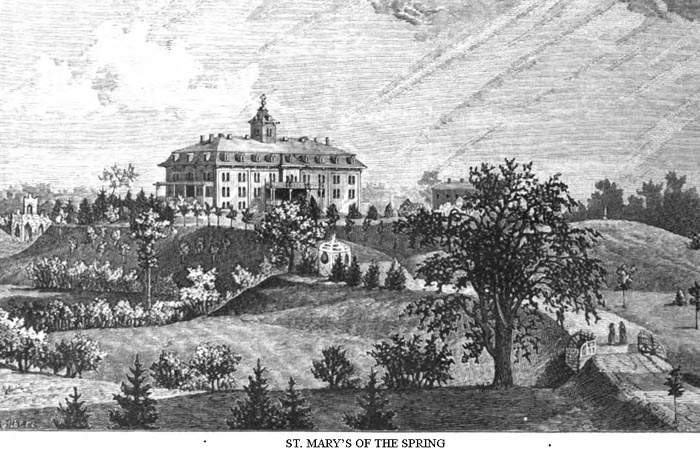
ST. MARY'S OF THE SPRINGS.
is a seminary for young
ladies; is under Catholic control, and is one of
the well-known educational institutions of
central Ohio. It is beautifully situated
upon a gentle eminence, near the southwest
corner of Mifflin township, and just three miles
from Columbus. It is near the lines of the
Pittsburgh, Cincinnati & St. Louis and the
Baltimore & Ohio railroads. It has claim
to the latter part of its name from the fact
that, within the extensive grounds, there are
several excellent springs from which bubbles up
an abundance of pure, cold water. There is
also an iron spring, and one of white sulphur,
which are said to be among the most valuable
medicinal springs in the State. The
institution, which has recently been
incorporated by the legislature, was established
in 1868, and is now under the direct
superintendence of the bishop and clergy of
Columbus, and the Rev. S. A. Clarkson, O.
P. The superior is Mother Francis.
The academy is a large and well-built structure,
three stories in height, and has all the
conveniences and luxuries that belong to a place
of its kind. The school is in a very
flourishing condition, and has been well
patronized from the time of its establishment.
A handsome view of the seminary is given
herewith.
DR.
SHEPHERD'S WATER-CURE
Dr. W. Shepherd has, in Mifflin township, a
private sanitarium and water-cure, which has
attained quite a wide celebrity. It is
situated in the southwest corner of the
township, upon the Alum creek road, and is about
four miles from the State house. The
buildings are, in themselves, attractive, and
they ornament a beautiful landscape. The
grounds are extensive, including about forty
acres, and are tastefully laid off, and adorned
with trees and all the varied greenery that can
combine to lend beauty to the place.
Dr. Shepherd, who is a graduate of the
Eclectic medical college of Cincinnati,
established the sanitarium in 1853.
Pg. 489 -
MILLS IN
MIFFLIN.
Early
in the history of the township, Ebenezer Dean
built a saw-mill on Alum creek, which he run for
a number of years, and in which was sawed a vast
deal of lumber used in the surrounding country.
His son, Francis B. Dean, also operated
the mill a number of years, and Judge Heyl
was at one time its owner. This was the
first mill in the township. The exact date
at which it was built can not be ascertained,
but it was undoubtedly earlier than 1825.
James Park built a mill on the same creek
about a mile up stream, and Andrew McElrain
put up one, about where St. Mary's seminary now
stands, in 1839. Dr. William Janney,
of Virginia, who was temporarily a resident of
Mifflin, built a saw-mill, in 1837, until Big
Walnut. Samuel Powell had a steam
saw-mill in operation for about ten years, near
where his widow now resides. There are now
steam saw-mills in, and near, Gahanna, the
former owned by J. W. Caldwell, and the
latter, upon the Columbus pike, owned by Eli
Chrysler.
The first and only grist-mill in the township was
built in 1859, at Gahanna, by Joel and Jesse
Baughman, and is still in operation.
Eli and Elias Chrysler bought out the
Baughmans in 1865. It subsequently
passed through a series of ownerships, among the
various proprietors, either wholy or in part,
being Joel Baughman and Eli Chrysler,
Edwin Harris, R. S. Katterman and W. W.
Berris, the present owner.
POST
OFFICES.
The
first post-office in the township was
established at Gahanna, and is known by the name
of the village in which it is located. It
was established in 1849, and Thomas Young
had the first commission as postmaster.
Another was established on Alum creek, at Park’s
saw mill, in 1851, and Jeremiah Lasure
was appointed postmaster. Two years later
he was succeeded by James Park.
This office has since been removed to the toll
gate, upon the Columbus and Westerville
turnpike, where it crosses the west line of the
township.
THE VILLAGE
OF GAHANNA, OR BRIDGEPORT
is a hamlet of about three
hundred population, of comparatively recent
growth. It is located in the east part of
the township, upon Big Walnut creek, and midway
between the northern and southern boundaries of
the township. That portion of the village
which is Gahanna, was laid out in 1849, by
John Clark, esq., and the other, properly
called Bridgeport, was laid out in 1853, by
Jesse Baughman. The village was
never incorporated. The first place of
residence which was built upon the site of
Gahanna, was a log cabin, erected by John
Ridenour, and dwelt in by John
Starritt. The first tavern was kept by
James Staley, and was known as the
Mifflin hotel. The first store was kept by
Thomas Young, and the second by
William Beecher. Gahanna has
had a slow growth and very moderate business
improvement. Three of the four churches of
the township are situated in the village, and it
has a good school, at present under the charge
of Leonard Graham, of
Reynoldsburg. William Ross
is postmaster, storekeeper, and hotel landlord.
The other stores are those of Mrs. S. A.
Quinn and Mrs. F. M. Percy.
Wagon making is carried on by John
Zuber and Jonas Glick, and Jacob
and Charles Breiret are manufacturers of
carriages. Theodore Carpenter
is a tinner and hardware dealer.
INDEPENDENT
ORDER OF ODD FELLOWS.
Mifflin Lodge, No. 518, is a flourishing
organization of Odd Fellows, which meets in
Gahanna. It was instituted June 27, 1872,
by Joseph Dowdall, P. G., and consisted
of the following charter members: G. H.
Gunderman, S. L. Quinn, D. Hollen, W. Beechard,
W. P. Dawson, C. Goodman, A Man, E. Ayres, L.
Stag, John Shilling, W. J. Cheney, John Miller,
J. Winsor and H. Cummins.
________oOo________
BIOGRAPHICAL
SKETCHES.
SAMUEL L.
QUINN.
EBENEZER
BUTLER.
Pg. 490 -
THOMAS HARWARD.
<
CLICK HERE to
RETURN to TABLE of CONTENTS > |