|
OHIO GENEALOGY EXPRESS

A Part of Genealogy
Express
|
Welcome to
FRANKLIN COUNTY, OHIO
History & Genealogy |
BIOGRAPHIES
‡Source
:
History of Franklin &
Pickaway Counties, Ohio
Published by Williams Bros.
1880
<
CLICK HERE TO RETURN TO
1880 BIOGRAPHICAL
INDEX >
<
CLICK HERE to RETURN to LIST of TABLES of
CONTENTS & BIOGRAPHICAL INDEXES >
 |
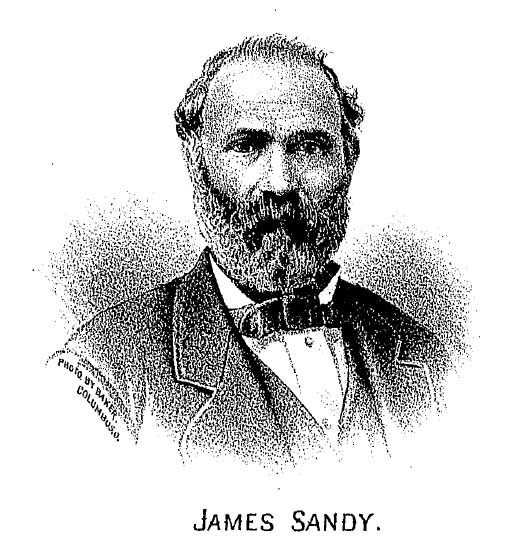
JAMES
SANDY. James Sandy,
sr., the son of William and
Ermine Sandy, was born in
Westmoreland county, Virginia, Apr.
16, 1788, his parents being of
Scotch descent. Here he was
raised, and soon after the
declaration of war with Great
Britain, in 1812, he joined the
"Virginia Blues," and while a member
of that organization, was quartered,
during one winter, in the town of
Franklinton. At that time the
ground now occupied by the State
house was covered with its native
forest. After his return to
Virginia, sometime in the year of
1813, he was married to Miss
Delilah Dulin, daughter of
William and Charlotte Dulin, who
was born Feb. 1, 1797. To them
were born eight sons and four
daughters.
In 1821 he moved, with his family to Ohio, and in 1825
settled in Washington township,
Franklin county, where he resided
until 1862, since which time, and
until his death, Oct. 20, 1864, he
has lived with his children in
Madison township. His wife
died Nov. 15, 1837, at the age of
forty years.
Mr. Sandy was an ardent lover of his country, a
true patriot, and a faithful
soldier. He felt, and often
expressed, the most earnest
solicitude for the success of the
war for the preservation of our
government during the late
Rebellion. For many years he
was a member of the Christian
church, and at his death was a
member of the Methodist Episcopal
church. The last few years of
his life were mostly devoted to the
reading of the holy scriptures, in
which he took great delight.
James Sandy, Jr., the subject of this sketch,
was the fourth son of James and
Delilah Sandy, and was born in
Norwich township, Franklin county,
Dec. 16, 1826. He remained on
the farm with his father until he
was eighteen years of age, and then
went to Pickaway county, where he
worked on a farm a year, after which
he went to Ross county, where he
also remained a year. He then
returned to Groveport, in this
county, where he learned the
carpenter's trade, at which he
worked eleven years. He then
moved on a farm east of Groveport,
where he has since resided, engaged
in agricultural pursuits.
He was married in Groveport, Feb. 28, 1848, to Sarah
Shoemaker, who was born Nov. 5,
1831. The result of this union
was one son, William Henry,
born Feb. 1, 1849. Mrs.
Sandy died June 6, 1850, aged
nineteen years.
Source:
History of Franklin & Pickaway
Counties, Ohio - Published by
Williams Bros. - 1880 - Page 457 |
| |
DAVID SCOTT
was born in Peterborough, New
Hampshire, in 1786, came to
Franklinton in 1811, engaged in the
practice of the law, and was
appointed prosecuting attorney from
1813 to 1814, by the court, in which
last year he died. He was
married.
Page 65 - Source:
History of Franklin & Pickaway
Counties, Ohio - Published by
Williams Bros. - 1880 |
| |
DAVID SMITH,
son of John and Elizabeth Smith,
was born at Francistown Hills,
Conough county, New Hampshire, Oct.
2, 1785, came to Franklinton in
1812, and moved to Columbus in 1816,
and practiced law. In
connection with Ezra Griswold,
in 1812, he commenced publishing the
Ohio Monitor, and remained
sole editor thereof until 1836, when
he sold out to Jacob Medary,
and the paper was merged into the
Hemisphere - a weekly Jacksonian
Democratic paper - and finally
became the Ohio Statesman,
when Samuel Medary was
elected State printer. Mr.
Smith was elected associate
judge in 1817, and resigned, on his
election to the legislature, in
1822. He was a member; also,
in 1822, and State printer in
1831-1834. He was a fine
writer, and was engaged mostly in
newspaper enterprises. In the
latter years of his life he was
absent, most of his time, from
Columbus, visiting his children, but
returned, and died here on February
3, 1863, in the seventy-eighth year
of his age, and was buried in Green
Law cemetery.
Page 65 - Source:
History of Franklin & Pickaway
Counties, Ohio - Published by
Williams Bros. - 1880 |
|
|
LYNE
STARLING.
Lynn Starling was born in
Mecklenburgh county, Virginia, in
the year 1784; removed to Kentucky
in 1794, and came to Franklinton in
1806. Through the influence of
his brother-in-law, Lucas
Sullivant, he was placed in the
clerk's office for Franklin county -
a position for which, though young,
he was well qualified by previous
training. Subsequently he was
appointed clerk of the circuit and
district courts of the United
States, and also of the supreme and
common pleas court of Franklin
county. Mr. Sullivant
afterward furnished the means and
formed a partnership wit his young
relative in the mercantile business,
and he became a successful merchant
and enterprising trader, being the
first one who ventured cargoes of
produce down the Scioto, and thence
to New Orleans in decked flat-boats.
This venture, proving remunerative,
was of great advantage, not only to
himself, but to others. He was
a commissary and large contractor
for supplies to the Northwestern
army under General Harrison,
which assembled at Franklinton and
Urbana during the war of 1812.
Mr. Starling was all his life a sagacious
business man, and was one of the
original proprietors of Columbus,
the present central portion of
the city having been laid out on
land owned by him. A short
extract from a letter to his sister
in Kentucky, dated Franklinton,
July, 1809, may be of interest, as
fixing the date of the purchase of
this land; "I have lately purchased
an elegant seat and tract of land
opposite town, on the other side of
the river, which I have an idea of
improving," evidently as a
gentleman's country seat, in the
suburbs of the capital -
Franklinton.
Judge
Gustavus Swan, who had known
Mr. Starling for forty years,
speaks thus of him in an obituary,
written with great apparent
fairness:
"The deceased was, by nature,
emphatically a great man. He
had a quick and clear perception, a
retentive memory, and a sound,
unerring judgment. He
possessed the rare faculty of
annihilating, in an instant, the
space between cause and effect.
He arrived at conclusions, and was
acting upon them, while ordinary
minds were contemplating the
premises. It was this peculiar
intellectual superiority which
rendered his efforts in business so
uniformly successful, and which
enabled him, before reaching the
meridian of life, to amass one of
the largest fortunes which have been
accumulated in the West.
His health failing, he traveled
extensively, both in this country
and abroad. Being a man of
quick perceptions, and a close
observer both of men and things, he
gained much practical knowledge,
and, from intercourse with the best
society, was much improved by his
travels; his experience, during
these years of leisure, compensating
for his early and exclusive devotion
to business.
Mr. Starling never held any political office,
though an unsuccessful candidate for
congress - his wealth and apparently
exclusive manner being against him
with the masses, who considered him
an aristocrat. He finally made
Columbus his permanent place of
residence, when he returned to take
charge, as administrator, of the
large and valuable landed estate of
Mr. Lucas Sullivant.
Not
long before his death, to show his
regard for the city whose first
houses he built, and in which his
fortune had been amassed, he donated
thirty-five thousand dollars to
establish a medical school, named
after him - Starling Medical
college. As he was never
married, at his death, which
occurred in 1848, his large estate
was distributed, by will, among his
relatives.
At his own request, he was buried in the old graveyard
at Franklinton, near his sister,
Mrs. Sullivant, and other
friends. When the Green Lawn
cemetery was established, the
remains were removed, and a fine
monument marks the last resting
place of one of the founders of the
city of Columbus.
Source:
History of Franklin &
Pickaway Counties, Ohio - Published
by Williams Bros. - 1880 - Page 581
SHARON WICK'S NOTE: Also
found
Lynn Starling in Chapter XVI. |

Fred'k Stombaugh |
THE
STOMBAUGH FAMILY.
John and Elizabeth (Baker)
Stombaugh were natives of York
county, Pennsylvania, where they
resided until the year 1808, when
they removed, with their family, to
Ohio. Mr. Stombaugh,
the year previous, had visited Ohio
- then the "far West" - and had
entered the west half of of section
number three, of township number
four, in range twenty-two
(Hamilton), and on this piece of
land the family commenced pioneer
life in the western wilderness.
The patent for this land is still in
possession of the family, and shows
the purchase price to have been two
dollars and fifty cents per acre.
Mrs. Stombaugh died in the early years of their
settlement, and Mr. Stombaugh
subsequently married again, his
second wife being Susan Lindsey,
of Hamilton. He was the father
of six children, all by his first
wife. Mary, the eldest,
was the wife of John Shannon,
and resided in Hamilton several
years, when she removed to Peoria,
Illinois, where she afterwards died;
Margaret is the wife of
David Mooberry, and is now
living in Peoria, Illinois; Ann
and Catharine (now deceased)
both lived in Peoria, Ann
being unmarried, and Catharine
being the wife of David Martin;
John Stombaugh married Nancy
Adams, daughter of Percival
Adams, one of the pioneers of
Hamilton, and died in Woodford
county, Illinois.
FREDERICK STOMBAUGH, whose portrait appears in
connection with this sketch, was the
youngest of the family. He was
born on the homestead, in Hamilton,
on the first day of June, 1811.
On Jan. 11, 1838, he was united
united in marriage to Elizabeth,
daughter of John and Catharine
Baylor (born July 28, 1817), who
came to this county from York
county, Pennsylvania, in 1825, and
settled on the Lancaster road, not
far from where the toll gate now is.
The father died at the age of forty,
and the mother some three years
since, at the age of eighty-three.
Mr. Stombaugh resided on the farm on which he
was born, until the day of his death
- Sept. 22, 1801. He was a man
of much energy and activity;
industrious, prudent, and
successful, leaving to his family,
as a result of his labor and
foresight, a fine property.
The children of Frederick and
Elizabeth Stombaugh (who is
still living on the homestead) are
as follows: Eveline,
born Dec. 29, 1839, is unmarried;
Mary C., born Oct. 14, 1840, was
married, Apr. 12, 1866, to Jacob
Wright, of Logan county, Ohio,
who died Aug. 31, 1868, and Mrs.
Wright now lives on the farm
with her mother; Elizabeth,
born Jan. 15, 1843, married, Apr. 4,
1805, S. K. Jones, and lives
on a portion of the homestead;
John, born Jan. 28, 1847,
married, Oct. 19, 1870, Louisa
Jane Klickenger, and also
occupies a portion of the home farm;
Caroline, born May 11, 1850,
married, Oct. 20, 1870, Cyracus
Wolfel, and resides in Columbus;
Sarah, born Feb. 25, 1853, is
unmarried; and Martha, born
May 11, 1857, married T. J. Moore,
Dec. 12, 1873, and is now living in
Marion township.
Page 397 - Source:
History of Franklin & Pickaway
Counties, Ohio - Published by
Williams Bros. - 1880 |
J. W. Story
& Margaret Story |
J.
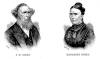
W. STORY,
Joseph W. Story was the fourth
child of
Marmer Duke Story and
Rachel Baggs. He was born
in Sussex county, Delaware, and came
to Ohio with his parents when he was
nine years old. The family
settled in Pickaway county.
The subject of this sketch settled in this county, on
the farm he now owns and occupied,
in the year 1834. He has been
three times married. His first
wife, whom he married in 1832, was
Nancy Turner, by whom he had
seven children, five of whom are now
living: Margaret, who
married Aaron Lambert, lives
in Iowa. John, who
married Elizabeth Thomas,
lives on the home farm.
Thomas, who married Miss
Louisa Moore, lives in
Georgesville, this county.
Sarah, who married Addison
Taylor lives in Nebraska.
Diana, who married Richard
Hay, lives in Pleasant township.
Matilda, who married Peter
Tanner, lives in Madison county,
Ohio, and Mary who married
Isaac tanner lives in Madison
county, Ohio.
His second wife was Susan Nichols whom he
married in the year 1853, and by
whom he had two children - a son and
daughter. Marmer Duke
is single and lives at home.
Virginia, the daughter, married
Richard Chaffin, and lives in
Pleasant township, Franklin county,
Ohio.
In 1872 he married his third wife, Margaret
White, who is very much his
junior, and by whom he has had two
children, only one of whom, little
Lora, is now living.
In politics, Mr. Story is a Democrat.
While he has suffered many losses,
financially and otherwise, for the
want of an education, now stain of
dishonesty has ever tarnished his
name. He is now seventy-one
years old, and lives at his ease,
surrounded by every comfort he
desires. |
| |
JOSEPH
SULLIVANT.
Joseph Sullivant, the
youngest and only surviving son of
Lucas Sullivant and Sarah
Starling, was born in
Franklinton, in 1809. In his
early years he was distinguished by
an ardent love of books, and, like
most boys having this passion,
devoured everything which came in
his way. Having a retentive
memory, he mastered the ordinary
school tasks of his time with little
difficulty, and, after attending the
first two classical schools which
his father was active in
establishing in Columbus he was sent
to the boys' boarding school in
Worthington, under the management of
Rev. Philander Chase,
bishop of Ohio. From this
school he carried away, and retained
in later life, added, it is
believed, to steady progress in
book-lore, a keen appreciation of
the motherly kindness of "that most
estimable woman," the wife of the
bishop. From Worthington he
was transferred to Ohio university,
and from thence, about a year after
his father's death, in 1823, and at
the early age of fifteen, he entered
Center college, Danville, Kentucky,
where his course of study was
completed. Having, as he says
of himself, at an early age embibed
a tast for, and an interest
in, the natural sciences, from his
father, who was "a dear lover of
nature," he devoted himself to their
study, and, before the age of
twenty-one, was appointed, by the
legislature, one of the corporators
of the Philosophical and Historical
society of Ohio, and was
corresponding secretary and curator
thereof for several years.
The limits of our article do not permit the indulgence
of our wish in the free use of the
abundant material for an extended
biographical sketch of Mr.
Sullivant; suffice it to say,
that he has been for the last forty
years one of the leading spirits in
all of the scientific and literary
enterprises which have given the
city of Columbus its present
enviable standing among the centers
of intelligence and culture in the
West.
For many years he devoted much time and attention to
the public schools of the city,
being first a member, and for
several years president, of the
board of education. Since his
final retirement from that position,
as a token of the esteem and regard
of the large body of teachers
connected with the schools, a bust
of Mr. Sullivant has been
placed in the hall of the beautiful
high school building, and later, his
old colleagues have erected the
largest and finest ward
school-building in the city, and, in
recognition of his long, gratuitous,
and efficient services, have named
it "Sullivant school," an
acknowledgment, and, at the same
time, a monument, of which any one
might justly feel proud.
Many years ago elected a member of the American
Scientific association; a member and
treasurer of the Ohio State Board of
Agriculture; a trustee of Starling
Medical college; and serving a
second term as trustee and secretary
of the Agricultural and Mechanical
college of Ohio; a member of the
executive committee, giving valuable
service in the late re-organization
of that institution under its
present charter as the Ohio State
university, he has held various
positions of honor and trust, some
involving much time and labor, but
none of emolument. Nor
have the labors of Mr. Sullivant
been confined to merely scientivid
and literary enterprises - a
pamphlet prepared by him on "A.
Water Supply for the city of
Columbus," being greatly influential
in arousing attention to this
important matter. He was also
the projector of Green Lawn
cemetery, selected its site, was a
member of its first board of
trustees, and, for several years,
president of the corporation.
With all these evidences of the high estimation of the
community in which his life has been
spent, no honor is so dear to him
(according to his own affectionate
confesson) as the remembrance of the
community of tastes and pursuits
which rendered especially close the
chain linking him with his
distinguished brother, whose fame
will increase in proportion as
knowledge and culture are increased.
Mr. Sullivant has been thrice married, and has a
family of several children.
----------------------
* There is less reasosn for noticing here Mr.
Sullivant's stupendous
operations in Illinois, since
elaborate descriptions of them have
been published in Harpers
Magazine, and other widely
circulated periodicals, thus giving
him a reputation which is none too
strongly characterized above.
Source:
History of Franklin & Pickaway
Counties, Ohio - Published by
Williams Bros. - 1880 - Page 581 |
| |
LUCAS
SULLIVANT.
Louis Sullivant, the leading
pioneer in that territory which
afterward became Franklin county,
was born in September, 1765, in
Mecklenbugh county, Virginia.
His starting out in life reminds us
strongly of the youthful career of
the greatest of all the Virginians -
Washington.
At the age of sixteen he joined, as a volunteer, an
expedition against the Indians, who
were threatening the western
counties of his native State, and
his good conduct and manly
intrepidity were such as to gain for
him the public commendation of his
commanding officer. Left alone
in the world by the death of his
parents and only brother, he used
his small patrimony in acquiring a
more liberal education, and
especially in mastering the science
and practice of surveying, which he
adopted as a profession.
The new and unsurveyed lands of Kentucky, then an
outlying county of the Old Dominion,
offering a wider field for his
enterprise, he went thither, while
quite a young man, and soon found
his talent and skill in constant
demand.
The officers and soldiers of the regular Continental
army having, under legislative
authority, met and appointed
Colonel Richard C. Anderson, a
distinguished officer of the
Revolution, surveyor-general of the
Virginia military land district,
Mr. Sullivant received from him
an appointment as deputy surveyor,
and, at the age of age of
twenty-two, became one of that
dauntless band of pioneers who
penetrated into the unbroken
wilderness, and opened one of the
richest portions of Ohio to the
advancing wave of settlement and
civilization. Defeated, in his
first attempts, by the wily savage,
he was compelled to organize a
stronger force, which was equipped
at Limestone (now Maysville),
Kentucky. With a party of
twenty men, he advanced into the
wilderness, and, in due time, having
arrived upon the banks of the
Scioto, he commenced his operations
in the territory of the present
Franklin county. The outfit of
this surveying party betokened an
occupation of the disputed
territory, rather than a flying
assault; and, in fact, though
constantly in the neighborhood of
hostile villages, and passing
through many exciting scenes and
hair-breadth escapes, Mr.
Sullivant brought his work to a
fortunate conclusion.
In the summer and fall of 1797 ten years after the
commencement of this adventurous and
dangerous career between the Scioto
and the Miami. Mr.
Sullivant, having obtained
possession of the surrounding lands,
laid out the town of Franklinton,
believing that, situated as it was
in the region of the greatest
fertility, on a then navigable
river, and so near the center of the
State, if it did not become the
capital, it would be near it, and
could not fail to become a great
center in the progress of the State.
Thi was five years before Ohio was
set off from the great northwest
territory as an independent State,
and six years before Franklin was
separated from Ross county.
About this time Mr. Sullivant was married to
Sarah Starling, daughter of
Colonel William Starling, of
Kentucky, and building the first
brick house in his proprietory
town of Franklinton, he resided thee
during the remainder of his life.
Though devoting himself principally
to the care of his own estate, he
was liberal and public spirited, and
the projector of many of the most
valuable improvements of those early
times, and his influence, counsels,
and pecuniary aid, shaped very
materially the destinies of Ohio's
capital. He was the builder of
the first bridge over the Scioto
between Franklinton and Columbus;
the president of the first bank
established in Columbus, built the
first church of the first
Presbyterian congregation on its
removed to Columbus; and was never
second in any enterprise which had
for its aim the intellectual or
material advancement of the
community in which he lived.
Firm and positive in his opinions,
but courteous in manner and
expression; prompt and decisive to
act upon his own convictions; he was
altogether a man of forcible
character, exercising a great
influence over those with whom he
came in contact.
In the full maturity of his powers, and his natural
force not abated, he died, Aug. 8,
1823, in the fifty-eighth year of
his age.
From tributes written by those who knew him well,
a few extracts will close this
imperfect sketch:
"He possessed a great spirit of liberality, which an
ample fortune, acquired by his own
industry, enabled him to gratify to
an uncommon extent. He was a
man of strict integrity, of the most
persevering industry and rigid
economy. He was a kind and
indulgent father, a sincere and
hospitable friend, and a generous
neighbor; and the poor were never
turned away empty from his
well-filled granaries."
"He showed, in his last illness, the same invincible
fortitude which had sustained him in
the midst of the privations and
dangers incurred in the early
settlement of the State."
Dr. John Edmiston, his physician and friend,
used to say of him: "Take him
all in all, with his strong and
vigorous intellect, his knowledge of
human nature, his decision of
character, good judgment, and high
sense of personal honor and
integrity, he is one of the most
remarkable men I ever knew. He
seemed born to be a leader, and in
whatever direction he had turned his
attention, he would have
distinguished himself and become a
man of mark."
Source:
History of Franklin &
Pickaway Counties, Ohio - Published
by Williams Bros. - 1880 - Page 579 |
| |
MICHAEL
L. SULLIVANT.
Michael L. Sullivant, second
son of Lucas Sullivant and
Sarah Starling, was born Aug. 6,
1807, in the village of Franklinton,
and educated at the Ohio university,
and Center college, Kentucky.
Very early in life, Michael
manifested a very decided
predilection for rural affairs, and,
after leaving college, instead of
studying a profession he determined
to marry, and deliberately chose
farming for his life-long vocation.
The fine body of land which he
inherited in the immediate vicinity
of Columbus, afforded an opportunity
for him to carry out his purpose on
a then unusually large scale.
He engaged in farming at a time when there was but a
limited price, as well as a limited
demand and a circumscribed market
for all kinds of farming products,
and be at he all at once saw that
the only remunerative method was to
consume the corn, hay, and grass,
through the medium of stock.
He consequently became a grazier and
stock-feeder, "stall-feeding," as it
was termed, many hundred fat cattle
during the fall and winter months.
This was, however, a laborious, and
often uncertain, business; for
cattle, when ready for market, must
b e driven over the mountains to
Baltimore, Philadelphia, or New
York, and the fluctuations in price
from the time of starting until the
journey was ended, was often of a
most vexatious kind, making all the
difference between a handsome profit
and an unhandsome loss.
These cattle had generally been
grazed in the "Barrens," or Sandusky
plains, in Ohio, or even on the
praries prairies of
Indiana and Illinois, where they
were picked up in lots by the
enterprising feeders in Ohio,
principally located in the Scioto
valley.
Mr. Sullivant remained in his native State,
occupying his ample inheritance,
until about the year 1854, always
showing himself independent and
progressive, a man of large views,
and taking the lead in many
innovations upon fossilized ideas.
He was one of the originators of the
Ohio Stock Importing company, and
one of the organizers of the Ohio
State Board of Agriculture, of which
he was twice the president. He
introduced new methods and machinery
on his farm here, being the first to
buy and put in operation a power
threshing machine in Franklin
county; also a reaper and a mower,
and was always interested in
everything that concerned
agriculture.
Seeking a wider field of operations - if not marked out
by destiny to inaugurate a
stupendous experiment - he disposed
of his large estate in Ohio, and,
removing to Illinois, where he had
secured a vast domain at government
prices, he gave his attention to
establishing the great farm of
"Broadlands," which, in connection
with that of "Bur Oaks," has given
him fame wherever there is an
English speaking people.*
"One of the most striking traits in the character of
Mr. Sullivant," says one who
knew him well, "was the tenacity of
purpose with which he pursued his
scheme, when once it was
deliberately planed."
He was twice married, and his domestic relations were
always happy, for, says the same
friend, he was good-tempered, and of
a liberal and generous disposition.
Mr. Michael Sullivant died Feb.
29, 1879, leaving a widow and
several children.
Source:
History of Franklin &
Pickaway Counties, Ohio - Published
by Williams Bros. - 1880 - Page 580 |
| |
WILLIAM
STARLING SULLIVANT.
William S. Sullivant, the
eldest son of Lucas Sullivant,
was born Jan. 15, 1803, in
Franklinton, the village, literally
in the midst of a wilderness, which
his father's indomitable energy,
more than that of any other one man,
had set on the road to empire.
His boyhood was exposed to all the
real dangers, and beset by all the
so-called hardships, incident to
pioneer life in those early days.
In 1812, when the subject of this
sketch was nine years old, the
shameful surrender of General
Hall to the British forces at
Detroit, exposed the whole frontier
to an irruption of bloody savages,
the allies of Great Britain.
For months, the inhabitants of this
new settlement, in common with
others still more exposed, were
harrassed harassed
with fears of such an invasion, and
of the cruelties and barbarous
atrocities which distinguished
savage warfare. Happily,
however, this danger was averted,
and peace and prosperity ensued.
At a proper age, young William, mounted astride
of a bag of wheat on one horse, and
leading another, on which also was
strapped a well-filled bag, was
often sent along the blazed
bridle-paths through the forest to
Sell's mill, near Dublin, to
Dyer's mill, on the Darby,
and sometimes to Kinnikinnick, in
Ross county, to procure flour for
the family. These expeditions
frequently involved two or three
days' waiting for the grist, and
necessitated sleeping in the mill,
wrapped in a blanket, where he was
fortunate who had a pile of corn or
wheat for his couch instead of the
hard floor. But, dear reader,
waste no sigh of pity for our young
friend, William, and doubt
not that in these pilgrimages he was
supremely happy, and that these and
similar experiences were fruitful in
producing, not only the fine
physical development and graceful
carriage which distinguished him in
his maturity, but also in arousing
those latent tastes and capacities
which have made his name an honor to
his family and to his country.
In those quiet journeyings through
the leafy aisles of "God's first
temples," and in those days of
"waiting for the grist,' when forest
and stream and bird and flower wooed
him to their companionship; to such
a nature as his, how entrancing must
have been this sweet communion with
nature! And who can say that
his chosen pursuit, in later life
was not the result of the bias given
in these days of his boyhood?
It is said, also, that he
accompanied his father upon some of
his shorter surveying expeditions,
where he gained that knowledge which
tended to make him an expert, rapid,
and accurate surveyor, when, after
his return from college, and after
his father's death, he had occasion
to exercise his skill in attending
to the large landed estate of the
family.
When old enough to be sent from home, he was placed in
a celebrated private school, in
Jassamaine county, Kentucky.
Afterward he pursued his classical
studies, under Professors Lindley
and Dana, at the Ohio
university, at Athens. Here he
was prepared for Yale college, from
which he graduated in 1823.
Though almost immediately immersed
in the cares and duties of active
business life, while yet in early
manhood, he found time to acquaint
himself most thoroughly with the
flora of central Ohio, discovering,
in his botanical researches, several
species hitherto unknown, to one of
which his eastern botanical
associates gave the name
Sillivantia Ohinis. Dr.
Asa Gray, the distinguished
botanist, and long the intimate
friend of Mr. Sullivant,
speaks thus of his scientific
researches: "As soon as the
flowering plants of his district had
ceased to afford him novelty, he
turned to the mosses, in which he
found abundant scientific
occupation, of a kind well suited to
his bent for patient and close
observation, serupulous accuracy,
and nice discrimination." And
it was in this field that his
world-wide reputation was won; some
of the most valuable contributions
to the bryology and hepaticology of
North America being the result of
years of quiet but earnest labor.
In the same article by Dr. Gray,
already quioted, occurs the
following estimate of the value of
these labors: "His works have laid
such a broad and complete foundation
for the study of bryology in this
country, and are of such recognized
importance everywhere, that they
must always be of classic authority.
wherever mosses are studied, his
name will be honorably remembered.
In this country it should long be
remembered with peculiar gratitude."
In accordance with his wishes, his
bryological books, and his
exceedingly rich and important
collections and preparations of
mosses, are to be consigned to the
Gray Herbarium building of Harvard
university, with a view to their
preservation and long-continued
usefulness. The remainder of
his botanical library, his choice
microscopes, and his remaining
collections, are bequeathed to the
State Scientific and Agricultural
college of Ohio, and to the Starling
Medical college, founded by his
uncle, of which he was himself the
senior trustee.
Did space allow an enumeration of all of Mr.
Sullivant's botanical labors and
publications, it would give emphasis
to the reflection that such
achievements in science, on the part
of one whose life, so far from being
given to the pursuit of literature,
was marked by great business
activity, are to say the least, of
very rare occurrence.
Source:
History of Franklin &
Pickaway Counties, Ohio - Published
by Williams Bros. - 1880 - Page 580 |
| |
GUSTAVUS
SWAN, son of John and
Sarah (Mead) Swan, was born July
15, 1787, at Petersborough, New
Hampshire. His means of early
education were limited, as his
parents were poor, but, by his own
perseverance and exertion, he
obtained an excellent classical,
mathematical and scientific course
of instruction, at the Aurean
academy, Amherst, Hillsborough
county, New Hampshire. Dr.
Reuben D. Murrey, son of Dr.
John Murrey, and who
subsequently settled in the city of
Boston, and became one of the most
celebrated surveyors in the country,
was a fellow schoolmate.
Judge Swan always said he was
indebted to Dr. John Murrey's
aid in his studies, and
encouragement, more than to any one
else, for his subsequent success in
life. He studied law with
Samuel Bell, a celebrated
lawyer, at Concord, New Hampshire,
who was afterwards governor of the
State, and was admitted to the bar
in New Hampshire.
He first came to Marietta, Ohio in 1810, and remained a
year there, and was admitted to the
bar of Ohio. In 1811 he came to
Franklinton, then the county seat of
Franklin, and commenced the practice
of the law. His ability and
industry soon gave him high
professional reputation, and he was
employed in all the important cases,
which brought him in constant
conflict with Beecher, Ewing,
Irwin, Baldwin, Grimke, and
other distinguished leaders of the
Ohio bar, who then rode the circuit,
and practiced in the courts held at
the capitol of the State.
Judge Swan, in these legal
contests, involving nice questions,
under the old rules of pleading, and
requiring a thorough knowledge of
the land laws, especially in the
Virginia military district, soon
took rank among the first at the
bar. He was a diligent
student, and fine speaker, having
great power with a jury, and his
practice extended through Fayette,
Madison, Union, Delaware, Pickaway
and Fairfield counties, where his
name is still associated, in the
traditions of the people, with the
pioneer lawyers of his day. He
was the first representative elected
by Franklin county, to the
legislature, as soon as she was
entitled to elect alone, in 1812,
and was elected again in 1817.
He was constantly engaged in the
practice of his profession, until
1823, when he was appointed, by
Governor Morrow, judge of the
court of common pleas, in place of
Judge J. Adair McDowell,
deceased, and was elected by the
legislature, on its meeting, for the
term of seven years, and was the
judge when the court was removed
from Franklinton to Columbus, in
1824, and made an able one. In
pursuance of the resolutions of the
general assembly, passed Jan. 22,
1825, he compiled the land laws for
Ohio, including the State laws to
1815-16, an invaluable publication
to the practitioner.
In 1820 he resumed the practice of law in Columbus, to
which place he moved his residence,
in 1815. He continued, from
that date, in active practice, until
1832, doing a lucrative and
extensive business. By this
time he had acquired a large
fortune. He had been
president, from 1823, of the old
Franklin bank, of Columbus,
incorporated by the legislature,
Feb. 23, 1816, whose charger expired
Jan. 1, 1843. On the
organization of the State bank, of
Ohio, and its branches, under the
act of February, 1845 - the old
Franklin bank, on July 1, 1845,
organized as one of its branches -
Judge Swan was elected one of
the directors, and afterwards
president of the ablest financiers
in the State. The duties of
the place required his whole time,
in connection with his other large
private interests, and he retired
from practice.
The last time he appeared as counsel, in court, was in
defense of William Clark, a
convict in the penitentiary, tried
for the murder of Cyrus Sell,
one of the guards, by a single blow
with a cooper's axe. He was
tired at the December term, 1843, of
the supreme court for Franklin
county, reported in the eighth
volume of the Ohio State reports,
and convicted of murder in the first
degree, and hung on Feb. 9, 1844,
with a female colored convict,
Esther, who had killed another
prisoner. The The
defense was insanity, and there was
an army of eminent counsel on both
sides, Judge N. H. Swayne
conducted the prosecution, examining
the medical experts of the defense,
including his own family physician.
Judge Swan, who had been
generally successful in criminal
cases, put forth his full powers,
and confidently remarked, it is
said, that he had never had a
client hung in his life, and if
Clark was, he never world
put his foot in the court house
again, as a lawyer; and he never
did, unless on his own business.
Judge Swan, from this time, devoted himself to
his duties as president of the State
bank of Ohio, and the management of
his large estate. He was very
fond of books and philosophical
discussions. On Oct. 14, 1819,
he was married, by Rev. Dr. James
Hoge, to Mrs. Amelia Weston,
daughter of George and Mary
Aldrich, born at Meriden,
Massachusetts, Dec. 20, 1785; died,
Nov. 5, 1859, and is buried under
the same monument, in Green Lawn
cemetery, with her husband who died
Feb. 6, 1860. Judge Swan
had two sons, both of whom died
before him. George was
lost at sea, on the ill-fated
steamer, Lexington. It was a
great grief to his father, which was
intensified by the death of
Charles, who, he hoped, would
have lived to take his position.
He had two daughters, Mrs. Sarah
Whitney, of New York city, and
Mrs. Jane Parsons, wife of
George M. Parsons, of Columbus,
Ohio.
Source:
History of Franklin & Pickaway
Counties, Ohio - Published by
Williams Bros. - 1880 - Page 64 |
| |
HENRY C.
SWISHER. In the year
1805, John Swisher and family,
of Sussex county, New Jersey,
emigrated to Ohio, and in 1807
settled in Madison township,
Franklin county. His wife,
who, before marriage, was Mary
Peterson, died in 1836, and he
again married, a Mrs. Shepherd,
of Washington township, and lived
near Dublin until his death.
Jacob, the oldest child of John and Mary
Swisher, was born in Sussex
county, New Jersey, July 5, 1803.
He married, for his first wife,
Eliza Scothorn, and resided on
the school section until her death,
which occurred about a year after
her marriage. A few years
subsequently he was again married to
Anah, daughter of Philemon
Needels, when he settled on the
farm where he now lives, and resided
there until 1842. He then
removed to the place now occupied by
John Anderson, which farm he
cleared up and improved. He
finally, after a short residence in
Groveport, moved back to the farm he
had previously occupied, and on
which he now resides. Besides
that of farming, Mr. Swisher's
principal occupation has been the
buying and selling of live stock.
At an early period of his business
career he commenced buying hogs,
which he would fatten and drive to
the eastern markets. He has
walked to Baltimore and back on such
trips a number of times, and for
several years made an annual
journey. In 1840 or 1841 he
combined with his live stock
business that of pork packing, in
connection with other gentlemen, in
Groveport. This branch of the
business, however, proving
unprofitable, it was afterward
abandoned.
His second wife died in September, 1862. They had
a family of nine children, of whom
Henry C., the subject of this
sketch, is the oldest. He was
born in Madison township, Franklin
county, Ohio, Jan. 8, 1837, and
married, Dec. 18, 1866, Jennie
Nau, daughter of Jacob and
Mary Arch Nau, of Madison
township. She was born Oct.
15, 1844, in Hancock county, Ohio.
Her mother died in 1856, and her
father is still living on a portion
of the Swisher farm.
The subject of this sketch has been
engaged principally in agricultural
pursuits, and is among the energetic
and successful farmers of his
township. For seven years he
cultivated a farm in the school
section, taking a lease for nine
years. He purchased the farm
on which he now lives, and to which
he has recently added, in the spring
of 1866, and built his residence, a
view of which is given elsewhere,
about five years since.
Mr. Swisher has also been to a
considerable extent engaged in the
shipment of live stock to the east,
which he has uniformly found a
profitable business.
To
Mr. and Mrs. Swisher have been
born the following named children:
Ella M., born Nov. 2, 1867 in
Crawford county, Ohio, where the
parents resided the first year after
their marriage; Charles C.,
born Feb. 19, 1869; Walter,
born Dec. 25, 1870, who died Jan. 9,
1871; Edgar A., born Jan. 23,
1872; Anah A., born Dec. 16,
1873; and Florence, born Dec.
13, 1878.
Source:
History of Franklin & Pickaway
Counties, Ohio - Published by
Williams Bros. - 1880 - Page 457 |
NOTES:
|
|
CLICK HERE to RETURN to
FRANKLIN COUNTY, OHIO
INDEX PAGE |
CLICK HERE to
RETURN to
OHIO GENEALOGY EXPRESS
INDEX PAGE |
|
FREE GENEALOGY RESEARCH
is My MISSION
GENEALOGY EXPRESS
This Webpage has been created by Sharon Wick
exclusively for Ohio Genealogy Express
©2008
Submitters retain all copyrights |
|