|
FRANKLINTON - THE PREDECESSOR AND ONE OF
THE COMPONENTS OF COLUMBUS.
Pg. 508 -
Pg. 509 -
Pg. 510 -
SITE SELECTED AND NAMED FOR THE FUTURE
CAPITAL.
HISTORY OF LANDS CONTAINED IN THE ORIGINAL
TOWN PLAT.
Pg. 511 -
INCREASE OF TERRITORY.
Pg. 512 -
TOWNSHIPS FORMERY AND AT PRESENT
OCCUPYING THE TERRITORY OF COLUMBUS.
The original township occupying the principal
ground now covered by the corporation of
Columbus, was LIBERTY, one of the four townships
into which the county of Franklin was first
divided. The order establishing it,
defining its boundaries, and appointing the
first election for the choice of justices of the
peace therein was passed by the Franklin court
of common pleas on Tuesday, May 10, 1803.
Following the extracts from the proceedings of
said court, of the date named, in relation to
Liberty township:
Ordered, That all that part of Franklin
county contained within the following limits and
boundaries, to-wit: Beginning on the east bank
of the Scioto river, at the intersection of the
sectional line between the sections number eight
and seventeen, in the fourth township, and
twenty-second range, running thence with the
said sectional line east, to the line between
the counties of Fairfield and Franklin; thence
north with the said line, and from the point of
beginning, with the Scioto, to the northerly
boundary of Franklin county, and he called
Liberty township.
Ordered, That there be elected, in
Liberty township, two justices of the peace, and
that the electors hold their election for that
purpose at the house of John Beaty, in
said township, on the 23d day of Jne next, as
provided by law.
At the election thus appointed, Joseph Hunter
and Ezra Brown were chosen as the first
justices of the peace in the new township.
In the course of a few years, as the result of
various divisions an dsub-divisions, the
township of Liberty became extinct. We
have not learned the precise year, but we know
that Montgomery township was established in that
part of Liberty which afterwards included the
corporation of Columbus, on the ninth day of
March, 1807 - the first justice of the peace
elected that year being William Shaw.
This township, with occasional changes of
boundary, has continued the present time.
The justices of the peace last elected (thenumber
having been increased to three) are as follows:
Theodore Jones, Lot 1., Smith, and
Mathias Martin.
For a long time after its incorporation, Columbus had
no territory outside the township of Montgomery.
But about the year 1860 it extended itself
westward, across the Scioto, taking in that part
of the township of Franklin lying in the bend of
the river. Several years afterward, in
1871, the city limits were still further
extended in that direction, taking in the old
town of Franklinton; and, in the same year, a
narrow belt of territory a little more than
three-fourths of a mile wide, lying along the
east bank of the Olentangy river, and running up
some two miles into the township of Clinton to
the village of North Columbus, was taken into
the corporation. Thus, at that time, the
city of Columbus occupied parts of three
different townships. This mixture of
jurisdictions being found inconvenient, the
county commissioners, in compliance with a
petition from the city council, passed an order,
on the twenty-fourth of February, 1973,
extending the boundaries of Montgomery township,
so as to include those portions of Franklinton
and Clinton embraced in the limits of Columbus,
and restricting the boundaries of the first
mentioned township in all other directions, as
so to make them coincide every where with the
city lines; and, at the same time, erecting the
territory, thus cut off, into a new township
(with some additions) to which was given the
name of Marion. By this action the
township boundaries and those of the town became
one and the same; and the only township officers
needed for the execution of the laws, in
addition to the municipal, county and State
authorities having jurisdiction oer the same
territory, ae three justices of the peace (who,
at the present time, are the ones named above),
and four constable acting under them - those
last elected being as follows: N. B.
Smith, Martin Van B. Little, Augustus Johns
and John Q. A. Robinson.
FIRST
EVENTS.
The
opening chapters of every local history, going
back to earliest times, must, of course, be
largely made up of first events. But among
such events there are always a number of
isolated facts, preserved in the memory of the
oldest inhabitants, and important only, or
mainly, because they are "the first.) We
have collected
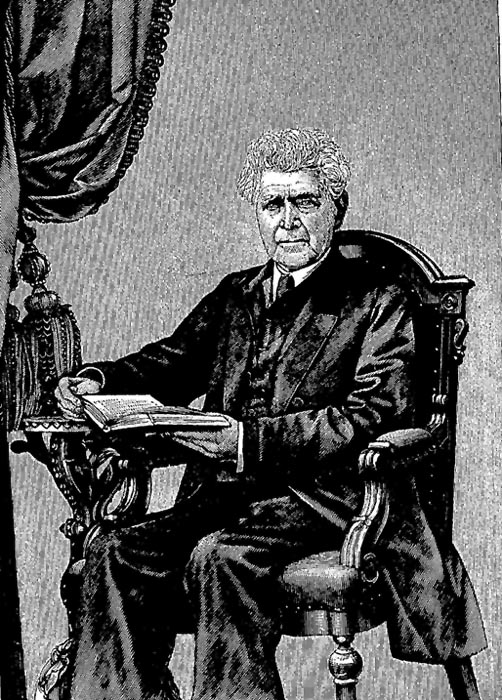
JOHN NOBLE.
|
John Noble was born in
Lancaster county, Pennsylvania, Nov.
14, 1789. His parents were
Samuel and Mary Patterson Noble.
With them he removed to Emmettsburgh,
Maryland, in early life. Here
his father joined with the
occupation of a farmer that of a
mechanic. John was
early engaged in labor, and had to
leave school at a very early age.
He chafed at the attitude the slave
owners assumed towards mechanics and
when he arrived at majority, he
announced his fixed purpose to leave
for a free State. This purpose
impelled his father to sell his
small property and removed, in May,
1811, to the state of Ohio.
They passed through Lancaster, to
Pickaway county, where the family
settled on a beautiful farm, near
Tarlton, where Samuel Noble
and most of his children lived and
died. John Noble
returned to Lancaster the same year,
and engaged at once in active
business. Full of energy and
enterprise, he made himself felt in
every department of life. He
advocated improved schools, the
building of a school-house and
market-house and all other
improvements that the young
community could afford.
In the winter of 1812-13, he commenced a trade of
ready-made clothing, shoes, etc.,
with the army, lying at Franklinton
and Delaware, and thence to Fort
Meigs, in passing through Columbus,
Front street was the chief street,
and it was full of logs and brush.
He attended a treaty with the
Indians at Piqua, of which he gave a
vivid picture in his "Pioneer
Skeches," published in the Columbus
Gazette, in 1870. The
money he made by these enterprises
was lost by a partner. He had,
therefore, to pursue every honest
calling he could, to support himself
and his young family.
In 1820, he commenced hotel keeping in Lancaster, a
business which ultimately became his
only occupation; but at that time
such an employment was too small for
his necessities, and he carried on
several mechanical branches, in
addition. In 1825-6, he took a
contract on what was called the deep
cut of the Ohio canal, in Licking
county, and was present and took
part in the ceremonies at Licking
summit, July 4, 1825, when
Governor Clinton, of New York,
took out the first spadeful of earth
for that canal. This
enterprise, with that of building
and banking-house, for the Ohio
bank, in 1826-7, and others, brought
him into debt. As money was
exceedingly scarce, and produce very
low, he determined to take a cargo,
by flat-boats, to New Orleans.
This was done by hauling the load to
Circleville, twenty-two miles, and
there loading about two miles above
town, on the Scioto, thence floating
down the Scioto and Ohio to the
Mississippi, to New Orleans.
This trip was successful, and he was
able to pay off his debts.
He found Lancaster was probably to be left at one side
by the advance of Columbus, and the
building of the National road; so,
in1832, he removed from Lancaster
with his family, and took charge of
the National hotel, in Columbus,
located where the Neil house
now stands. He remained in
this house nearly seven years.
During this period the Cumberland,
or National road was built, and the
line of Neil, Moore & Co's
stages furnished the great means of
travel to the west. Emigration
was at its height, and many
thousands of people stopped at his
house in Columbus, who afterwards
settled in Ohio, or the States |
further west. As he had a
wonderful facility for making
acquaintances he was in those days
as well known as any man in Ohio.
In Columbus he showed the same interest in the
advancement of the interests of that
city that he had shown in Lancaster.
He became supervisor of roads at one
time, in order to have the power to
improve Broad street, and was the
first person who redeemed that
beautiful avenue from the swamp.
He was afterwards one of the
commissioners to plant the trees
that now beautify that street.
He was, for many years, a member of
the city council. In July 4,
1839, he assisted actively at the
laying of the corner-stone of the
new capitol, provided the jars
deposited in the corner-stone, and
aided in filling them with all
manner of documents, to be opened
for the enlightenment of future
ages. These incidents indicate
the energy and spirit of the man.
In 1840 he removed to to
Cincinnati, to take charge of the
Dennison house, which he kept
for five years. While here he
gaind a very large and favorable
acquaintance in Cincinnati, and all
southern Ohio. He retured with
his family to Columbus, in1845, and
remained here until the summer of
1847. While here he was
elected a representative to the
forty-fifth general assembly of
Ohio, from Franklin county, and
served with intelligence and
fidelity.
In 1847, he returned to Cincinnati, and took charge of
the Pearl Street house, which he
kept for seven years, when he went
back finally to Columbus, and
abandoned all active business. In
1854 he was elected again to the
city council, and remained a member
for several years. On the
sixteenth of July he was elected
president of the council, to fill an
unexpired term, ending Apr. 10,
1856.
When the war of 1861-5 broke out, he was deeply
interested, and gave every aid and
comfort he could to the Union cause.
He was always interested in the
advance of the city, State, and
nation. By nature he was
active and enterprising. These
qualities continued to the end of
his life. His step in his last
days was as elastic, his eye as
clear, his speech as ready, and his
hearing as good, as in his youth.
At the ripe age of eighty-one, on
the twenty-fourth day of June, 1871,
at six in the morning, he passed
away. Beautiful tributes were
paid to him in public and private.
His was a life of usefulness and
honor, marked by justice and
integrity. He was genial by
nature, winning and retaining many
fields, and crowned the whole by a
firm, consistent christian faith.
The example of such a life, worthy
in its every relation, is of lasting
benefit to the race. It
inspires others to the highest aims
and noblest purposes in the
accomplishment of life's great work.
Human effort and aspiration are
usually content with that which is
not worthiest, best, even if within
their grasp; hence the lasting
benefit to man of a career which
furnishes an exception to this rule,
and which has been satisfied only
with highest attainment.
The children of Colonel Noble were:
Catharine, wife of Godfrey M.
Robinson; Mary, widow of
Clement J. Acton; Margareat Delia,
wife of Dr. Stadwig Loring;
and Henry C. Noble, all
residents of Columbus, and
General John W. Noble, of St.
Louis, Misouri. Mrs. Kate
Myers, wife of E. L. Taylor,
of Columbus, is a granddaughter. |
Pg. 513 -
INCORPORATION OF
COLUMBUS - BOROUGH AND CITY
Pg. 514 -
THE FRANKLIN DRAGOONS
Pg. 515 -
CHURCH HISTORY.
SECOND PRESBYTERIAN CHURCH.
Pg. 516 -
THE HOGE PRESBYTERIAN CHURCH.
THE WELSH PRESBYTERIAN
CHURCH.
METHODIST EPISCOPAL
CHURCHES - TOWN STREET CHURCHE.
Pg. 51 -
John Brickle, treasurer. About the
same time the first Methodist church or class
was formed in Columbus, by the Rev. Samuel
West. The class at first consisted of
but four members - George McCormick, George
B. Harvey, Mrs. George McCormick, and
Miss Jane Armstrong, who soon afterwards
became Mrs. George B. Harvey. The
next member admitted was Moses Freeman, a
colored man, who left, about 1822, for Liberia,
Africa. The original proprietors of
Columbus, in 1814, donated the lot on which the
Town Street church now stands, to the trustees
above named, for the use and benefit of the
Methodist church of Columbus. In 1815, a
small hewed log building was erected for the use
of the church. We find George McCormick
and John Cutler appointed a committee, in
1817, to have the meeting house "chinked,
daubed, and underpinned," and to appoint a
suitable
Pg. 518 -
N. A. Sims, Buris Maynard, and Joseph
Martin. The class leaders are: M.
W. Bliss, J. B. Kirk, H. J. Wylie, Burris
Maynard, Wesley Boyce, Phillip Trigg, H. J.
Maynard, J. W. Crawford, Thomas Griffin, and
Frank M. Westerman. The Rev. Mr.
Bethauser, late of Circleville, was assigned
to the charge of this church in the fall of
1879.
WESLEY METHODIST EPISCOPAL
CHURCH.
ST. PAUL'S AFRICAN
METHODIST EPISCOPAL CHURCH.
GERMAN METHODIST EPISCOPAL
CHURCH.
BIGELOW METHODIST EPISCOPAL
CHURCH.
Pg. 519 -
THIRD AVENUE METHODIST
EPISCOPAL CHURCH.
CHRISTIE METHODIST
EPISCOPAL CHURCH.
HEATH METHODIST EPISCOPAL
CHURCH.
BROAD STREET METHODIST
EPISCOPAL CHURCH.
PROTESTANT EPISCOPAL
CHURCHES.
Pg. 520 -
TRINITY CHURCH.
ST. PAUL'S EPISCOPAL
CHURCH.
Articles of association having been signed by
members of Trinity church, and others, for the
purpose of organ-
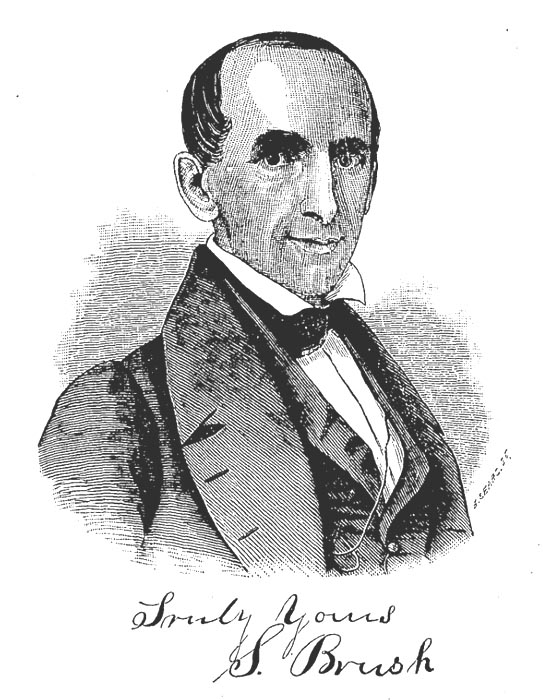
S. BRUSH
|
Samuel Brush, son of Platt
and Elizabeth (Treat) Brush, was
born Jan. 13, 1809, in the town of
Greene, Chenango county, New York,
his father being, all that time, a
practicing lawyer in Oxford, in the
same county, where they resided
until 1815.................... |
|
Pg. 521 -
TRIAL OF THE
REV. COLIN C. TATE.
CHURCH OF
THE GOOD SHEPHERD.
Pg. 522 -
ROMAN
CATHOLIC CHURCHES.
HOLY CROSS
CHURCH.
ST.
PATRICK'S CHURCH.
ST. MARY'S
CHURCH.
Pg. 523 -
ST. JOSEPH'S
CATHEDRAL.
CHURCH OF
THE HOLY FAMILY.
BAPTIST
CHURCHES - THE FIRST BAPTIST.
Pg. 524 -
SECOND BAPTIST CHURCH.
SHILOH
BAPTIST CHURCH.
THE
UNIVERSALIST SOCIETY.
Pg. 525 -
CONGREGATIONAL CHURCHES - FIRST CONGREGATIONAL
CHURCH.
WESLH
PRESBYTERIAN, OR CONGREGATIONAL, CHURCH.
HIGH STREET
CONGREGATIONAL CHURCH.
Pg. 526 -
NORTH
COLUMBUS CONGREGATIONAL CHURCH.
ST. PAUL'S
GERMAN EVANGELICAL CHURCH.
UNITED
BRETHREN IN CHRIST.
OLIVE BRANCH
CHURCH.
This church, located in Neil's addition, near
the Piqua railroad shops, was oranized in 1867,
by Rev. W. B. Davis after his retirement
from the pastorate of the First church.
The pastor in 1872 was Rev. W. H. Spencer.
The trustees, at that time, were: George
Davidson, John Nelson, Joseph Fuller, John
Henvon, and William B. Davis.
The church had at that time ninety members, and
a Sunday-school of one hundred and ten
pupils, with Samuel Mateer as
superintendent. The property was then
valued at three thousand five hundred dollars.
GERMAN
UNITED BRETHREN CHURCH.
This church was organized in 1868. It is
located on the south side of Friend street, east
of Seventh. It had, in 1872, twenty-five
members, and fifty pupils in the Sunday-school.
The church property was then valued at four
thousand dollars. No response was made to
our circular requesting further information.
TRINITY
GERMAN EVANGELICAL CHURCH.
THE GERMAN
INDEPENDENT PROSTESTANT CHURCH.
EMANUEL'S
CHURCH.
Pg. 527 -
THE HEBREW
TEMPLE.
FIRST
ENGLISH LUTHERAN CHURCH.
THE CENTRAL
CHRISTIAN CHURCH.
ST. JOHN'S
GERMAN EVANGELICAL CHURCH.
FRIEND'S
MEETING.
Pg. 528 -
fifty or sixty pupils. Religious services
are kept up every Lord's day.
CHARITABLE
INSTITUTIONS.
COLUMBUS
FEMALE BENEVOLENT SOCIETY.
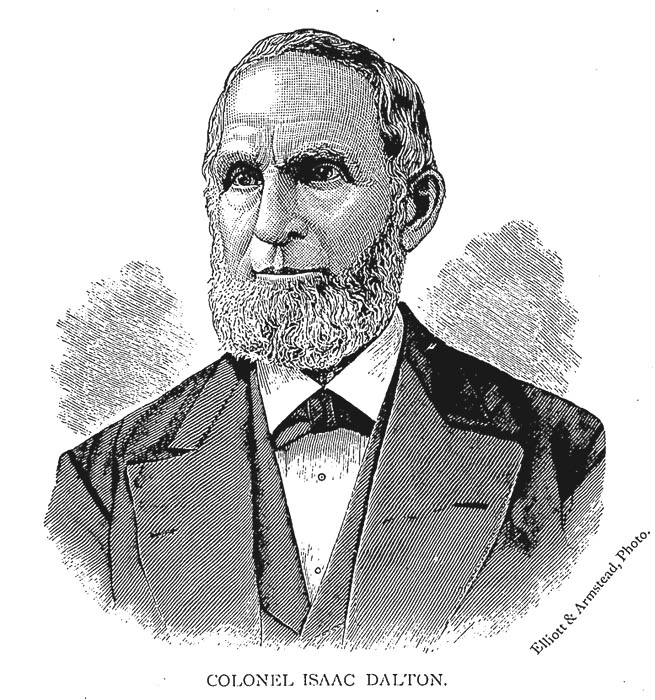
COLONEL ISAAC DALTON.
|
The subject of this sketch is one of
the older settlers of Franklin
county, and his family genealogical
record is of considerable interest.
Philemon Dalton, Hannah, his
wife, and Samuel their son,
came to this country from England in
the ship "Increase," on the
fifteenth of April, 1635 - fifteen
years after the landing of the
Pilgrims. Samuel Dalton
married three times, his third wife,
Mehitabel Palmer, having many
children - the eldest, Samuel
Dalton. This Samuel
married, and had one son, Isaac,
who married, and had six children,
viz.: Samuel, Abigail, Mary,
Meriam, Moses, and Ruth.
These names are all given in a
letter written by their father,
Isaac Dalton, from the
battle-field of Louisburg, in 1745,
a copy of which is the possession of
Benjamin Dalton Dorr, of
Philadelphia, Pennsylvania.
Samuel Dalton, who was grandfather of the
subject of this sketch, married
Hannah Evans, and had ten
children, viz: Mollie, Hannah,
Ruth, Isaac (father of the
colonel), John, Jonathan,
Abigail, Dorithy, Meriam, and
Lucy.
The
full records of Samuel's
family is in what is called the old
Dalton Bible, now in
possession of Benjamin Dalton
Dorr, of Philadelphia,
Pennsylvania. Valuable
information has been obtained,
in the genealogical history of the
Dalton family, from the "New
England Genealogical and Historical
Register," published quarterly at
Boston since 1841, "Farmers'
Genealogical Register," and "Shirtlieff's
Records of Massachusetts."
The said Isaac Dalton, sr. (father of the
colonel), was born in Salisbury,
Massachusetts, Mar. 2, 1761.
After serving through the Revolution
as a soldier, he married Eleanor
Merrill, who was born in
Amesbury, Massachusetts, in 1763.
They moved into New Hampshire, where
they had fourteen children, six of
whom only lived to grow up, viz:
Samuel, who married Judith
Brown, and had three children,
Hannah, who married John
Stewart, and had six children;
Nancy, who married Samuel
Collins, and had ten children;
Polly, who married William
Merrill, and had one son;
John E., who married Clarissa
L., Cassett and Elizabeth
Cassett, and had eight children,
and Col. Isaac Dalton, who
was born in Warner, New Hampshire,
on May 27, 1801, and baptized on
Sept. 13, 1801, by the Rev.
William Kelley, pastor of the
Congregational church. He
experienced religion in the fall of
1821, and was received into the
Congregational church, June 23,
1822, by Rev. John Woods,
pastor. After holding various
military positions, in 1831 he was
commissioned by the governor of the
State of New Hampshire to serve as
colonel of a regiment of State
militia. H also held a
prominent position in the masonic
fraternity, having been exalted to
the sublime degree of royal arch
mason, and also to that royal |
and select master.
He came to Columbus, Ohio, on Sept.
15, 1831, and received dismission
from and recommendation to the
church, on June 20, 1833, by the
Rev. Jubilee Wellman, pastor.
He united with the First
Presbyterian church, in July, 1833 -
the Rev. James Hoge, pastor.
He was married to Elizabeth
Foster, of Canterbury, New
Hampshire, on Oct. 27, 1834, who
died Nov. 28, 1841. He was
elected and ordained elder in the
First Presbyterian church, in the
spring of 1835. His first
child, Sarah Foster, was born
Oct. 25, 1836, and died Aug. 8,
1837; the second, Joseph Merrill;
was born Feb. 9, 1839, and died Oct.
8, 1846; the third, Alfred Foster,
was born May 22, 1840, and died Aug.
31, 1841; the fourth, Sarah
Elizabeth, was born Oct. 28,
1841, and died Nov. 2, 1873.
He was married to Elvira Stewart,
of Columbus, on the twenty-eighth of
December, 1843. By her, his
first son, William, was born
Apr. 16, 1845, and died Dec. 16,
1866; his second son. John
Calvin was born on May 31, 1849.
During the colonel's early life, he lived on a farm
with his parents, until about
eighteen years of age, when he left
home to follow the carpenter
business, in which he was engaged
until he came to Columbus. On
Apr. 1, 1837, the trustees of the
Institution for the Blind appointed
him steward, and Mrs. Dalton,
matron, to collect the pupils, and
board and teach them. The
institution was formally opened on
July 4, 1837, under the charge of
A. W. Penniman. He
remained in the institution four
years, until Mr. Wm. Chapin
was appointed superintendent, and
took charge of the same. He
then returned to his former
occupation until 1859, when he
commenced plain-making, and worked
for the Ohio Tool company until
April, 1862. He was at that
time commissioned by Governor
David Tod, to take charge of the
sick and wounded soldiers arriving
at the union depot, feeding them to
get transportation to their homes,
or sending them to the hospital.
He was here engaged at the Soldiers'
Rest for over four years, until all
the Union soldiers were discharged
or returned home.
During the prevalence of the cholera in 1849 and 1850,
he was appointed by the city
council, a member of the special
board of health, to attend to all
cholera patients, and see that they
were supplied with good nurses, and
make a full report of every case to
them daily. He was thus
engaged about three months each
year.
After his services at the Soldiers' Rest, he returned
to his home near the court house, on
south High street, which he
purchased in 1834, where he has
lived most of the time since that
date. |
Pg. 529 -
THE HARE
CHARITY FUND.
Jacob Hare, a native of Pennsylvania, came
to Columbus in 1812. He was present at the
first sale of lots in the summer of that year,
and bought a lot on High street, which he never
suffered to pass out of his hands. His
investments turned out well, and by these and
the increased value of his real estate, he left
at his death an estate variously estimated at
from fifty to eighty thousand dollars.
Mr. Hare died in this city on the third of
November, 1860, in the eightieth year of his
age. The balance of his estate, both real
and personal, after the settlement, thereof, and
an annual allowance to his widow, was devised to
the city of Columbus, to form a charity fund for
the benefit of the poor and unfortunate of the
city. This fund was to be forever under
the control and management of the city council,
where were not to diminish it below the original
amount. The wish of the testator is more
clearly defined, in the requirement, that at
such time as the state of the fund should
justify it, a suitable building should be
erected, to be named the Orphans' home, or
Beneficial asylum. Mr. Hare
appointed William T. Martin executor of
his will, and in case of Mr. Martin's
deceased before that of the testator, he
nominated James Cherry, executor.
On the fifteenth of April, 1861, Mr.
Donaldson presented to the city council a
copy of Mr. Hare's will, which was
referred to a standing committee, to be called
the Hare charity fund committee,
consisting of Messrs. Stauring, wilson,
and Comstock. The original bequest,
about eighty thousand dollars (says Mr.
Chadwick, chairman of the committee of
council on the home, in 1872), was by a
compromise, divided with the heirs of Mr.
Hare, leaving about thirty-five thousand
dollars, the interest of which only could be
used for the maintenance of the home. This
sum was, however, increased by the surrender,
upon the part of the Ladies' Benevolent society,
of Columbus, of their home, including the
building and other property, valued at about
eight thousand dollars, the city council of the
institution. The report from which these
facts are gleaned, continues thus: That
both parties to this transfer - ladies and city
council - thought this action, at the time, a
prudent, if not actually a necessary one, there
can be no question; but that for the
beneficiaries of the home, it was most
unfortunate, every fact in its subsequent
history fully confirms." The same report
concludes in the following words of earnest
wisdom: "The secretary can ot well forbear, in
view of the foregoing statements, to suggest, if
it can be done in accordance with the provisions
of Mr. Hare's will, that this charity
should be transferred to the care of the Ladies'
Benevolent society, or some other private
charitable organization in the city of Columbus;
or that in some way, the orphan children of
Columbus; or that in some way, the orphan
children of Columbus should be secured in their
rights under the generous provisions
contemplated by their benefactor." It is
gratifying to know, that immediately after the
publication of this report, such radical changes
were made in the management of the home, that
the comfort of its inmates was secured as far as
the circumscribed accommodations of the building
would allow. Miss Lida Daniels, now
Mrs. Dr. J. M. Wheaton, succeeded Mrs.
Loomis, as matron, and bears testimony to
the readiness of the board of trustees to
second, to the extent of their ability, every
suggestion with reference to the welfare of the
home and its inmates. The location and
construction of the building making it every way
unfitted for a home for children, it was, for
years, the earnest wish of those to whom was
committed the care of this fund, to secure
another location, possessing the advantages so
utterly wanting in the old, and at the same time
within the means placed at their command.
by the conditions of the bequest, only the
annual interest could be applied to the erection
of buildings or the current expenses of the
home.
The recent purchase of an attractive cottage, with a
domain of over seven acres surrounding it, in
the northeast part of the city, gives ample
evidence of a wise management of the fund.
The new home is in the midst of a native grove,
and seen, as now, in its gorgeous garb of
autumnal glory, it seems as though nature had
put on her brightest, to welcome the hapless,
though now, doubtless, happy little ones, to
this sweet retreat, and, at the same time, to
prepare, in crimson and gold, a crown for the
heads of those who have ministered, and yet do
minister, to those of whom the loving Master
said: "The poor ye have always with you."
There is room, wisely economized, as at present
it appears to be, under the management of
Mrs. C. M. Barringer, as matron, to
accommodate the limited number for which the fun
will provide; and, with a few, but much needed,
improvements, the Hare Orphan's home may
be looked upon as having entered upon a new era
of usefulness. The cottage was built for a
private residence, and, naturally, the kitchen
is quite inadequate for the work of a family of
over twenty. As a sanitary provision
merely, a laundry should be built, suitably
connected with the main building, and containing
a bath-room, with ample water supply.
Judging from what has already been accomplished,
the friends of the home will not wait long for
that which all acknowledge as a pressing need,
and which can be secured at so modest an outlay.
The present board consists of the following
named gentlemen: Peter Baker, esq.
(president), William Ide (secretary),
Mr. Hess, and General Samuel Thomas.
There are at present, Oct. 1, 1879, eighteen
children at the home, all except one under ten
years of age.
THE LADIES'
SOLDIERS' AID SOCIETY.
The Ladies' Soldiers' Aid society of Columbus,
like the loyal uprising of its citizens, had its
counterpart in every city, town, and hamlet,
throughout the n orth. The untold material
wealth represented by the vast accumulations of
hospital supplies, which have been made
efficient through the agency of the sanitary
commission, was emphatically the product of a
labor of love. How much these labors
influenced teh final result, it is impossible to
say, but of their adaptedness to ameliorate the
sufferings inseperable from war, there is no
doubt. And, as the scale on which they
were conducted was
Pg. 530 -
commensurate with the vast operations involved
in that terrible struggle, what language can
adequately express..............
SOLDIERS'
HOME.
Naturally, in the vicissitudes of a
long-continued war, many sick, disabled and
destitute soldiers would be found at all central
points of army operations, not provided for by
military organizations accessible, without a
greater expenditure than would be involved in
caring for them at those points where they were
found in any considerable numbers. This
work was assumed by the Sanitary commission, and
gave rise to large numbers of temporary
"soldiers' homes." The Soldiers home,
located in this city, was an efficient agency in
this good work. It was established, Apr.
22, 1862, under the auspices of the Soldiers'
Aid society, in a room in the raiload
railroad depot, and was placed under the charge
of Isaac Dalton of this city. On
the 17th of October, 1873, it was removed into a
building erected by the Columbus branch of the
United States' Sanitary commission. The
building cost about two thousand, three hundred
dollars, and contained forty-five beds.
Soldiers were lodged in the home, and those who
were destitute were supplied with food and other
necessaries. In the spring of 1864, one
thousand, eight hundred dollars were expended,
in an addition to the former structure, making
the entire building one hundred and forty-feet
long. The addition contained eighty beds,
like those in the first building - on iron
bedsteads. It was opened July 20, 1864,
for the reception of soldiers. At the same
time Mr. Dalton was succeeded by
T. E. Botsford, who continued to serve as
superintendent till the home was closed.
Men, from almost every State in the Union, who
had no where else to go, were hospitably
entertained, and when recovered, or refreshed,
sent on their way rejoicing. During Mr.
Botsford's superintendence, from July 20,
1864, to May 7, 1866, thirty-four thousand, nine
hundred and eighty-two persons were furnished
with lodgings, and ninety-nine thousand, four
hundred and sixty-three meals were distributed
to thirty thousand and fifty-five men, of whom
twenty-five thousand, six hundred and forty-nine
were members of Ohio regiments. Many
refugees from the south were also entertained.
On the closing of the home, the superintendent,
under the direction of the representatives of
the Sanitary commission, donated to the
Hannah Neil Mission, or Home of the
Friendless, the building, and other property,
belonging to the Soldiers' home.
THE
INDUSTRIAL SCHOOL.
Pg. 531 -
THE HANNAH
NEIL MISSION AND HOME OF THE FRIENDLESS.
CERTAIN
CATHOLIC INSTITUTIONS.
HOLY CROSS
CHURCH SCHOOL.
The school-building connected with this
church is very creditable to the energy of the
pastor and the congregation. It was built
at a cost of eleven thousand, eight hundred
dollars, and has seven rooms, each twenty-seven
by thirty-two feet. Three of the upper
rooms are used for the female department, under
the care of the Sisters of Notre Dame, with
about two hundred pupils. the male
department is on the first floor, with an
average attendance of one hundred and fifty.
ST.
PATRICK'S SCHOOL.
This school is located on the corner of Seventh
street and Mount Vernon avenue, and will
accommodate about
Pg. 532 -
five hundred pupils. The female
departmens departments, like that of
Holy Cross Church school, is under the care of
the Sisters of Notre Dame. value of school
property - twelve thousand dollars.
SISTERS OF
NOTRE DAME.
The sisters of this order devote their time
principally to the education of the female
pupils of the catholic parish schools of the
city. The house of the sisterhood is
located on Rich, between Sixth and Seventh
streets.
ST. ALOYSIUS
SEMINARY.
This institution of learning was founded, by
Bishop Rosecrans, in September, 1871.
The course of study embraces theology,
philosophy, history, mathematics, and the Latin,
Greek German and English languages and occupies
eight years. The object of the seminary is
the education of Catholic youth for the
priesthood, and derives its chief support from
the Catholics of the diocese. Location - a
short distance south of west Broad street.
THE ST.
FRANCIS HOSPITAL.
THE HOUSE OF
THE GOOD SHEPHERD - FOR PENITENT FEMALES.
CEMETERIES.
GREEN LAWN
CEMETERY.
Green Lawn Cemetery association, of Columbus,
was organized under a general statute, passed in
the winter of 1847-8. At a meeting of the
citizens, at the council chamber, on the evening
of the twelfth of July, 1848, a committee of
eleven was appointed, consisting of A. P.
Stone, A. F. Perry, Joseph Ridgway, jr., Wm. B.
Thrall, John Walton, John Miller, William Elsey,
William B. Hubbard, Joseph Sullivant, Robt. W.
McCoy and William A. Platt, charged
with the duty of looking for a site and
reporting a plan for the organization of a
cemetery association. At a subsequent
meeting of citizens, held on the second of
August, 1848, the committee reported articles of
association, which were considered, amended,
adopted, and signed by a competent number to
authorize a complete organization. The
first meeting for the purpose of effecting an
organization, was held on the twenty-sixth of
August, when Wm. B. Hubbard, Joseph
Sullivant, Aaron F. Perry, Thomas Sparrow,
Alfred P. Stone, William B. Thrall,
and John W. Andrews, were elected to
constitute the first board of trustees, Alex.
E. Glenn being chosen clerk. Mr.
Hubbard was unanimously chosen president of
the board. At a meeting of the board of
trustees, held on the first day of February,
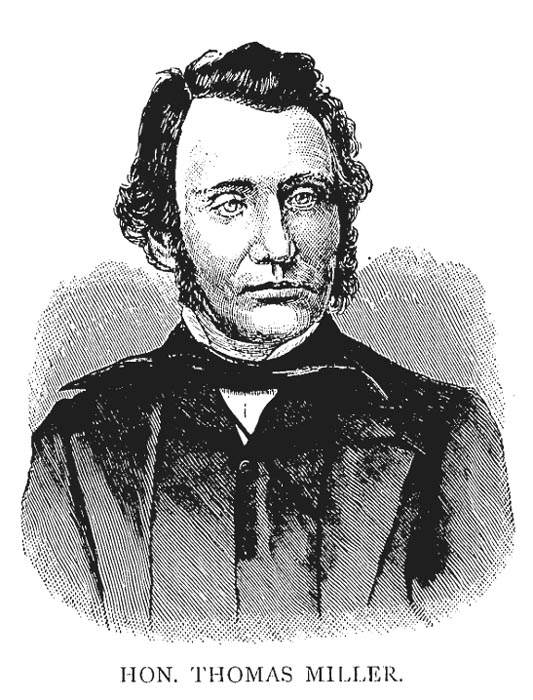
HON. THOMAS MILLER.
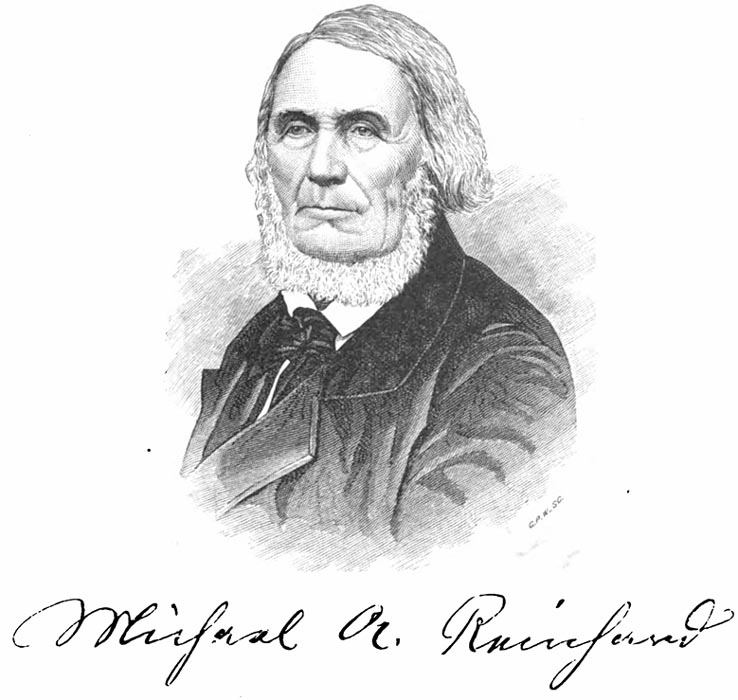
_______ ___ REINHARD
was born in Niedernberg,
near Aschaffenburg, in Bavaria, Germany,
on the eighth day of March, 1789.
He was married in 1814 to Miss
Barbara Geis, by which marriage
eight children, four boys and four
girls, were born, five of whom are now
living, three of them dying in their
infancy.
In 1832, with his wife and children, the oldest of whom
was but seventeen years old, Mr.
Reinhard emigrated to the United
States. He purchased a farm in
Prairie township, Franklin county, Ohio,
and on it toiled, lived and died.
He lost his wife in 1834, and never
remarried. In the latter days of
his life, he lived on his farm with his
son, William, during the summer
months; the winter months he spent with
his son, Jacob, fo the firms of
Reinhard & Co., bankers, and
Reinhard & Fieser, editors and
owners of Der Westbote newspaper.
Mr. Reinhard was among the first
German farmers in this State to
cultivate the grape, and from it to
produce the Ohio wine, so near in taste
to the cheap wines of Germany, so
healthy and pleasant that it has
banished much of the stronger liquors
from German households, and as the late
Judge John McLean of the United
States supreme court, told the writer of
this sketch, was the best auxiliary of
temperance yet produced.
Michael Reinhard led to blameless
life, and had the confidence and esteem
of all who knew him. He was a
model husband and parent, and friend.
His disposition led him, after the death
of his wife, to seek a retired life.
He never sought or accepted, when
offered, office of any kind, nor did he
seek distinction. The friends he
had were knit to him as with hooks of
steel. His charity was of the
unostentatious kind, never allowing his
left hand to know what his right hand
did. He died June 2, 1879, at the
ripe age of ninety, in the well-founded
hope of a blessed immortality beyond the
grave, leaving many to bless, but none
to curse, his memory.
JACOB REINHARD,
editor, publisher, and banker, is, by
birth, a German. His father,
Michael A. Reinhard, emigrated to
the United States when the subject of
this sketch was but seventeen years of
age, and died on the twelfth of June
1870, full of years, honest,
industrious, and universally esteemed as
one of our most respected citizens.
The education which Jacob Reinhard
received in the fatherland was finished
in Ohio, as far as the common schools
and private lessons could accomplish it,
in English tuition. When not at
school, he worked on his father's farm.
At the age of twenty-one, Jacob,
young as he was, took a number of
contracts to furnish broken stone for
macadamizing the National road, east of
Columbus, in the fulfillment of which he
showed so much judgment and skill, that,
on their completion, he was appointed
assistant engineer, which responsible
office he held until 1843. During
his leisure hours, and on rainy days and
nights, he read law with Heman A.
Moore, a rising lawyer of Columbus,
who died shortly after, while
representing the Franklin district in
Congress.
After leaving the employ of the State, young
Reinhard, in company with his
present partner, Frederick Fieser,
started "Der Westbote, a weekly
Democratic newspaper, printed in the
German language. The first number
of the paper was issued and printed in a
frame building on east Friend street, on
the lot where Isaac Eberly's fine
residence now stands. The new
paper soon became a pecuniary success,
and in politics was a power in the
State, its circulation extending into
every county in Ohio, where there is a
German population; and it is now, and
for years has been regrded as the most
successful German newspaper in the
State. It is now printed in the
Westbote building, one of the finest
business houses on High street, the same
in which the banking-
|
house of Reinhard &
Co. do an extensive and safe
business. The printing office,
with its steam presses, and large
assortment of type, does a large and
paying business in book and job
printing.
In 1852, Mr. Reinhard was elected a member of
the city council, and for twenty years,
until he refused longer to be a
candidate, he was re-elected, generally
without opposition. For five years
he was the presiding officer of the
council; and when not president, he was
either a member or chairman of the
finance committee. To Jacob
Reinhard, as much as, if not more
than, to any other man, is attributed
the fact that Columbus, a growing
populous, and wealthy city, had less
taxation imposed upon her citizens than
any other in the State. The effect
of this low taxation was to invite
business, and it was at that time that
Columbus took its star, in
manufacturing, which has added so much
to its growth that it now stands the
third in the State in population, and is
substantial prosperity is excelled by
none. In the development of part,
by aiding, to the extent of his means,
every enterprise calculated to advance
its interests and that of the producing
classes. From his careful business
habits, Mr. Reinhard was a
favorite director in a number of the
leading enterprises which have tended to
make Columbus a large manufacturing
city. Before he was a voter, Mr.
Reinhard was a Democrat, and has
always been considered as among the
ablest and most devoted advocates of the
party. For years he has been a
member of the State executive committee
of that party, and its treasurer.
He never practiced law as a profession.
Had he done so, there is every reason to
believe he would have made a successful
practitioner. The only speeches he
has made, outside of the city council,
were political ones, in defence of his
party, its candidates, and its
principles. In the wild excitement
of 1840, the friends of General
Harrison, the Whig candidate for
president, challenged by supporter of
Mr. Van Buren, the
Democratic nominee, to debate with Mr.
Lewis Heyl, in the German
language on the issues of the campaign.
Mr. Heyl, in the German
language, on the issues of the campaign.
Mr. Heyl was then prosecuting
attorney for Franklin county, and as a
public speaker, especially in German,
stood first among the Whig orators in
the county. Colonel
Medary, of the Ohio Statesman,
insisted that the challenge be accepted,
and that Jacob Reinhard,
then working on the National road,
be the Democratic champion..
Knowing Mr. Heyl's talent as a speaker,
it was with the greatest difficulty that
Mr. Reinhard could be induced to
accept. The debate came off, and
was largely attended. Mr. Heyl
underrated his opponent, and this gave
Mr. Reinhard the advantage.
The German Democrats were wild with
excitement over Mr. Reinhard's
public discussion. On two
different occasions he was the nominee
of his party for secretary of State; and
in 1857, out of a total vote of three
hundred and thirty thousand, six
hundred, and ninety-eight, he was only
defeated by one thousand one hundred and
ninety-seven votes. In his younger
days, the only military companies in
Columbus were German, and Mr.
Reinhard was elected and served as
major, a title by which his friends
still call him.
In 1841 he was married to Miss Catharine Hamann,
of Perry county, by whom he had eight
sons and three daughters. Four of
the former, and two of the latter are
still living.
The writer of this sketch has known Mr. Reinhard
for nearly forty years, intimately and
well. In all that time never has
he heard a word against his honor or his
honesty as a man or citizen. His
life has been energetic and active; and
as a son, husband, parent, citizen, or
public officer, he hasnot only escaped
calumny, but is cited by those who know
him best as pure and conscientious, as
"God's noblest work, an honest man," in
precept and practice, a christian
gentleman. |
Pg. 533 -
1849, Mr. Andrews tendered his
resignation, and William Platt was chosen
to supply the vacancy. the grounds
originally purchased by the association
consisted of about eighty-three acres, admirably
adapted to the purpose for which they were
intended. They were situated about two
miles and a half southwesterly from the State
House. The cost of the whole was about
three thousand, seven hundred and fifty dollars.
In the summer of 1849, under the superintendence
of Howard Daniels, architect and civil
engineer, tasteful and appropriate improvements
forward with the energy and esthetic ability
which characterized its inception. The
visitor cannot fail to be impressed by the high
order of talent, as well as the large
liberality, which have united to produce results
so pleasing. The first person buried in
this cemetery was Leonora, daughter of
Aaron F. Perry, on the seventh of July,
1849, a few days preceding its formal
dedication. The dedication services were
held in a beautiful grove near the center of the
grounds, on the ninth of July, 1849, in the
presence of a large concourse of people.
The services were conducted by some of the
leading clergymen of the city, Dr. Hoge
delivering the dedicatory address. A
graceful dedicatory ode was written for the
occasion by Benjamin T. Cushing, Esq.,
for which we regret we have not space. In
the summer of 1856, the question arose as to the
propriety of selling lots to colored persons,
and thereby admitting them to membership in the
association. A circular was addressed to
each member, or stockholder, stating the
proposition to set apart a portion of the
cemetery grounds for the burial of colored
persons, and requesting the stockholder
receiving it to indorse his preference upon the
back of the circular, and return it to the
office of the trustees. A large proportion
of the stockholders, who made returns, were
opposed to the proposition, and the division was
not made until February, 1872. In 1872,
sixty-two acres were added to the domain, making
the cemetery to consist of about one hundred and
forty-seven acres, forming nearly a square, of
gently undulating surface. The officers,
at the present time, are as follows:
John Greenleaf, president; P. W.
Huntington, treasurer; Joseph Dowdall,
secretary; Oliver P. Hines, James S. Abbott,
H. B. Albery, J. P. Bruck, Wm. B. Hawks,
trustees.
MOUNT
CALVARY CEMETERY.
is located on the Harrisburg turnpike, about
half a mile beyond the southeastern limits of
the city. Its area is twenty-seven acres,
purchased, in 1865, by the Catholics of
Columbus, for three thousand dollars. A year
after the cemetery grounds were purchased, by
the joint action of all the Catholics of the
city, the Germans thee hundred dollars for the
choice between the two halves of the tract, and
took the north half. Rev. John W.
Brumer was the first Catholic priest buried
in the portion of the grounds set apart as a
burial place for the Catholic clergy.
Mount Calvary cemetery was consecrated by
Bishop Rosecrans, Nov. 2, 1874.
Previously, portions of ground had been blessed
for the interment of the dead. Few have
been removed from the old burying ground, though
it is the intention to remove all to the new
cemetery. The grounds are under the charge
of Father Meara, of St. Joseph's
cathedral.
THE HEBREW
CEMETERY.
About the year 1850, the few Israelites, then in
the city, who were organized as a congregation
for public worship, purchased a half-acre lot,
to be used as a cemetery. The lot lies in
the eastern part of the city; but, as a city
ordinance prohibits interments within the limits
of the corporation, a lot was procured and laid
out, about the year 1876, comprising two acres
of ground, and situated just south of Mount
Cavalry cemetery.
THE NORTH
GRAVEYARD.
On acre and a half of the tract of land, known
afterward as the "North Graveyard," was donated
by the original proprietors of Columbus, July 2,
1813, for a burial ground. John Kerr,
one of the proprietors, was authorized to
execute the deed of conveyance. That was
not done until Apr. 21, 1821, though the lot had
been used as a burial place from the time the
grant was made. In February, 1830, eight
and a half acres, adjoining the above described
lot, were added, by purchase.
John Brickell, in 1845, added a strip of
twenty feet in width, giving the city, however,
no control over it. These three parcels of
land, embracing about ten and a half acres, and
surrounded by a board fence, constitute the
tract known as the "North Graveyard," and were
for many years the principal burying ground of
the city. It lies on the west side of High
street, about one-eighth of a mile north of the
railroad depot. As the city was expanding
around and beyond it, the council, by an
ordinance passed July 21, 1856, made it a penal
offence to use it any longer for interments.
Such, however, was the clamor against the
ordinance, that it was repealed before the day
arrived for it to take effect. The
practice of burying in this place was gradually
discontinued, however, and when, in May, 1864,
the council passed a second prohibitory
ordinance, it was merely formal; no interments
having been made there for several years.
Many of the bodies buried there have been
removed to Green Lawn cemetery; and, though the
city authorities have taken means to preserve
the grounds, no doubt this city of the dead
will, in time, be obliterated by the steady
encroachments of the city of the living.
THE OLD
CATHOLIC BURYING GROUND.
The lot, or tract, generally known by this name,
contains three acres and a quarter. It is
located in the northeast part of the city, north
of Naughten street, and east of Ninth street, or
Washington avenue. It was conveyed, Sept.
11, 1848, by Peter Ury, to Archbishop
Purcell, to be held in trust as a
burying-ground, for the use of the catholics of
Columbus. The tract had, however, been
used for that purpose for two or three years
before this conveyance was made. The
ordinance of the city council, in 1856,
prohibited burials.
Pg. 534 -
THE EAST
GRAVEYARD.
This tract of land, lying about a mile and a
half east of the court house, on Livingston
avenue, contains eleven and a quarter acres, and
was conveyed to the city of Columbus, in 1839,
by Matthew King, without conditions or
restrictions. It was purchased expressly
for a cemetery, and about two -thirds of it was
laid out in lots, and sold by the city to
purchasers. This was formerly used as a
public burying-place, principally by the
Germans, but of late years only for the burial
of the very poor, the friendless, and public
paupers. A portion of the lot proving to
be too wet for the purpose of a burying ground,
and its existence retarding the growth of the
city in that direction, it was proposed, several
yeas ago, to remove the bodies already interred
in it, and convert the ground into a public
park, in connection with the beautiful grove in
the rear of it - the only grove of native forest
trees remaining in the eastern portion of the
city. Although the plan has not yet been
carried out, its execution is only a question of
time.
STATE
INSTITUTIONS
THE OLD
STATE HOUSE.
The four original proprietors of Columbus,
Kerr, McLaughlin, Starling, and Johnston,
under the superintendence of William Ludlow,
the director appointed by the legislature,
erected a State house on the southwest corner of
State house square. The building was
completed in 1814; the free-stone for the window
and doorsills was brought on wagons from Black
Lick, twelve or fourteen miles east from the
city, through swamps and mire. The bricks
used in its construction, were made in part of
the ancient mound which formerly stood at the
intersection of High and Mound streets.
The building was seventy-five feet north and
south of High street, and fifty feet east and
west on State street, and the principal entrance
was in the center of the south front, on .......
THE OLD
STATE OFFICES
Pg. 535 -
CAPITOL
SQUARE
THE NEW
CAPITOL
Pg. 536 -
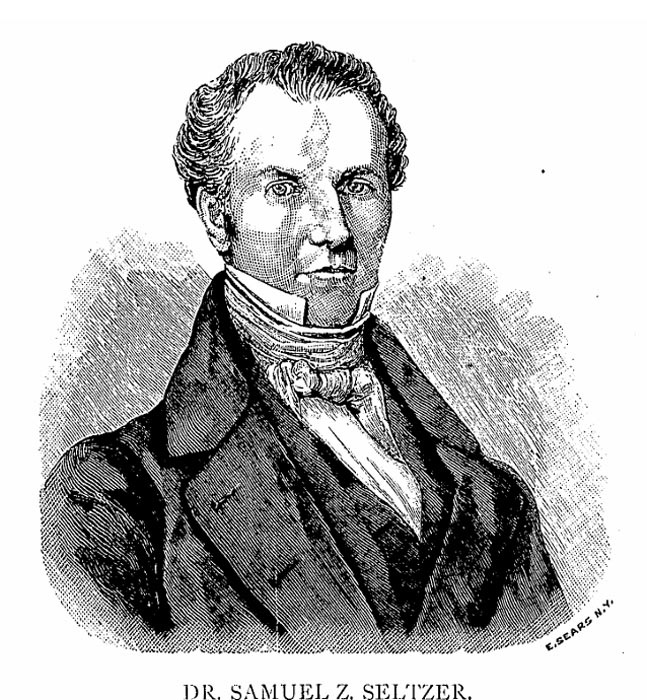
DR. SAMUEL Z. SELTZER
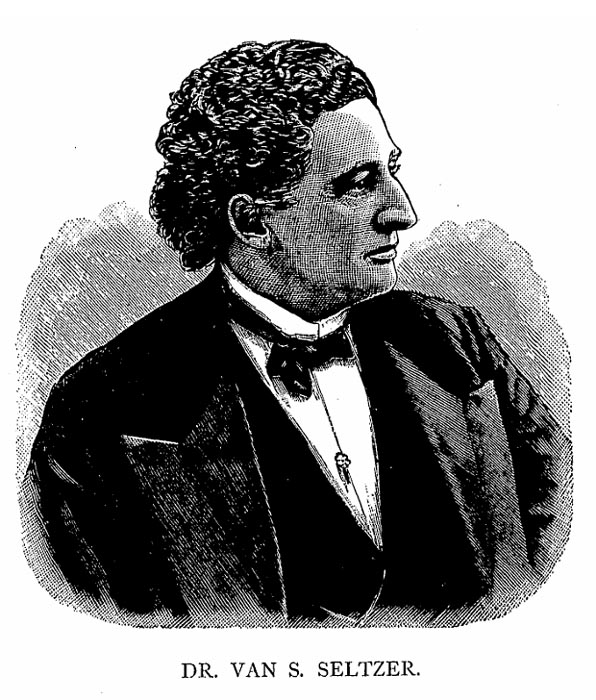
DR. VAN S. SELTZER
Pg. 537 -
I NOW LAY THE CORNER-STONE OF THE CAPITOL
OF OHIO."
Pg. 538 -
Pg. 539 -
Pg. 540 -
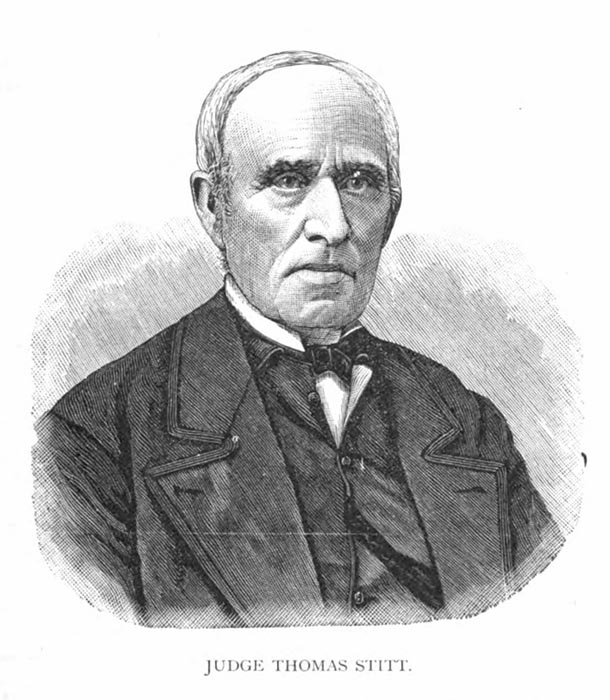
JUDGE THOMAS STITT
|
This gentleman, one of the oldest
residents of Columbus, was born in
County Down, Ireland, June 24, 1804.
His grandparents on one side were of
the Scotch blood, but had settled in
Ireland some years before the birth
of Thomas. James Stitt,
his father, was an elder son,
Inherited the paternal farm, and
also married a Scotch woman, named
Mary Newell. To them
were born six children: Nancy,
James, Archey, Thomas (the
subject of this sketch),
Alexander, and William.
About the year 1801, he came with
all his children then in his family
to America, and settled in
Huntington county, Pennsylvania,
where he undertook the labors of a
farm which he rented. Two
years thereafter, he died. His
boys all learned trades, Thomas
becoming a shoemaker.
William, the sole surviving
brother, became a tailor, and now
resides in Pulaski, Lawrence county,
Pennsylvania. Thomas
learned his trade with John Scott,
father of Congressman and United
States Senator Scott, of that
State, at Fannettsburgh, Franklin
county, Pennsylvania. About
1828 he left that place, and resided
for a year or two at Spence Creek,
Huntingdon county, same State, and
thence removed in 1830, to Ohio.
Stopping about a month in Cleveland,
he pushed on to Newark, remained
there about a year, and in 1831 he
reached Columbus, where he has sicne
most of the time resided. At
first he took the superintendency of
the shoe shops at the old State
prison, but left the post upon the
completion of the new penitentiary
in 1834. He then secured the
contracts for the manufacture of
shoes in the penitentiary, and
remained in this business five
years. In 1839 he returned to
Newark, and opened a clothing store,
which he conducted for a year, but
the business proving unprofitable,
he went back to Columbus.
There he en |
gaged in the manufacture of
saleratus in a factory, where his
lime-kiln now stands. The
article was in good demand, and he
made a lucrative thing of it for
five years, when he exchanged it for
the manufacture of lime, which
dragged somewhat in its profits
until 1849, when the business
improved and presented brighter
prospects. In it he remained
continuously until 1874, when he
leased it to his nephew,
Alexander Stitt, who had then
recently arrived in Columbus.
The elder Stitt has since
almost wholly retired from business,
having acquired a fortune by his
industry and fidelity which enables
him to live comfortably without
personal labor. He resides
with his son, in a handsome
residence on Spruce street,
Columbus, and is still hale and
vigorous in both body and mind,
though now well advanced in his
seventy-sixth year. Twice a
day, usually, he walks from his home
to the business centre of the city,
a mile away, and considers
pedestrianism his only means of
locomotion. He mind is clear,
his memory good, and his hearing is
but slightly impaired. The
title given him by his friends, and
preserved at the head of this
notice, is purely complimentary.
He has nothing to do with the law,
except to observe it punctually as a
quiet, peaceable citizen. His
early education was limited, as he
had but small advantages in the
schools of his time, but he studied
much with book before him while
working at the bench, and has since
improved the opportunities which the
abundant literature of later days
affords, to become a well-informed
man. He has remained a
bachelor, but redeems the lack of a
family of his own by rearing and
supporting a number of
neices nieces and nephews,
to whom, with other members of his
family, most of his surplus means go
every year. |
Pg. 541 -
constitute one of the most
picturesque objects that one meets when
straying through the capitol, or about its
grounds. As a somewhat tardy, and yet
timely, act of justice, the legislature,
convinced that he had not been fairly
remunerated for his great work, made an
appropriation of three thousand, five
hundred dollars for his benefit, in the
spring of 1878. We have not time, nor
would this be the place for an extended
notice of Mr. Jones' work, but we
cannot forbear to mention the following:
A colossal soldier, carved in
1865, as embodying the ideal of American
valor. It is executed in native
freestone, about twelve feet high, and is
standing on the bank of the Ohio. This
has been copied in several other places.
During the war, he executed, in marble, a
fine bust of Secretary Chase, and
about the same time, one of Thomas Ewing
- another of Ohio's greatest statesmen.
All fo these works are greatly admired.
THE FIRST PENITENTIARY.
Pg. 542 -
THE PRESENT
PENITENTIARY.
Pg. 543 -
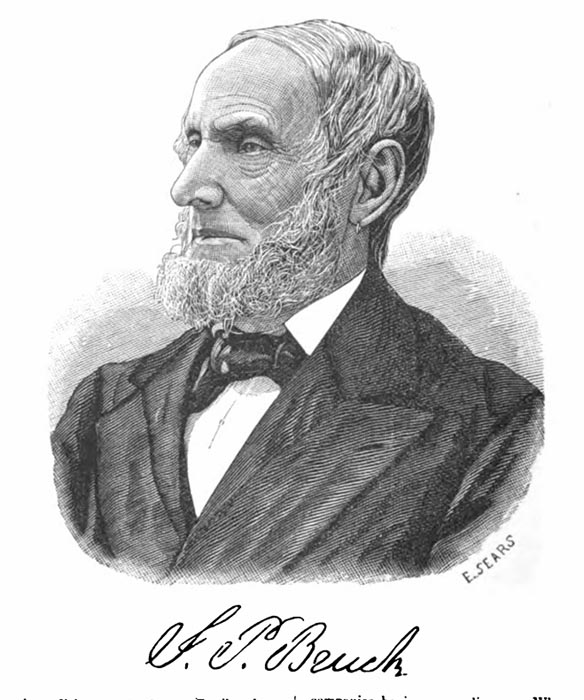
J. P. BRUCK
son of Ludwig
Bruck, a saddler, was born Feb.
28, 1807, at Zweibruchen, now in
Rhine, Bavaria, which, at that time,
belonged to France by conquest under Napoleon.
The city was called by the
French Deux Ponts (Two Bridges).
After receiving his common-school
education, which is enforced in
Bavaria and other German
principalities, young Bruck
was apprenticed to a cabinet maker.
After serving his apprenticeship,
with knapsack on his back, and
passport in his pocket, he traveled
eight yeas as a journeyman, to
perfect himself in his trade, as was
the custom of the country. In
this manner he traveled over almost
the whole of Germany, working in
different cities as long as he could
learn anything new at his trade.
At Meinz, on the river Rhine, where
the finest work is furniture is made
in Germany or France, Mr. Bruck
spent three years. While
there, he made a small oblong table
for the Duke William of
Nassau, composed of three hundred
and sixty-five pieces of wood, of as
many varieties as could be procured;
for which he was paid one Prussian
dollar per week, which was then
considered fair wages, although but
a trifle over ten cents per day,
with board for the four months
occupied in working on this table.
It was greatly admired for its
exquisite taste and superior
workmanship, and sold for seven
hundred and sixty-six Prussian
dollars. He also made an
inlaid mosaic, or parquette, floor
at the palace of the general
commanding the garrison at Meinz,
which, from the drawings still
preserved, must have been a splendid
piece of workmanship. While in
this city, Mr. Bruck, after
working hard six days each week,
attended in drawing school on
Sunday, his tuition costing him about
forty cents per quarter. His
natural taste for drawing so on made
him a proficient draughtsman.
He has preserved a scrap-booko of
excellent drawings of all the fine
cabinet work made by him, which
shows his rare skill as a workman.
In 1834, Mr. Bruck left Germany for the United
States, landing in New York.
On board the sailing vessel that
brought him was a young friend,
George Cullman, accompanied by
his sister. Shortly after
arriving at New York, Mr. Bruck
and Miss Caroline Cullman were
married. They lived there for
three years, while he worked at his
trade, making fancy French chairs
and sofas, such as could only be
made by experience foreign workmen,
and for which the most remunerative
prices were paid, there being at
that time no machinery in use by
which the hard work could be
performed. In carved work,
then new in this country.
Mr. Bruck especially excelled.
After his stay in New York, the
young journeyman removed to Ohio,
landing in the Buckeye State with
one thousand dollars in cash, which
had been earned by his industry and
skill. A part of this was
expended in the purchase of the lot
on South Front street, Columbus,
where he now resides. On his
arrival at Columbus, in 1837, Mr.
Bruck commenced cabinet making,
which he carried on successfully
until 1844.
In 1842, he was elected justice of the peace. The
city and township were both largely
Whig in politics, yet Mr. Bruck
was elected by a decided majority
over his Whig opponent, he being the
first Democrat ever elected on a
party ticket in Columbus. This
office he held, by repeated
re-election, for nine years, when
his health failed from overwork, and
he was imperatively ordered by his
physician to resign. During
his term of office he, by his sound
judgment and careful attention to
its duties, gradually gathered into
this court two-thirds of all the
drawing deeds and powers of attorney
to be sent to Germany, and was the
referee in all cases of dispute
among Germans not brought before the
courts. In 1844, Esquire
Bruck was appointed, by
Governor Shannon, a notary
public, which office, by successive
reappointments, he continues to
hold.
Since Mr. Bruck arrived in Columbus, in 1837, he
has never been absolutely rich.
He made money, but lost much of it
in aiding in the growth of the city,
by subscribing, as his means would
allow, for stocks in various
enterprises, some of which paid
dividends, but the major part was a
total loss. In most of these
|
companies he is now a director.
Whatever improvement would inure to
the benefit of Columbus, and find
employment for men out of work,
found his purse-strings always open,
to the extent of his means.
In company with the late Peter Ambos, Louis Koster,
and Jacob Maurer, Mr. Bruck
organized the Independent Protestant
congregation of Columbus, which now
numbers over three hundred members,
and owns a fine large brick church,
unincumbered with a dollar of debt.
At a time when there was scarcely any military
organization in Ohio, Mr. Bruck,
more than any other man, was
instrumental in forming two
independent companies of artillery,
composed entirely of Germans, and
wit their members formed two German
benevolent societies, which are
still in existence. When the
Mexican war broke out, the artillery
companies were dissolved by the
enlistment of many of their members.
Among those enlisting was George
Cullman, brother of Mr. Bruck's
first wife, who died of sunstroke,
near Vera Cruz.
After the death of Colonel Beck, one of the
county commissioners of Franklin
county, Mr. Bruck was
appointed to fill the vacancy, and,
at the next election, was elected
for three years. He
subsequently declined a re-election.
He was appointed one of the
directors of the Ohio penitentiary,
by Governor Medill, but was
soon swept out by the Know Nothing
furor of that day. Governor
Chase, under the reorganizing
law, appointed a new board, and
tendered to Mr. Bruck, as the
most fitting man in his knowledge, a
trusteeship of the Blind asylum, and
afterwards, a trusteeship of the
Insane asylum, both of which were
declined. In 1873, Mr.
Bruck was again made a director
of the Ohio Penitentiary, by
Governor Allen, which post he
held till the expiration of his
term. To Mr. Bruck is
principally due the action of
Governor Shannon, in calling the
attention of the legislature to the
necessity of mixed German and
English schools. There are
now, in consequence, in the city of
Columbus alone, more than twenty
such schools.
In
1841, Mr. Bruck lost his
wife, who left an infant son.
In 1842, he married Miss Margaret
B. Ell, of Union county, by whom
he had four children - two sons and
two daughters. One of the
former died in California, in 1876,
where he had gone for his health;
the other is junior partner in the
firm of Braun & Bruck,
druggists, on North High street.
The daughters are still living, and
are both well married. His
oldest son, George, a
machinist by trade, enlisted among
the volunteers when the war broke
out in 1861, and again, in the
Nineteenth United States regular
infantry. He was, for a time,
leader of the band at Newport
barracks, and was known as a fine
musician. He died at Little
Rock, Arkansas, of cholera, in 1866.
The whole Bruck family seemed
to inherit a musical taste
from their father. In 1848,
he, with others, organized the
Columbus Mannerchor, a singing
society, which is still in
existence, Mr. Bruck
and Henry Treyens
being the only surviving members.
The writer of this sketch has known him for almost
forty years, and in that long time
can say with truth that he never
heard a single word uttered to his
disparagement. It seldom falls
to the lot of any man of positive
character to command more of the
undivided respect of the whole
community than is allotted by all to
Esquire Bruck. As a
citizen he has aided much - ten
times more than other men with ten
times his wealth - to build up the
interests of the city of his
adoption, and to aid her laboring
classes. As a public officer,
he has been beyond reproach honest,
impartial, and with much sounder
judgment than is usually possessed
by public officials. A
mechanic by trade, he has much
feeling and sympathy for those who
earn by the sweat of their brow the
bread they eat. And in his
liberality in aiding to improve the
city of Columbus, he always took
special care that the improvements
he aided would inure to the benefit
of the laborer, in giving him work.
The men of toil love him,
because he first loved them.
|
Pg. 542 -
Pg. 543 -
Pg. 544 -
Pg. 545 -
Pg. 546 -
Pg. 547 -
Pg. 548 -
Pg. 549 -
Pg. 550 -
Pg. 551 -
Pg. 552 -
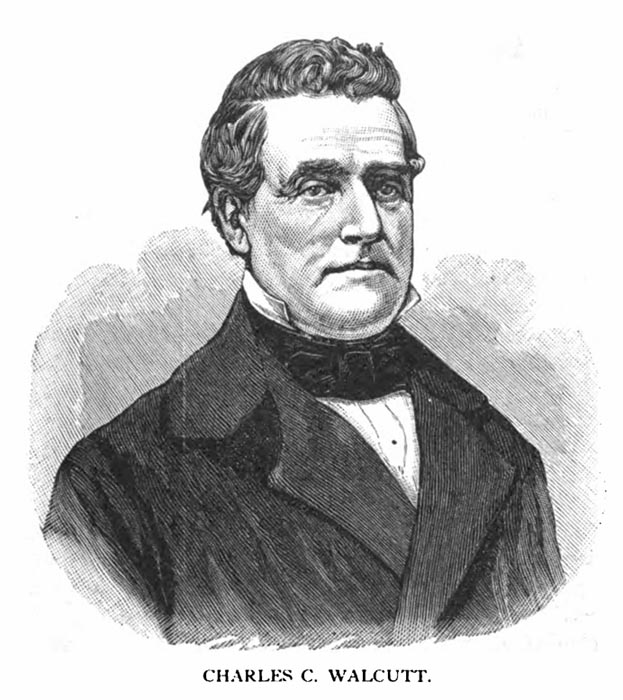
CHARLES C. WALCUTT
|
General Charles C. Walcutt,
collector of internal revenue for
the seventh district of Ohio, was
born in Columbus, Feb. 12, 1838, the
son of John M. Walcutt and
Mariel (Broderick) Walcutt.
They were among the pioneer settlers
of the city, where the former
carried on the business of
chair-making. His early
education was acquired in the public
schools of his native place, and at
the Kentucky military institute,
from which institution he graduated
in the class of 1858.
Returning to Columbus, he was
elected surveyor for Franklin county
the next year, and held that
position until the breaking out of
the Rebellion, when he relinquished
it in order to offer his services to
the government. Hastily
raising a military company in the
State capital, he entered the
service Apr. 17, 1861, with the
commission of Captain. The
next June he was promoted to the
rank of Major, and served on the
staff of General Hill until
August, when he was appointed Major
of the Forty-sixth regiment of Ohio
volunteers. January, 1862, he
was appointed to a
lieutenant-colonelcy, and, with his
regiment, joined Sherman's
army at Paducah, Kentucky, where the
Tennessee river expedition was then
in course of organization. At
the memorable battle of Shiloh, he
received a severe wound in the
shoulder from a musket-ball, which
has never been extracted.
October 16th of the same year, he
was made colonel of his regiment,
and participated in the campaigns
against Vicksburg and Jackson,
Mississippi. At the battle of
Missionary Ridge he was assigned to
the command of the Second brigade of
the First division, Fifteenth Army
Corps, and behaved against repeated
charges by superior numbers, that he
was recommended for promotion in
General Sherman's report.
From Chattanooga he moved with the
column advancing to the defense of
Knoxville, being still in command of
the brigade, and led the assaulting
party of the Army of the Tennessee
at the battle of Kenesaw Mountain.
After the battle of July 22nd, in
which the brave McPherson
fell, he was raised to the full rank
of Brigadier-General. He
participated in all the engagements
of the Atlanta campaign, and after
the destruction of the city fought
the only battle - that of
Griswoldsville - which occurred
during the famous |
march to the sea. In this
engagement, isolated from the main
body of the army, and wit his
command reduced to thirteen hundred
men, he sustained an attack by a
body of Confederate troops over
seven thousand strong, under
General Coombs. He not
only bore up against that
overwhelming force, but finally
routed it with such complete success
that the number of the enemy left
dead and wounded on the field
exceeded that of the whole force
with which he had entered the
engagement. For this memorable
act of gallantry he was breveted
Major-General, and again
distinguished by a very laudatory
notice in the report of General
Sherman. He then received,
however, a severe shell-wound in the
leg, which disabled him for several
months, and he was unable to resume
his command until the army entered
North Carolina, when he was assigned
to the command of the First
division, Fourteenth army corops,
and a few months later passed with
the victorious troops in grand
review before the President at
Washington. He then took
his command to Louisville, where it
was mustered out, in August, 1865.
He, personally, however, served in
the western department until
January, 1866, at which date he was
mustered out, and accepted the
wardenship of the Ohio penitentiary.
While in this position he accepted
the wardenship of the Ohio
penitentiary. while in this
position he accepted also the
appointment of a
lieutenant-colonelcy in the United
States regular cavalry service, and
reported to General Hancock,
at St. Louis, for duty. But
three months later, finding that no
imperative duty called him to the
life of a soldier in time of peace,
he handed in his resignation and
returned to the pursuits of civil
life, resuming his position as
warden in the penitentiary.
That office was held by him for
three years, he being the first man
under whose management the
institution returned a revenue to
the State treasury. In 1869 he
was appointed collector of internal
revenue, for the seventh district of
Ohio, and still holds that position.
He has always taken a zealous
interest in public affairs, and in
the cause of education, in Columbus.
In 1868 he was presidential elector
for his district, and cast his vote
for General Grant. In
1872 he was chairman of the State
Republican executive committee, and
conducted the Presidential and State
campaign of that year, in Ohio, with
distinguished success. |
Pg. 553 -
in a speech of welcome. Kossuth's
response was regarded as one of his best
efforts while in this country.
Pg. 554 -
Pg. 555 -
Pg. 556 -
Pg. 557 -
Pg. 558 -
Pg. 559 -
Pg. 560 -
Pg. 561 -
Pg. 562 -
Pg. 563 -
Pg. 564 -
Pg. 565 -
Pg. 566 -
Pg. 567 -
Pg. 568 -
Pg. 569 -
Pg. 570 -
Pg. 571 -
Pg. 572 -
Pg. 573 -
Pg. 574 -
Pg. 575 -
Pg. 576 -
Pg. 577 -
Pg. 578 -
Pg. 579 -
LUCAS SULLIVANT
Pg. 580 -
WILLIAM STARLING
SULLIVANT
Pg. 581 -
<
CLICK HERE to
RETURN to TABLE of CONTENTS >
|